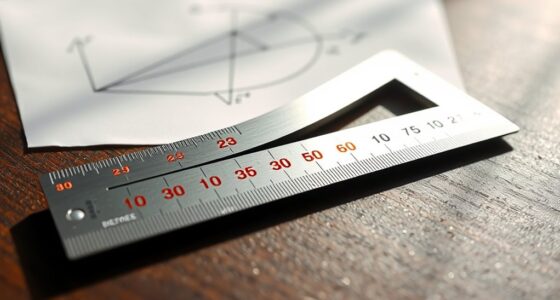

To bisect an angle with a compass and straightedge, start by placing the compass point at the angle’s vertex. Draw an arc that intersects both sides of the angle, then mark the points where it cuts each side. Without changing the compass width, draw arcs from these points that intersect inside the angle. Use a straightedge to connect the vertex to the intersection point of the arcs. Keep going, and you’ll learn how to guarantee precise bisecting every time.
Listen free for 30 days with Audible
Thousands of audiobooks and originals — cancel anytime.
As an affiliate, we earn on qualifying purchases.
Key Takeaways
- Place the compass point at the angle’s vertex and draw an arc intersecting both sides of the angle.
- Mark the intersection points of the arc with each side as points A and B.
- From points A and B, draw two arcs with the same compass radius that intersect each other.
- Label the intersection of these arcs as point C.
- Connect the vertex to point C; this line bisects the original angle into two equal parts.
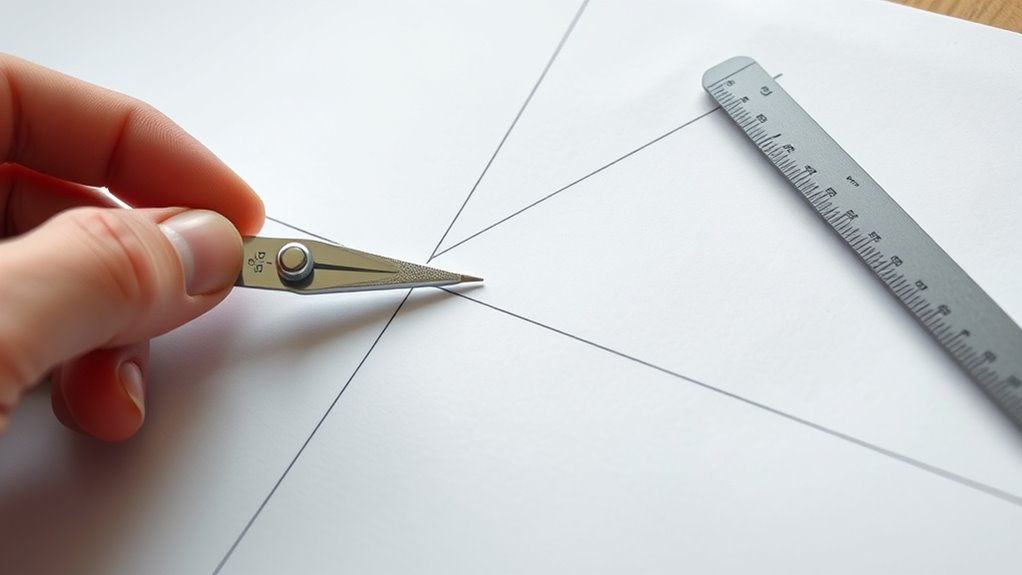
Bisecting an angle is a fundamental skill in geometry that involves dividing an angle into two equal parts. This process, known as angle construction, is essential for creating precise geometric figures and solving various problems. To accurately bisect an angle with a compass and straightedge, you need to follow a systematic process that guarantees the two resulting angles are congruent. This method is rooted in geometric proofs that confirm the correctness of your construction, providing a solid foundation for more complex geometric tasks.
Start by placing the compass point at the vertex of the angle you want to bisect. Without changing the compass width, draw an arc that intersects both sides of the angle. These intersection points create two new points, which you can label as points A and B. Next, with the compass still set to the same radius, place the compass point on point A and draw a small arc inside the angle. Then, without changing the compass width, repeat this step from point B, creating a second arc that intersects the first arc. The intersection of these two arcs, which you can label as point C, is essential because it lies equidistant from both sides of the original angle.
To bisect an angle, draw intersecting arcs from the vertex and connect the intersection point to the vertex.
Using your straightedge, draw a straight line from the vertex of the angle to point C. This line effectively bisects the original angle into two equal parts. To confirm your construction, you can rely on geometric proofs that demonstrate the congruence of the two angles formed. By showing that the two new angles are equal through the properties of intersecting arcs and equal radii, you verify that your angle construction is precise. Such proofs are indispensable in geometry because they provide logical validation for your constructions, ensuring they hold under rigorous mathematical standards.
This method of bisecting an angle with a compass and straightedge is widely taught because of its simplicity and accuracy. It teaches you not just how to perform the task but also how to understand the underlying principles of geometric proofs that validate your work. With practice, you’ll develop a steady hand and the ability to perform angle constructions confidently, which will serve you well in more advanced geometric problems. Whether you’re constructing bisectors for other angles or solving complex proofs, mastering this foundational skill is an essential step in your geometric journey.
Top picks for "bisect angle compas"
As an affiliate, we earn on qualifying purchases.
Frequently Asked Questions
Can I Bisect an Angle Without a Compass?
You can bisect an angle without a compass by using a geometric construction with just a straightedge. First, draw a straight line through the angle’s vertex, then mark equal segments along the arms of the angle using a ruler. By connecting these points, you’ll create a new line that divides the original angle into two equal parts. This method relies on precise angle measurement and straightedge techniques, making it effective without a compass.
How Precise Is a Compass and Straightedge Bisecting Method?
A compass and straightedge bisecting method is quite precise for angle measurement, usually accurate to within a fraction of a degree. Your geometric constructions rely on careful drawing and precise tool handling, so if you follow the steps carefully, you can achieve highly accurate angle bisectors. Keep your tools steady and your measurements consistent, and your bisecting results will be reliable for most practical purposes.
What Tools Are Needed Besides a Compass and Straightedge?
Sure, you need nothing but a compass and straightedge—who needs fancy gadgets, right? But if you’re feeling adventurous, protractor alternatives or digital angle tools can make your life easier. These gadgets help you measure angles more precisely, saving you from the chaos of guesswork. So, while your trusty compass and straightedge do the job, upgrading with these tools can turn geometry from a headache into a breeze.
Can Bisecting an Angle Be Done in Three Dimensions?
Yes, bisecting an angle can be done in three-dimensional geometry, but it’s more complex than in two dimensions. You need to understand 3D angle measurement and use tools like a protractor or digital angle finders to accurately bisect the angle in space. Techniques involve constructing planes and lines that divide the angle equally, often requiring advanced tools or software for precise results in three dimensions.
Is There a Shortcut for Bisecting Multiple Angles Quickly?
Think of bisecting multiple angles as hitting a bullseye with one arrow. There isn’t a true shortcut for quick angle duplication or measurement, but you can save time by using a protractor or an angle measuring tool. Mark all angles beforehand, then quickly use your compass to replicate each one. Practice makes perfect, turning what once took many steps into a swift process.
Conclusion
Now that you’ve learned to bisect an angle, think of your compass and straightedge as your trusted compass and map, guiding you through the geometric landscape. With patience and precision, you’ve navigated the intricate terrain of angles, carving out a perfect division like a master sculptor shaping a masterpiece. Remember, each step you take is a brushstroke in the grand canvas of geometry, turning simple tools into a gateway of endless discovery.
Flea & tick season Picks
flea and tick prevention
As an affiliate, we earn on qualifying purchases.