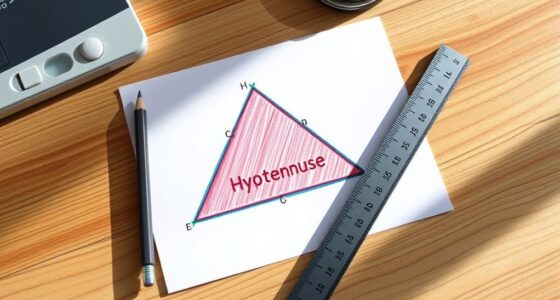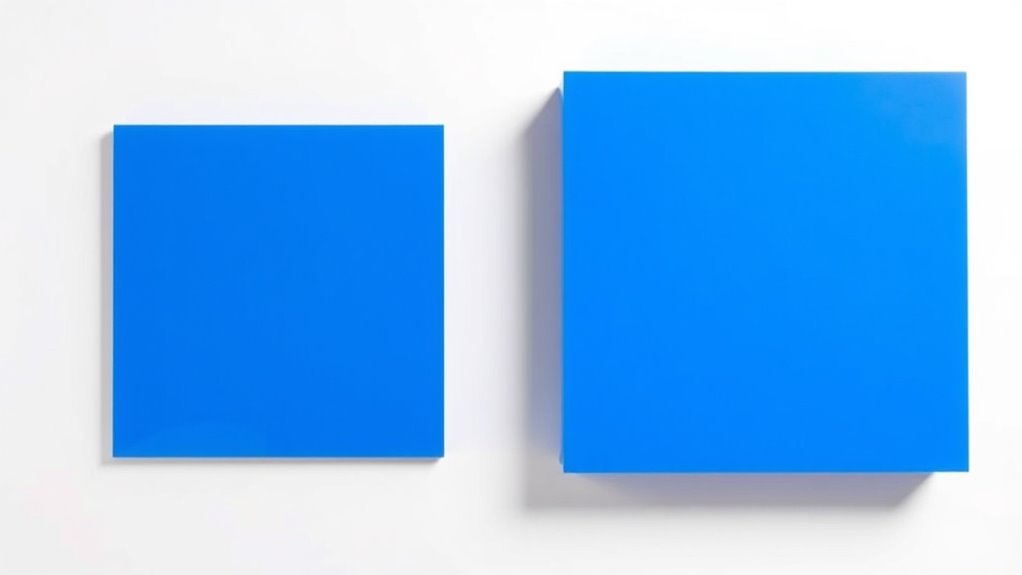

In geometry, when shapes are congruent, they are exactly the same size and shape, meaning one can be perfectly superimposed onto the other through transformations like rotations or reflections. Similar shapes, however, have the same shape but differ in size proportionally, with their corresponding angles equal and sides scaled by a constant factor. Understanding these differences helps you analyze and compare geometric figures effectively—if you keep exploring, you’ll discover even more about how these concepts apply.

Prime made for students and young adults
- Fast, free delivery for dorm and study essentials
- Prime Video and Amazon Music included
- Member-only deals
Key Takeaways
- Congruent shapes are identical in size and shape, while similar shapes have the same shape but differ in size proportionally.
- Congruence is achieved through transformations like translations, rotations, and reflections; similarity involves scaling (dilation).
- Congruent figures have equal side lengths and angles; similar figures have proportional sides and equal corresponding angles.
- Recognizing congruence confirms figures are “the same,” while similarity shows figures are scaled versions of each other.
- Both concepts are fundamental in geometric proofs, problem solving, and understanding shape relationships.

Have you ever wondered how shapes and spaces work together? Understanding the relationship between congruent and similar shapes is key to grasping the fundamentals of geometry. When exploring these concepts, it’s helpful to think about how transformations—like translations, rotations, reflections, and dilations—alter or preserve the properties of geometric figures. These transformations are the foundation for many geometric proofs, allowing you to demonstrate relationships between different shapes. For example, when two shapes are congruent, they’re fundamentally identical in size and shape, which means you can superimpose one onto the other through a series of transformations such as rotations or translations. Recognizing these transformations helps confirm congruence because the figures will match perfectly after the moves, maintaining all side lengths and angles. Additionally, payment processing technology can be used to improve the accuracy and security of digital geometric tools and resources.
On the other hand, similar shapes are related by transformations like dilation, which scale a figure proportionally while preserving its shape. When two figures are similar, their corresponding angles are equal, and the lengths of their sides are proportional. This proportionality is what makes them similar rather than congruent. Knowing this distinction is vital during geometric proofs, especially when establishing relationships between different figures. For instance, you might prove two triangles are similar by demonstrating that their corresponding angles are equal and their sides are in proportion. This process often involves applying the criteria for similarity, such as AA (angle-angle), SAS (side-angle-side), or SSS (side-side-side). These proofs are fundamental because they help you connect different parts of a geometric figure, making it easier to solve problems involving scale factors, areas, and perimeters.
Transformations also provide a visual and practical way to approach these proofs. They allow you to manipulate figures to see how properties are preserved or changed, which is essential when working through geometric proofs step-by-step. For example, you might transform one shape to align with another, demonstrating their congruence or similarity explicitly. By understanding how transformations function, you can simplify complex problems, see the underlying relationships more clearly, and communicate your reasoning more effectively. This approach makes it easier to verify properties like equal angles or proportional sides, reinforcing your understanding of the core principles of congruence and similarity.
As an affiliate, we earn on qualifying purchases.
Frequently Asked Questions
How Do Congruence and Similarity Relate in Real-World Applications?
You use congruence and similarity in real-world applications like creating scale models and architectural designs. Similar shapes help you understand proportions and visualize structures at different sizes, making planning easier. Congruent shapes ensure exact matches in parts, which is vital for detailed components. By applying these concepts, you can accurately reproduce, analyze, and communicate designs, making sure everything fits together perfectly and models reflect real-world objects accurately.
Can Two Shapes Be Both Congruent and Similar?
Yes, two shapes can be both congruent and similar. When shapes are congruent, they have matching angles and exactly the same size and shape. When they are similar, they have matching angles but different sizes, with a consistent size comparison. So, if the shapes have matching angles and the same size, they are both congruent and similar, meaning they are fundamentally identical in size and shape.
What Are Common Mistakes When Identifying Congruent Shapes?
You might make misidentification errors when identifying congruent shapes if you rely on visual similarity alone instead of checking all criteria, like size and angles. A common mistake is misapplying criteria such as side lengths and angles, leading you to think shapes are congruent when they’re not. Always verify all conditions carefully to avoid these errors, ensuring shapes match exactly in size and shape before concluding they are congruent.
How Does Scale Factor Affect Similar Shapes?
Did you know that the average scale factor for city maps is about 1:10,000? When you work with similar shapes, the scale factor determines how much the shape’s size changes. A larger scale factor increases the shape size, making it bigger, while a smaller one shrinks the shape. So, understanding the scale factor helps you accurately compare shapes and predict how their size relates, even if their shape stays the same.
Are There Shapes That Are Neither Congruent nor Similar?
Yes, some shapes are neither congruent nor similar. You’ll find these in distinct shape classifications and non-standard geometries, where shapes don’t match in size, shape, or proportional angles. For example, irregular polygons or certain artistic designs don’t fit the criteria for congruence or similarity. These shapes challenge typical geometric rules, highlighting the diversity in geometry and showing that not all shapes can be directly compared through size or proportionality.
As an affiliate, we earn on qualifying purchases.
Conclusion
Now you know the difference between congruent and similar shapes. Imagine you’re designing a scaled-down model of a building; the shapes are similar because they’re proportional but not identical in size. Understanding these concepts helps you recognize when shapes match exactly or just share proportions. Whether you’re an architect or an artist, mastering these basics makes your work more precise. So next time you see a tiny replica or a blueprint, you’ll know exactly what makes them similar or congruent.
congruent and similar shapes manipulatives
As an affiliate, we earn on qualifying purchases.
As an affiliate, we earn on qualifying purchases.
geometric transformation software
As an affiliate, we earn on qualifying purchases.
As an affiliate, we earn on qualifying purchases.
Fall Picks
fall essentials
As an affiliate, we earn on qualifying purchases.