
Symmetry groups are mathematical tools that describe how objects or patterns can be transformed through movements like rotations, reflections, and translations without changing their core appearance. They help you understand the repeated movements that create balanced and harmonious designs. These groups follow specific rules, such as combining symmetries to form new ones and including an identity operation that leaves the object unchanged. If you’re curious, exploring further reveals how these concepts explain many natural and artistic patterns.
Key Takeaways
- Symmetry groups consist of transformations like rotations, reflections, and translations that preserve an object’s structure.
- They follow group rules: closure, identity, inverses, and associativity, enabling systematic analysis of repeated transformations.
- Group actions describe how symmetries operate on patterns, revealing invariance and structural properties.
- Classifying symmetry groups helps understand patterns, tilings, and natural designs in geometry and art.
- Repeated application of symmetry operations generates complex, harmonious patterns and aids in pattern recognition and design.
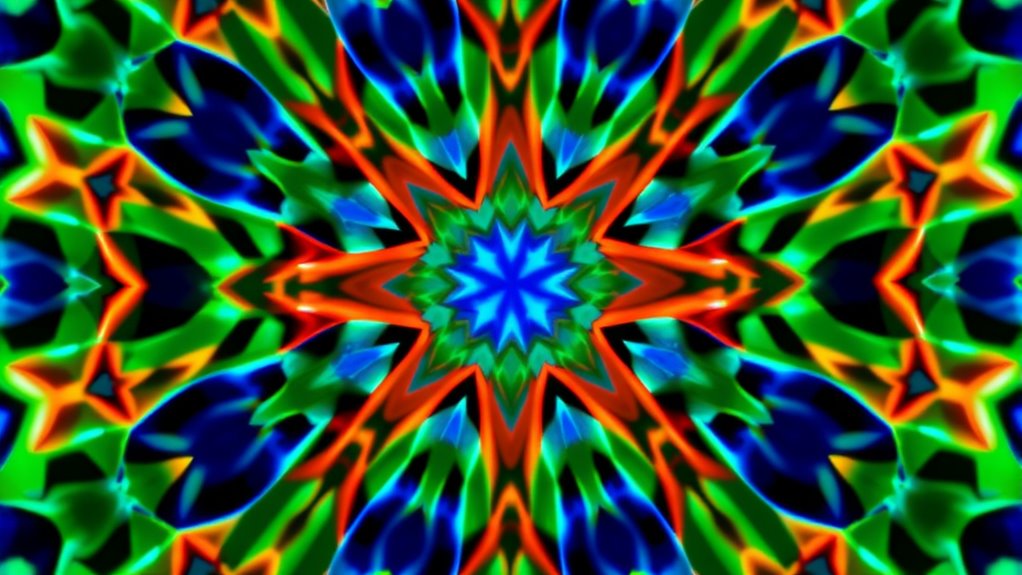
Symmetry groups are mathematical structures that describe the symmetries of objects and systems. When you explore these groups, you’re fundamentally studying how certain transformations can be applied repeatedly without changing the core nature of what you’re examining. At the heart of this concept are group actions, which are specific ways that elements of a symmetry group operate on objects or points in space. These actions help you understand how an object can be manipulated—rotated, reflected, translated—while preserving its main structure.
Imagine looking at a pattern or a design. The geometric patterns you see often exhibit repeating features that can be mapped onto each other through symmetry operations. The geometric patterns you see often exhibit repeating features that can be mapped onto each other through symmetry operations. These operations form a group because they follow specific rules: combining two symmetries results in another symmetry within the same set, an identity operation leaves the pattern unchanged, and each symmetry has an inverse that reverses its effect. By analyzing these symmetries, you can classify patterns based on their invariance under certain transformations, revealing the underlying structure that governs their repetition.
Group actions serve as the bridge between the abstract algebraic concept of a group and the visual, tangible world of geometric patterns. When you consider how a group acts on a pattern, you’re examining how each symmetry transforms the pattern’s features—rotating a tile by 90 degrees, flipping it along an axis, or translating it across a plane. These actions help you understand the full symmetry of the pattern, allowing you to see which transformations leave it unchanged and which alter its appearance. This insight is vital in fields like crystallography, art, and architecture, where the beauty and functionality of designs often depend on their symmetrical properties.
Furthermore, understanding group actions on geometric patterns enables you to classify all possible symmetries for a given pattern. For example, wallpaper patterns and tilings can be categorized into specific symmetry groups based on their transformations. This classification simplifies the study of complex designs, helping you identify the fundamental symmetries that define them. It also provides a systematic way to generate new patterns by applying known symmetries, expanding your creative toolkit.
In essence, by studying symmetry groups and their actions, you gain a powerful lens for analyzing the repetitive beauty in nature and human-made objects. It’s a way to decode the rules behind the visual harmony you observe in everything from snowflakes to mosaics, revealing the mathematical elegance hidden within the patterns that surround you. Recognizing fundamental principles in these symmetries allows mathematicians and designers alike to better understand and utilize the inherent order present in complex patterns.

Patterns of the Universe: A Coloring Adventure in Math and Beauty
Experiment llc
As an affiliate, we earn on qualifying purchases.
As an affiliate, we earn on qualifying purchases.
Frequently Asked Questions
How Are Symmetry Groups Applied in Real-World Architecture?
You apply symmetry groups in architecture to create appealing patterns and guarantee structural stability. By using these principles, you design buildings with balanced, harmonious features that distribute weight evenly and resist stress. Symmetry influences architectural patterns like domes, facades, and tiling, making structures both beautiful and resilient. Understanding symmetry groups helps you innovate while maintaining the integrity of your designs, blending aesthetics with functionality seamlessly.
What Is the Difference Between Finite and Infinite Symmetry Groups?
Imagine symmetry groups as a library: finite groups are like a collection of books with a limited number of titles, each representing a specific set of symmetries with a fixed group order. Infinite groups resemble an endless scroll of pages, with no end in sight. The key difference lies in group classification—finite groups have a limited, countable structure, while infinite groups extend indefinitely, embodying continuous or unbounded symmetries.
Can Symmetry Groups Be Used to Classify All Geometric Shapes?
Yes, symmetry groups help classify shapes based on their shape symmetry. By analyzing the group classification of a shape’s symmetries, you can determine its geometric properties and categorize it within a broader framework of shapes. This method is especially useful for understanding regular polygons, polyhedra, and other symmetric objects, allowing you to identify key features and relationships through their symmetry groups.
How Do Symmetry Groups Relate to Modern Physics Theories?
You see, symmetry groups are like the secret code that unlocks the universe’s deepest mysteries. In modern physics, they dance through quantum field theory, guiding our understanding of particle interactions. These groups shape the laws governing fundamental forces, revealing how nature’s patterns repeat at the tiniest scales. By studying symmetry, you unravel the hidden harmony behind the chaos, bringing you closer to comprehending the fabric of reality.
Are There Visual Tools to Better Understand Symmetry Groups?
You can use interactive models and visualization software to better understand symmetry groups. These tools let you manipulate objects and see how their symmetries work in real-time, making complex concepts clearer. By exploring different transformations visually, you gain a deeper intuition for how symmetry groups function. Whether you’re a student or enthusiast, these visual aids help you grasp the structure and beauty of symmetries more effectively.

Circle Templates Geometric Drawings Drafting Stencils Measuring Tools Artist Design Drawing Aid Tool Geometry Ruler, 2 Pack
High Quality Materials: Drafting Stencils Measuring Tools are made of quality plastic, Good flexibility, not easy to break,…
As an affiliate, we earn on qualifying purchases.
As an affiliate, we earn on qualifying purchases.
Conclusion
Now that you’ve glimpsed the elegant dance of symmetry groups, imagine them as the invisible threads weaving patterns into the fabric of our world. These mathematical guardians shape everything from snowflakes to galaxies, guiding their graceful repetitions. As you walk through life, recognize the silent symphony of transformations around you—each a brushstroke in the grand masterpiece of nature’s design, forever echoing the timeless rhythm of symmetry.

Beautiful Symmetry: A Coloring Book about Math (Mit Press)
As an affiliate, we earn on qualifying purchases.
As an affiliate, we earn on qualifying purchases.

NAKLEO Border Wall Stencil 8,3”x17,7”, Geometric Classical Symmetry Ornament Pattern, Reusable Plastic Template, Painting Stripe DIY Art and Craft Home Decor, Fabric Furniture Wood Paper Patio
SIMPLE WAY TO DECORATE YOUR INTERIOR: Bordered painting stencils are a great and economical idea for creating decorations…
As an affiliate, we earn on qualifying purchases.
As an affiliate, we earn on qualifying purchases.