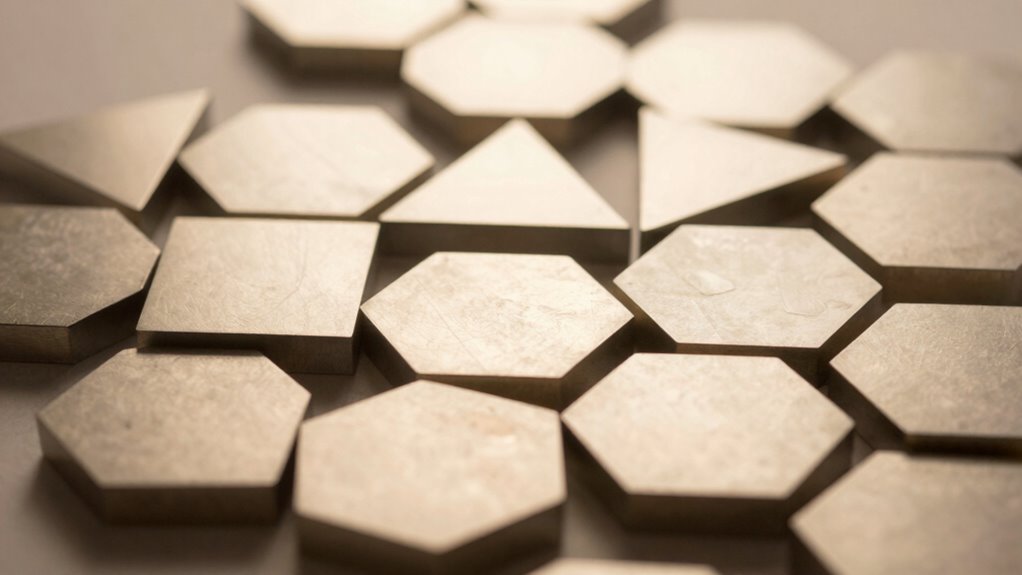

You naturally find regular polygons satisfying because their perfect symmetry and uniform shapes create a sense of harmony and order. Your brain perceives these consistent angles and equal sides as balanced, which triggers feelings of calmness and stability. Their rhythmic patterns resemble a visual melody, easing your eyes and mind. This innate preference for symmetry makes them visually pleasing. Keep exploring, and you’ll discover even more about why these shapes resonate so deeply with you.

Get school and study supplies delivered free — and shop member deals
- Fast, free delivery on millions of items
- Access to Prime Big Deal Days deals on October 6–7
- Prime Video, Amazon Music and more included
Key Takeaways
- Symmetry and uniformity create visual harmony, making shapes pleasing and easy for the brain to process.
- Repetition of angles and sides establishes a rhythmic pattern that evokes a sense of order.
- The balanced proportions trigger feelings of calmness and satisfaction through innate perceptual preferences.
- Constructing regular polygons reinforces their sense of harmony and precision.
- The mathematical beauty of regular polygons resonates with natural patterns, enhancing their aesthetic appeal.

Regular polygons have a natural appeal that can be surprisingly satisfying to observe and draw. Their clean, straight edges and uniform angles create a sense of order that immediately draws your eye. When you look at shapes like triangles, squares, or hexagons, you’re witnessing more than just geometric figures; you’re seeing a manifestation of mathematical symmetry that resonates deeply with your perception of order and balance. This symmetry isn’t just aesthetic—it’s rooted in mathematical principles that produce visual harmony, making these shapes inherently pleasing to the eye.
Regular polygons embody perfect symmetry and harmony, creating a visually pleasing balance that resonates deeply with our perception of order and beauty.
You might find yourself captivated by how each side of a regular polygon is identical, and how each interior and exterior angle is consistent. This repetition creates a rhythm that your brain naturally recognizes and appreciates. It’s like a visual melody, where harmony is achieved through uniformity. The more you study these polygons, the more you notice how their symmetry guides your gaze smoothly around the shape, with no abrupt interruptions. That seamless flow is part of what makes regular polygons so satisfying; your eyes are naturally drawn to the predictable, balanced pattern they present.
Drawing regular polygons can be almost meditative because of this sense of order. As you carefully construct each side, ensuring all angles and lengths match, you’re engaging with the same principles that give these shapes their appeal. The process reinforces the sense of harmony, both in the shape itself and within your own sense of precision. It’s as if you’re tapping into a universal language of geometry that speaks to your innate understanding of symmetry and balance. Recognizing the importance of geometric principles can deepen your appreciation for these shapes and their innate appeal. Moreover, understanding the visual perception involved in recognizing these balanced forms can enhance your overall appreciation of their beauty.
On a deeper level, the human brain seems wired to find comfort in symmetry. Regular polygons exemplify this perfectly—they are the epitome of balanced, symmetrical shapes. When you view them, your mind intuitively recognizes the mathematical symmetry behind the shape, which enhances your perception of visual harmony. That’s why they often evoke feelings of calmness and satisfaction. Their balanced proportions reassure your subconscious that everything is in order, creating an almost instinctive response of pleasure whenever you encounter them.
Ultimately, the appeal of regular polygons lies in their ability to blend mathematical symmetry with visual harmony. Your eye appreciates their consistency, and your mind recognizes the underlying mathematical symmetry, making them irresistibly satisfying to observe and draw. This harmony between form and function is what makes regular polygons not just shapes, but symbols of natural beauty rooted in mathematical precision.
geometric drawing set for regular polygons
As an affiliate, we earn on qualifying purchases.
As an affiliate, we earn on qualifying purchases.
Frequently Asked Questions
Do Regular Polygons Have Any Symbolic Meanings Across Cultures?
Regular polygons often hold cultural symbolism and spiritual meanings across different societies. You might see them representing harmony, balance, and perfection, reflecting ideals valued in many traditions. For example, the circle symbolizes unity, while triangles can signify stability or change. In spiritual contexts, these shapes are believed to convey deeper truths or divine principles. When you encounter regular polygons, you’re engaging with symbols that resonate deeply, connecting visual harmony with cultural and spiritual significance.
How Do Regular Polygons Relate to Natural Patterns?
Regular polygons relate to natural patterns through their geometric harmony and visual balance, which mirror the structures found in nature. You’ll notice these shapes in honeycombs, flower petals, and snowflakes, where symmetry creates stability and beauty. This alignment with natural patterns appeals to your subconscious, making regular polygons feel inherently satisfying. Their precise geometric harmony resonates with your innate sense of order, fostering a deep visual connection and appreciation.
Are There Psychological Reasons Why Humans Prefer Certain Polygons?
Yes, there are psychological reasons behind your preference for certain polygons. You naturally seek visual harmony and cognitive simplicity, which regular polygons provide through symmetrical shapes and predictable patterns. Your brain finds these structures easier to process and more pleasing because they reduce mental effort. This innate preference taps into your desire for order and balance, making regular polygons feel satisfying and comforting to your eyes.
Can Regular Polygons Be Found in Modern Design and Architecture?
Regular polygons are everywhere in modern design and architecture, like in the sleek lines of skyscrapers or the intricate patterns of tiling. You’ll notice they create a sense of symmetry and balance, fostering visual harmony that appeals to your eye. These shapes evoke stability and order, making spaces feel more inviting. Architects and designers intentionally use regular polygons to craft environments that feel both aesthetically pleasing and structurally sound.
Do Regular Polygons Appear in Mathematical Art and Tessellations?
Yes, regular polygons frequently appear in mathematical art and tessellations. You’ll notice their geometric symmetry creates stunning visual harmony, making patterns feel balanced and appealing. Artists and mathematicians use these shapes to craft intricate designs that emphasize repetition and order. As you observe tessellations, the regular polygons’ consistent angles and sides generate mesmerizing, seamless patterns that draw you in with their perfect harmony and precise structure.
constructing regular polygons kit
As an affiliate, we earn on qualifying purchases.
As an affiliate, we earn on qualifying purchases.
Conclusion
You might not realize it, but your brain loves regular polygons—over 60% of people find their symmetry incredibly satisfying. Their even, balanced shapes trigger a sense of order and harmony, making them feel soothing to look at. So next time you’re drawn to a perfect hexagon or pentagon, remember it’s your mind craving that visual comfort. It’s a fascinating reminder that beauty often lies in simple, predictable patterns.
geometric pattern stencils for drawing
As an affiliate, we earn on qualifying purchases.
As an affiliate, we earn on qualifying purchases.
As an affiliate, we earn on qualifying purchases.
Halloween Picks
halloween
As an affiliate, we earn on qualifying purchases.