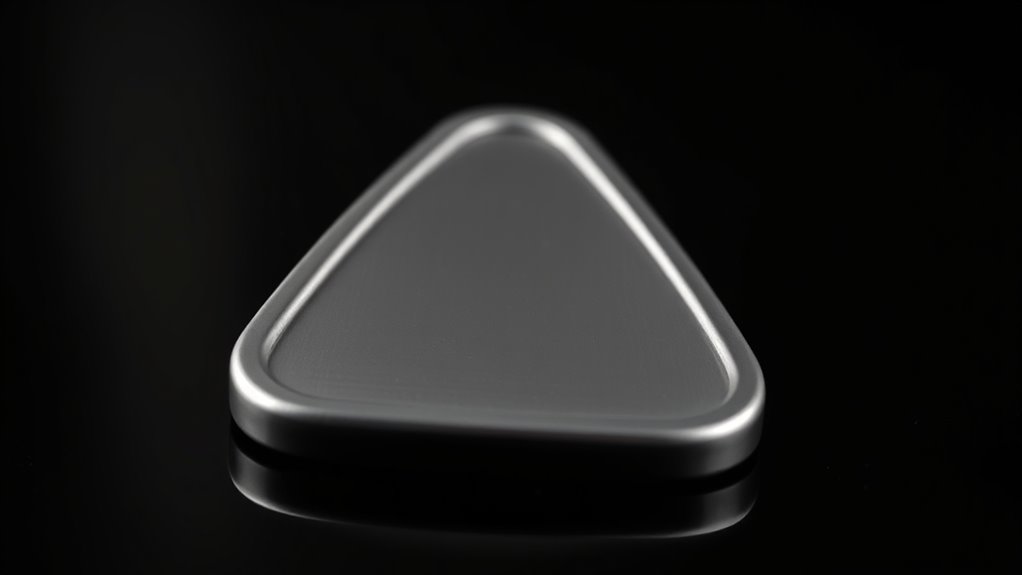

The Reuleaux triangle is a fascinating shape made entirely of circular arcs, giving it constant width—meaning it measures the same in every direction. This property allows it to roll smoothly between parallel surfaces without changing orientation, making it unique among geometric figures. Its curved design isn’t just mathematically intriguing but also useful in engineering and architecture, inspiring innovative structures. If you keep exploring, you’ll discover how this shape combines beauty, function, and practical applications in surprising ways.
Key Takeaways
- The Reuleaux triangle is a curved shape formed by three circular arcs, not straight lines or right angles.
- It maintains constant width, allowing it to roll smoothly between parallel planes without changing orientation.
- Its unique geometric property makes it useful for practical applications like coins, drill bits, and gears.
- Architecturally, its curved form enhances aesthetic appeal and supports modular, flowing designs.
- The shape exemplifies how curved lines can combine mathematical properties with innovative design and engineering uses.
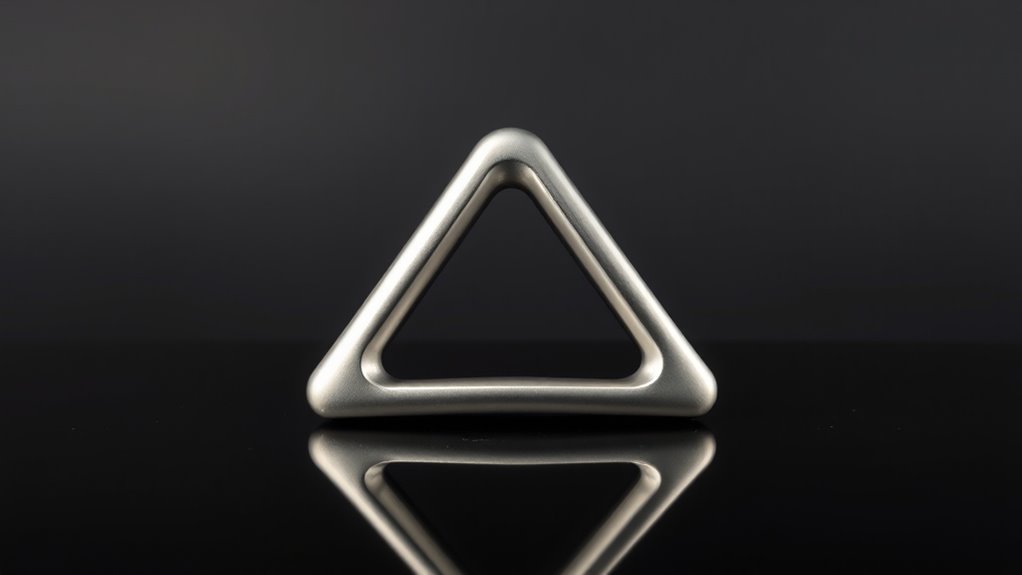
Have you ever wondered what makes the Reuleaux triangle a fascinating shape in geometry? Its unique form captures attention because of its intriguing combination of curves and mathematical properties. Unlike most shapes, which rely on straight lines and right angles, the Reuleaux triangle is composed entirely of circular arcs, giving it a distinctive appearance. This shape is a prime example of a curve in architecture that challenges conventional design ideas, inspiring architects to incorporate curves that aren’t just aesthetic but also functional. Its constant width means it maintains the same distance across all directions, a property that’s rare and engaging in geometric figures. The shape’s curves allow for innovative applications in design and engineering, highlighting its practical significance beyond pure mathematics.
When you look at the Reuleaux triangle, you notice its three curved sides, each formed by a segment of a circle. These curves aren’t arbitrary; they’re carefully constructed so that every pair of opposite sides is equidistant. This constant width property means you can roll the shape smoothly between two parallel planes without changing its orientation. This property isn’t just a mathematical curiosity; it has real-world applications in designing objects like drill bits, coins, and gears, where consistent contact and smooth motion are essential. The mathematical properties of the Reuleaux triangle reveal a shape that defies the norms of traditional Euclidean geometry, showing how curved lines can create stable, functional forms.
In architecture, curves in architecture inspired by the Reuleaux triangle are often used to achieve both aesthetic appeal and structural efficiency. Its smooth, rounded edges can soften the appearance of buildings, making them more inviting and organic-looking. Additionally, because of its constant width, the shape lends itself well to creating modular structures that can rotate or fit together in innovative ways. Think about how a building might incorporate these curves in its facade or interior design to evoke a sense of flow and harmony. The mathematical properties of the Reuleaux triangle also allow architects to experiment with curved spaces, making them both visually striking and structurally sound.
Frequently Asked Questions
Can Reuleaux Triangles Be Used to Create Smooth Curves?
Yes, you can use Reuleaux triangles to create smooth curves. Their curved surfaces provide unique design flexibility, allowing for innovative and seamless shapes. By combining multiple Reuleaux triangles or integrating them into larger structures, you can design smooth, rounded edges that aren’t easily achieved with traditional shapes. This makes them ideal for applications requiring smooth curves, such as in architecture, engineering, and product design, where fluid, continuous forms matter.
Are Reuleaux Triangles Practical in Modern Engineering Applications?
Reuleaux triangles are surprisingly practical in modern engineering, though you face manufacturing challenges and material limitations. You might imagine crafting these shapes as sculpting impossible, perfectly smooth curves that defy conventional tools. Still, their constant width makes them ideal for applications like drill bits, rotary engines, and coin designs. With advanced manufacturing techniques, you can overcome obstacles, turning this fascinating shape into a functional, innovative component that pushes engineering boundaries.
How Does the Reuleaux Triangle Differ From a Circle in Function?
You notice that a Reuleaux triangle differs from a circle in function because it offers constant width despite its shape, thanks to its unique rotational symmetry. This allows it to roll smoothly like a circle, making it useful in applications like drill bits. Its area calculations are more complex, but its constant width gives it practical advantages. Unlike a circle, it maintains its width at all orientations, enabling specific mechanical advantages in design.
Can Reuleaux Triangles Be Scaled Without Losing Their Properties?
Yes, you can scale Reuleaux triangles, but beware of scaling limitations. When you resize proportionally, the key properties of constant width remain intact, allowing the shape to function as intended. However, if you try to distort or non-uniformly resize it, you’ll lose those properties. So, for preserving its unique features, stick to proportional resizing, and the shape’s intriguing qualities will stay consistent no matter the size.
What Other Shapes of Constant Width Exist Besides Reuleaux Triangles?
Besides Reuleaux triangles, you find other shapes of constant width like the Reuleaux polygons, which include shapes like Reuleaux pentagons and hexagons. These shapes are used in gear mechanisms for smooth rotation and are popular in artistic designs due to their unique, eye-catching forms. You can explore these shapes for innovative engineering projects or creative art pieces, knowing they maintain their width regardless of orientation.
Conclusion
Now that you’ve explored the Reuleaux triangle, imagine holding a tiny universe of curves and angles woven together like a delicate, enchanting puzzle. Its shape, like a whisper of geometric magic, rolls smoothly across surfaces, defying expectations. This shape of constant width isn’t just math; it’s a mesmerizing dance of form and function. As you ponder its curves, see it as a tiny world of wonder, inviting your curiosity to spin and explore forever.