
Understanding a circle starts with its core elements: the radius, diameter, and circumference. The radius is the distance from the center to any point on the edge, while the diameter passes straight through the center, twice the radius. The circumference is the total perimeter, calculated using the diameter or radius. By mastering these basics, you’ll be able to measure and design circular objects more confidently—continue exploring to uncover more useful details about working with circles.

Prime made for students and young adults
- Fast, free delivery for dorm and study essentials
- Prime Video and Amazon Music included
- Member-only deals
Key Takeaways
- The radius is the distance from the circle’s center to any point on its edge.
- The diameter is twice the radius and passes through the circle’s center.
- The circumference is the total length around the circle, calculated using diameter or radius.
- Calculating the circumference involves multiplying diameter or twice the radius by pi (π).
- These elements are fundamental for designing, measuring, and calculating properties of circles.
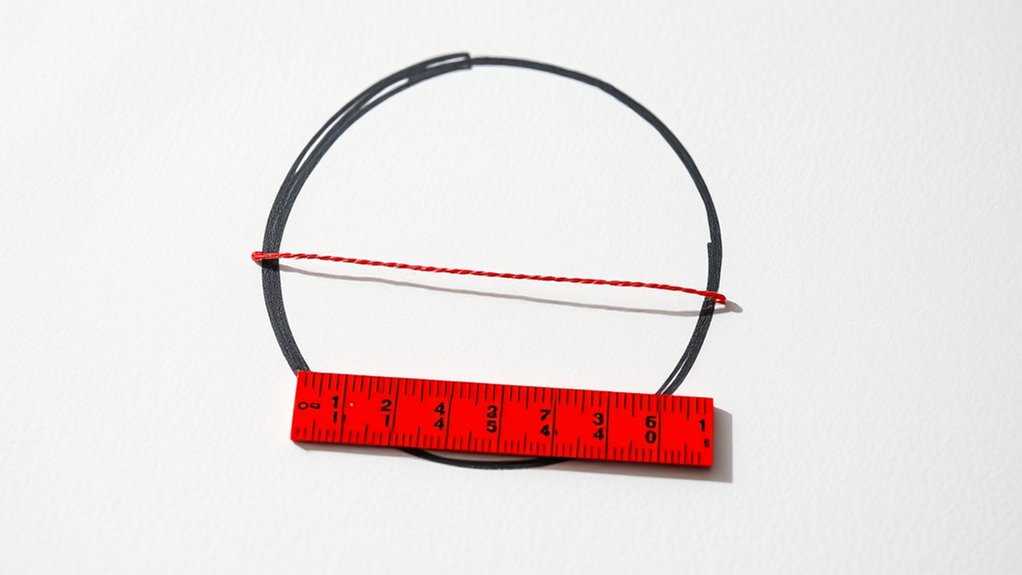
Have you ever wondered what makes a perfect circle indispensable in design and everyday life? It’s all about understanding its core elements—the radius, diameter, and circumference—that help us quantify and work with circles effectively. When you’re designing a logo, building a round table, or even calculating the space inside a circular garden, knowing these basics becomes invaluable. The radius, which is the distance from the center to any point on the edge, serves as the foundation for many calculations. For example, if you want to determine the area of a circle, you need to square the radius and multiply by pi (π). This is called area calculations, and it tells you exactly how much space the circle covers. Similarly, the diameter, which runs straight across through the center, is simply twice the radius. Knowing the diameter helps you quickly identify the size of a circle without measuring the radius directly.
The circumference is another essential measurement. It’s the total length around the circle and can be found by multiplying the diameter or twice the radius by pi. This measurement is indispensable in many real-world applications, like estimating the length of a fence needed to enclose a circular yard or calculating the distance a wheel travels in one complete turn. But beyond the basic measurements, understanding arc length is equally important—especially when dealing with parts of a circle rather than the whole. Arc length refers to the distance along a segment of the circle’s edge, which is particularly useful in engineering, architecture, and even navigation. If you’re designing a curved pathway or a segment of a circular track, calculating the arc length helps you figure out how long that curve will be, based on the angle it subtends at the center.
To find the arc length, you need to know the radius and the measure of the central angle, typically in degrees or radians. The formula involves multiplying the radius by the angle in radians, giving you a precise length for that segment. This approach makes it easier to plan projects or analyze parts of a circle without having to measure every detail physically. Additionally, understanding the relationship between the radius, diameter, and circumference enhances your ability to solve geometry problems involving circles. Whether working with full circles or segments, knowing how to perform area calculations and find arc length allows you to approach design problems with confidence. In essence, mastering these circle fundamentals gives you a powerful toolkit for both practical tasks and creative projects, making circles not just simple shapes but fundamental tools in your everyday problem-solving.
As an affiliate, we earn on qualifying purchases.
Frequently Asked Questions
How Do I Measure the Radius of an Irregular Circle?
To measure the radius of an irregular circle, you should first identify the center point, which may require estimating, especially if the shape isn’t perfect. Then, measure from this center to the outer edge at various points, using a ruler or flexible measuring tape. Take multiple measurements to get an average, helping you accurately approximate the radius of the irregular shape. This approach guarantees your measurement reflects the true size.
Can the Diameter Be Longer Than the Circumference?
Daringly, the diameter can’t be longer than the circumference because the circle’s core concept is that the circumference always exceeds the diameter. Imagine comparing the circle’s diameter, the straight stretch across, to the total trip around it—the circumference. The circle’s diameter is always less than the circle’s circumference, making it impossible for the diameter to outsize the complete circle, emphasizing the essential difference between diameter versus circumference.
What Is the Relationship Between Area and Circumference?
You see, the relationship between area and circumference involves circle formulas and pi relationships. The area formula, (pi r^2), depends on the radius, while the circumference, (2 pi r), relates directly to the radius too. As the radius increases, both area and circumference grow, but at different rates. So, understanding these circle formulas helps you see how changes in one affect the other through pi relationships.
How Do I Find the Circumference Without a Calculator?
Think of measuring a circle’s edge like tracing a ribbon around a cake. To find the circumference without a calculator, use simple measurement techniques and an approximation of pi, like 22/7 or 3.14. Multiply your diameter by this pi approximation. This way, you get a close estimate without complex tools, turning math into a straightforward task, just like wrapping a ribbon smoothly around your cake.
Are There Real-World Objects With Perfect Circles?
Yes, you can find real-world objects with nearly perfect circles, like coins, wheels, and clock faces. While they aren’t perfectly circular, mathematical models and geometric approximations help us analyze their shapes. These objects often serve as practical examples in geometry, and their slight imperfections are usually negligible for everyday purposes. You can measure or observe these objects to understand their circular properties, relying on approximations for most real-world applications.
measuring tape for circular objects
As an affiliate, we earn on qualifying purchases.
As an affiliate, we earn on qualifying purchases.
Conclusion
Now that you understand the basics of radius, diameter, and circumference, you’ll see how these elements connect in every circle around you. Did you know that the circumference of a circle is always about 3.14 times its diameter? That number, pi, has fascinated mathematicians for thousands of years. With this knowledge, you’ll be better equipped to explore circles in real life, from wheels to clocks, and appreciate the beauty behind their simple yet complex shapes.
As an affiliate, we earn on qualifying purchases.
As an affiliate, we earn on qualifying purchases.
Fall Picks
fall essentials
As an affiliate, we earn on qualifying purchases.