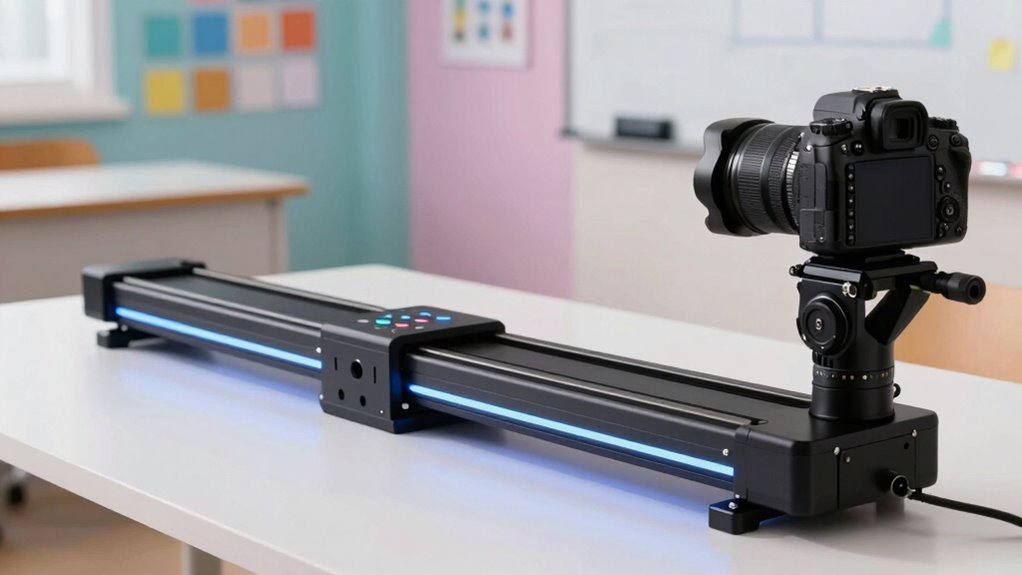

For online teaching, the GVM GP-120QD 48-Inch Motorized Camera Slider stands out as the best overall choice due to its balance of rail length, payload capacity, and intuitive app control. It allows educators to create engaging, cinematic pans across whiteboards or desks without manual jitter. The NEEWER ER1 Carbon Fiber Slider is a strong alternative for those prioritizing lightweight portability and silent operation, while the iFootage Shark Nano II offers superior precision for detailed close-ups of hands-on demonstrations. The main tradeoff you face is between rail length and setup complexity; longer rails provide more dynamic movement but require more space and time to level, whereas compact sliders are easier to store but limit your framing options. Read on to see which model fits your specific classroom or home studio setup.

Prime made for students and young adults
- Fast, free delivery for dorm and study essentials
- Prime Video and Amazon Music included
- Member-only deals
Key Takeaways
- App-based control is now standard for mid-to-high-end sliders, eliminating the need for bulky wired remotes during live lessons.
- Carbon fiber rails reduce vibration significantly compared to aluminum, which is critical for maintaining focus on text-heavy slides or whiteboards.
- Sliders under 20 inches are often too short for wide classroom shots, making 32-48 inch rails the sweet spot for most teaching setups.
- Silent motors are non-negotiable for voice-over recording; cheaper DC motors often introduce audible hum that requires post-production cleanup.
- Battery life varies drastically between models, with some offering only 30 minutes of continuous use, forcing frequent charging breaks between lessons.
| GVM GP-120QD 48-Inch Motorized Camera Slider |  | Best for Long, Deliberate Teaching Shots | Rail length: 48 in (120 cm) | Material: Carbon fiber | Maximum recommended load: 5 kg | VIEW ON AMAZON | See Our Full Breakdown |
| GVM 27-inch Aluminum Alloy Motorized Camera Slider with Time-Lapse, Video and Round Trip Shooting |  | Best for Angled Setups | Rail length: 23.6 in (60 cm) | Construction: Aluminum alloy | Maximum load: 5.5 lb (2.5 kg) | VIEW ON AMAZON | See Our Full Breakdown |
| NEEWER ER1 47.2-Inch Motorized Carbon Fiber Camera Slider |  | Best for Quiet, High-Capacity Moves | Rail length: 47.2 in (120 cm) | Material: Carbon fiber | Horizontal load capacity: 11 lb | VIEW ON AMAZON | See Our Full Breakdown |
| NEEWER DL400 Motorized Camera Slider Dolly with App Control |  | Best for Small Teaching Spaces | Maximum load: 6.6 lb | Item weight: 3.75 lb | Motor noise: Below 30 dB | VIEW ON AMAZON | See Our Full Breakdown |
| IFOOTAGE Shark Nano II 860 Motorized Camera Slider, 34 in |  | Best for Gimbal-Based Multi-Axis Shots | Rail length: 34 in | Maximum horizontal load: 5 kg | Maximum vertical load: 2.5 kg | VIEW ON AMAZON | See Our Full Breakdown |
| iFootage Shark Slider PICO PRO 15.8-Inch Motorized Camera Slider |  | Best for Smartphone & Compact Camera Creators | Brand: iFootage | Slider Length: 15.8 inches | Max Payload: 3.3 lbs | VIEW ON AMAZON | See Our Full Breakdown |
| GVM 32″/80cm Motorized Wireless Camera Slider with Carbon Fiber Dolly Rail |  | Best for Professional-Quality Smoothness | Length: 32 inches / 80 cm | Material: 8-layer carbon fiber | Connectivity: Bluetooth wireless | VIEW ON AMAZON | See Our Full Breakdown |
| NEEWER DL400 Motorized Camera Slider Dolly with App Control |  | Best for Heavy DSLR Cameras | Maximum Load: 6.6 lb | Battery Runtime: Up to 5 hours | Motor Noise: Under 30 dB | VIEW ON AMAZON | See Our Full Breakdown |
| IFOOTAGE Shark Slider Pico Pro Motorized Mini Slider, 15.7-Inch, 2-Axis |  | Best for Minimalist & Space-Saving Setups | Slider Length: 15.7 inches | Axes: 2 | Maximum Payload: 2.4 lb | VIEW ON AMAZON | See Our Full Breakdown |
| NEEWER 3-Wheel Wireless Motorized Camera Dolly with Remote Control |  | Best Budget Entry Point | Wheel Adjustment: 180° for straight or circular routes | Speed Settings: 3 speeds (1.4, 2.4, 3.0 cm/s) | Remote Range: 6 m (19.7 ft) | VIEW ON AMAZON | See Our Full Breakdown |
| iFootage Shark Slider PICO 15.8″ Motorized Camera Slider |  | Best for Content Creators Using Small Cameras | Slider Length: 15.8 inches | Payload Capacity: 2.4 lbs | Battery Runtime: 7 hours | VIEW ON AMAZON | See Our Full Breakdown |
| IFOOTAGE PICO Motorized Camera Slider |  | Best for Solo Shooters Needing App Control | Rail Length: 15.8 inches | Motion Types: 2-axis linear movement with 360° pan | Control Method: App control, NFC one-tap | VIEW ON AMAZON | See Our Full Breakdown |
| GVM 48-Inch Motorized Carbon Fiber Camera Slider with App Control |  | Best for Wide-Angle Classroom Setups | Length: 48 inches (120 cm) | Material: Carbon Fiber | Weight: 4 kg | VIEW ON AMAZON | See Our Full Breakdown |
| IFOOTAGE Shark Nano II 660 Motorized Camera Slider |  | Best for High-Payload Professional Setups | Travel Distance: 17 inches | Max Horizontal Payload: 7 kg (15.4 lb) | Motor Noise: <20 dB | VIEW ON AMAZON | See Our Full Breakdown |
More Details on Our Top Picks
GVM GP-120QD 48-Inch Motorized Camera Slider
The 48-inch travel gives this slider room for slow, sustained movement across a wide teaching setup—useful when a lesson benefits from showing a desk, instrument, or demonstration area without a cut. Its tracking, time-lapse, and panoramic modes offer more shot options than the GVM 27-inch slider, while adjustable start and end points help repeat a planned move. It can also run manually, which is handy when I want a quick reposition without setting a motorized move.
The tradeoff is its footprint: at 11.8 pounds, it is much less convenient to move between rooms than a compact dolly such as the NEEWER DL400. Its 5 kg load recommendation also limits heavier camera-and-lens combinations, and it is not water resistant. I’d choose it for a fixed or semi-permanent teaching studio, not a lightweight travel kit.
Pros:- 48-inch rail supports longer moves than the GVM 27-inch model.
- Tracking, time-lapse, and panoramic modes expand shot options.
- Adjustable start and end points, speed, and interval support repeatable setups.
- Includes a battery, controller, charger, and carrying bag.
Cons:- The 11.8-pound weight is a drawback for frequent transport.
- The 5 kg recommended load can rule out heavier camera rigs.
- Not water resistant, limiting use in exposed or damp locations.
Best for: Online instructors filming in a dedicated studio who want long, repeatable camera moves across a wide teaching surface.
Not ideal for: Teachers who frequently pack up or use heavy camera rigs; its 11.8-pound body and 5 kg recommended load make those setups less convenient.
- Rail length:48 in (120 cm)
- Material:Carbon fiber
- Maximum recommended load:5 kg
- Shooting modes:Tracking, time-lapse, panoramic
- Operation:Manual and motorized
- Item weight:11.8 lb
- Included items:Controller, battery, charger, connection and shutter cables, carrying bag
- Warranty:One year
Our verdict“Choose the GP-120QD for long, controlled studio moves if rail length matters more than portability.”
GVM 27-inch Aluminum Alloy Motorized Camera Slider with Time-Lapse, Video and Round Trip Shooting
The adjustable feet and multiple mounting angles are this GVM slider’s clearest advantage for teaching videos. It can be set horizontally, vertically, or at 45 degrees, making it easier to frame a close-up demonstration or add a slight rise to a move than with the GVM GP-120QD, whose strongest case is its longer rail. Video, time-lapse, and automatic round-trip modes also suit a fixed camera move that needs to repeat while I teach.
Its 23.6-inch rail takes less room than the GP-120QD’s 48-inch span, but it gives up that wider travel. The aluminum construction is sturdy, though the slider still weighs 5.5 pounds and supports only 2.5 kg. That load ceiling is restrictive for larger camera setups, so this pick fits compact teaching rigs better than heavy cinema-style builds.
Pros:- Supports horizontal, vertical, and 45-degree positioning.
- Video, time-lapse, and automatic round-trip modes suit repeatable lesson shots.
- Aluminum alloy construction and adjustable non-slip feet support stable placement.
- Includes both 1/4-inch and 3/8-inch mounting threads.
Cons:- Maximum load of 2.5 kg restricts heavier cameras and lenses.
- At 5.5 pounds, it is not especially light for a short slider.
- The 23.6-inch rail offers less travel than the GVM GP-120QD.
Best for: Instructors using a compact camera who need a repeatable slider move at horizontal, vertical, or 45-degree angles.
Not ideal for: Teachers with heavy camera rigs or wide studio scenes; its 2.5 kg load limit and shorter rail constrain those setups.
- Rail length:23.6 in (60 cm)
- Construction:Aluminum alloy
- Maximum load:5.5 lb (2.5 kg)
- Product weight:5.5 lb (2.5 kg)
- Camera mounting threads:1/4-inch and 3/8-inch male threads
- Tripod mounting threads:Dual 1/4-inch and 3/8-inch female threads
- Shooting modes:Time-lapse, video, automatic round-trip
- Included items:Carrying bag, controller, power bank adapter
Our verdict“Pick this GVM when angled positioning matters more than long travel or a high load capacity.”
NEEWER ER1 47.2-Inch Motorized Carbon Fiber Camera Slider
For a teaching studio that needs a long move but uses a heavier camera, the NEEWER ER1’s 11-pound horizontal capacity is a meaningful advantage over the GVM GP-120QD’s 5 kg recommendation. Its silent stepper motor and app control suit recorded lessons where motor noise could distract from speech, while the included 4400 mAh battery means one key power component arrives in the box. Manual, video, and time-lapse modes cover both quick camera repositioning and planned movement.
The ER1 is not as ready-to-use as that GVM kit: its 2.4 GHz remote and USB-C charger are sold separately. It also supports only 5.5 pounds when tilted at 45 degrees, and minor shake may show up in macro shots. I’d favor it for horizontal teaching shots with a quiet, heavier rig, rather than close-up work that demands maximum steadiness.
Pros:- 11-pound horizontal capacity exceeds the GVM GP-120QD’s 5 kg recommendation.
- Silent stepper motor helps keep movement unobtrusive during recorded lessons.
- Includes a 4400 mAh NP-F750 battery.
- App control and manual, video, and time-lapse modes support varied workflows.
Cons:- USB-C charger and 2.4 GHz remote are not included.
- Tilt capacity drops to 5.5 pounds at 45 degrees.
- Minor shake may occur during macro photography.
Best for: Instructors recording with a heavier camera who want quiet motorized movement across a long studio setup.
Not ideal for: Teachers who need a complete control-and-charging kit out of the box or who rely on extremely steady macro close-ups.
- Rail length:47.2 in (120 cm)
- Material:Carbon fiber
- Horizontal load capacity:11 lb
- Tilt load capacity:5.5 lb at 45 degrees
- Battery:4400 mAh NP-F750 included
- Control:App; 2.4 GHz remote not included
- Shooting modes:Manual, video, time-lapse
- Item weight:2.5 kg
- Warranty:One year
Our verdict“Choose the ER1 for quiet, horizontal moves with a heavier camera, provided you can supply the missing charger and remote.”
NEEWER DL400 Motorized Camera Slider Dolly with App Control
The DL400 is a wheeled dolly rather than a long rail slider, which changes the kind of movement it suits. Its compact 3.75-pound body can travel around a tabletop or across a small clear floor area, making it a practical fit when a full-length slider like the GVM GP-120QD would take over a teaching room. App control, five speed settings, and a ball head with 360-degree rotation and 90-degree tilt help adjust framing without rebuilding a rail setup. The motor noise is specified below 30 dB, a useful detail when recording spoken instruction.
That compact approach also limits the shot: it needs a suitable flat path, and its 6.6-pound load limit is lower than the NEEWER ER1’s horizontal capacity. The listed runtime is up to five hours, but time-lapse shooting needs a separately purchased shutter cable. I’d choose it for modest camera moves in a tidy studio, not for long, precisely constrained rail travel.
Pros:- Compact 3.75-pound dolly is easier to place in a small teaching room than a 48-inch rail.
- Quiet dual motors are specified below 30 dB.
- Five speed settings and app control allow adjustment to different lesson shots.
- Includes an NP-F750 battery with up to five hours of runtime and an adjustable ball head.
Cons:- The 6.6-pound load limit is lower than the NEEWER ER1’s horizontal capacity.
- Time-lapse use requires a separately purchased camera shutter cable.
- The movement path depends on a clear, suitable surface rather than a fixed rail.
Best for: Online teachers with a small, clear floor or tabletop area who want quiet, app-controlled movement without setting up a long rail.
Not ideal for: Instructors who need a long, fixed travel path, use heavier rigs, or cannot keep the dolly’s route clear.
- Maximum load:6.6 lb
- Item weight:3.75 lb
- Motor noise:Below 30 dB
- Battery:NP-F750 rechargeable lithium-ion
- Battery runtime:Up to 5 hours
- Movement speeds:Five settings: 60, 50, 35, 25, and 15 s/m
- Ball head:360-degree rotation; 90-degree tilt
- Manual movement:30 degrees left and right
Our verdict“Choose the DL400 for quiet, compact movement in a small studio, but select a rail slider for long, repeatable travel.”
IFOOTAGE Shark Nano II 860 Motorized Camera Slider, 34 in
The Shark Nano II 860’s 360-degree pan control and compatibility with selected DJI RS gimbals make it the most specialized option here for coordinated multi-axis movement. With a compatible gimbal, the camera can pan as the slider travels, which can add motion to a teaching demonstration that a basic single-axis setup like the GVM 27-inch slider cannot match. Its touchscreen and app control, customizable waypoints, and AI subject tracking also provide more control than the simpler app-operated NEEWER DL400.
That flexibility comes with a substantial setup dependency: the compatible DJI gimbal is sold separately, and DJI integration calls for a 60W-or-higher power supply. At 34 inches, it offers less rail length than the 47.2-inch NEEWER ER1. I’d choose it for a gimbal owner building complex, repeatable shots, not for a beginner seeking a straightforward slider kit.
Pros:- 360-degree pan control supports multi-axis moves with compatible DJI RS gimbals.
- Touchscreen and app control provide multiple ways to set up motion.
- AI subject tracking and customizable waypoints offer more shot control than the NEEWER DL400.
- Supports USB-C PD, F970 batteries, or wall power.
Cons:- Compatible DJI RS gimbal is sold separately.
- DJI integration requires a 60W-or-higher power supply.
- The 34-inch rail is shorter than the NEEWER ER1’s 47.2-inch rail.
Best for: Instructors who already own a compatible DJI RS gimbal and want synchronized panning, waypoints, or subject tracking in lesson videos.
Not ideal for: Teachers seeking a simple standalone slider or who do not own a compatible DJI gimbal and suitable power supply.
- Rail length:34 in
- Maximum horizontal load:5 kg
- Maximum vertical load:2.5 kg
- Pan movement:360 degrees
- Control:IPS touchscreen and iOS/Android app
- USB-C power:PD 60W
- Compatible gimbals:DJI RS2, RS3 Pro, RS4, RS4 Pro, RS5
- Included accessories:Carrying bag, shutter and magnetic cables, adapters, quick-release plate, PD charger, USB-C cable
Our verdict“Pick the Shark Nano II 860 if you already have compatible DJI gear and want coordinated pan-and-slide movement.”
iFootage Shark Slider PICO PRO 15.8-Inch Motorized Camera Slider
This slider stands out for its versatile compatibility with smartphones and compact cameras like the DJI Pocket series, making it ideal for educators who prefer lightweight gear. Compared to the bulkier NEEWER DL400, the PICO PRO is significantly more portable at just 1.8 lbs, though it sacrifices some payload capacity. The 360° pan rotation adds dynamic movement options that fixed-rail sliders lack, allowing for engaging lecture intros or product demos. However, the 3.3 lb payload limit means it cannot support larger DSLR setups with heavy lenses, restricting its use to smaller rigs.
Pros:- Supports a wide range of devices including smartphones, action cams, and compact cameras
- Features five shooting modes and programmable shot markers for precise lesson planning
- Quiet brushless motor ensures audio recording isn’t compromised by mechanical noise
- 360° pan rotation allows for creative angles beyond standard linear movement
Cons:- Payload capacity is limited to 3.3 lbs, excluding heavier professional camera setups
- Advanced features like AI tracking require purchasing separate, compatible accessories
Best for: Educators using smartphones, DJI Osmo Pocket cameras, or mirrorless bodies with small primes for desk-based teaching.
Not ideal for: Users needing to mount heavy DSLR cameras with zoom lenses, as the 3.3 lb payload cap will cause strain or instability.
- Brand:iFootage
- Slider Length:15.8 inches
- Max Payload:3.3 lbs
- Battery Life:Up to 7 hours
- Charging Speed:0–100% in 2.5 hours (30W)
- Shooting Modes:Video, Time-Lapse, Stop Motion, Panorama, Multi-Target
- Compatibility:DJI Pocket 3/4, Action 5/6, Smartphones, Compact Cameras
Our verdict“Choose this if you primarily use a smartphone or compact camera and need a portable, quiet solution for dynamic video lessons.”
GVM 32″/80cm Motorized Wireless Camera Slider with Carbon Fiber Dolly Rail
The GVM slider differentiates itself with an 8-layer carbon fiber rail, which reduces vibration and weight compared to the aluminum alternatives like the GVM 27″ Aluminum Alloy Slider. This material choice results in ultra-smooth motion that is critical for professional-looking teaching videos without post-production stabilization. Bluetooth app control allows for precise programming of speed and dwell times, offering more granular control than the simple remote of the NEEWER 3-Wheel Dolly. The tradeoff is the lack of specified battery details, which creates uncertainty for long, unplanned recording sessions.
Pros:- Carbon fiber construction delivers vibration-free, ultra-smooth footage
- Bluetooth app control enables precise customization of speed and start/end points
- Includes multiple mounting ports and shutter release cables for versatile setup
- Portable design with carry bag supports on-the-go content creation
Cons:- Battery life and power source specifications are not explicitly defined
- May require additional accessories for specific camera triggers depending on model
Best for: Content creators prioritizing cinematic smoothness and precise motion control via smartphone app for high-production value lectures.
Not ideal for: Users who need guaranteed long-duration battery life without checking specs, as power source details are not clearly specified.
- Length:32 inches / 80 cm
- Material:8-layer carbon fiber
- Connectivity:Bluetooth wireless
- App Compatibility:iOS & Android
- Shooting Modes:Tracking, Panoramic, Time-lapse, Video, plus 2 others
- Mounting Ports:1/4-inch and 3/8-inch screw ports
- Included Accessories:6 shutter release cables, extension cable, carry bag
Our verdict“Select this model if you demand the smoothest possible motion for professional video quality and prefer app-based control.”
NEEWER DL400 Motorized Camera Slider Dolly with App Control
This dolly is engineered for users with heavier camera rigs, supporting a payload of up to 6.6 lbs, which is double the capacity of the iFootage Shark Slider PICO PRO. The dual-motor system ensures stability under this extra weight, while the under 30 dB noise level keeps the slider quiet enough for simultaneous audio recording. Unlike the GVM 32″ Slider, the DL400 explicitly lists a 5-hour battery runtime, providing peace of mind for longer sessions. However, the Time Lapse mode requires an optional shutter cable, adding a layer of complexity and cost for automated workflows.
Pros:- High 6.6 lb payload capacity supports DSLR cameras with large lenses
- Dual motors provide stable movement under heavy loads with minimal noise (<30 dB)
- Includes a rechargeable NP-F750 battery with up to 5 hours of runtime
- Ball head allows 360° rotation and 90° tilt for flexible framing
Cons:- Time Lapse mode is not fully functional without an optional shutter cable
- Bulkier and heavier than compact sliders, reducing portability
Best for: Instructors using DSLR cameras with zoom lenses who need high payload capacity and verified battery life for long recordings.
Not ideal for: Users wanting a plug-and-play time-lapse solution, as it requires purchasing a separate shutter cable for that specific mode.
- Maximum Load:6.6 lb
- Battery Runtime:Up to 5 hours
- Motor Noise:Under 30 dB
- Movement Speeds:5 speeds (15 to 60 seconds per meter)
- Ball Head:360° rotation and 90° tilt
- Battery Type:NP-F750 rechargeable
- Weight:3.8 lb
Our verdict“This is the right choice if your teaching setup involves heavy DSLR gear that would overwhelm lighter, compact sliders.”
IFOOTAGE Shark Slider Pico Pro Motorized Mini Slider, 15.7-Inch, 2-Axis
Sharing the same platform as the iFootage Shark Slider PICO PRO, this version emphasizes its 2-axis design and built-in image stabilization for smoother handheld-like results. It is slightly lighter and more focused on video shooting rather than complex multi-target animations. While it shares the compact form factor, the 2.4 lb payload limit is lower than the PRO model’s 3.3 lbs, making it strictly for smartphones and very light cameras. It lacks the extensive mode set of the PRO, catering instead to users who want simple, smooth pans without programming complexity.
Pros:- Compact 2-axis design fits easily on small desks or shelves
- Built-in image stabilization enhances video smoothness
- Lightweight and portable for travel or multi-room teaching
- Supports smartphones and DJI Osmo Pocket devices seamlessly
Cons:- Payload capacity is limited to 2.4 lbs, excluding most mirrorless setups
- Lacks the advanced programmable shot markers found in the PRO model
Best for: Creators with limited desk space who use smartphones or ultra-compact cameras and prioritize simplicity over advanced programmable modes.
Not ideal for: Users who need to mount mirrorless cameras with standard kit lenses, as the 2.4 lb payload limit is too restrictive.
- Slider Length:15.7 inches
- Axes:2
- Maximum Payload:2.4 lb
- Compatible Devices:Smartphones, DJI Osmo Pocket 3/4, Action Cameras
- Image Stabilization:Yes
- Primary Use:Video Shooting
Our verdict“Pick this slider if you need the absolute smallest footprint for smartphone-based teaching and don’t require advanced animation features.”
NEEWER 3-Wheel Wireless Motorized Camera Dolly with Remote Control
This dolly offers the most affordable entry into motorized movement, utilizing a 3-wheel design that allows for both straight and circular routes by adjusting the wheel angle. Unlike the rail-based GVM 32″ Slider, this unit is a free-roaming dolly, meaning it requires a flat surface rather than a track. The 6-hour battery life is competitive, but the 3-speed remote lacks the precise programming capabilities of app-controlled models. It is a basic tool for adding motion to static shots, but it cannot deliver the repeatable, frame-perfect moves needed for complex time-lapses.
Pros:- Adjustable wheels allow for both straight and circular movement paths
- Long battery life of up to 6 hours supports extended recording sessions
- Simple wireless remote control for easy speed and direction adjustments
- Compact size makes it easy to store when not in use
Cons:- No app control or programmable motion paths for repeatable shots
- Requires a perfectly flat surface to operate smoothly, limiting location options
Best for: Beginners on a tight budget who want to add simple linear or curved motion to static camera shots without complex setup.
Not ideal for: Professionals needing repeatable, precise motion paths or time-lapse automation, as the remote control lacks programming features.
- Wheel Adjustment:180° for straight or circular routes
- Speed Settings:3 speeds (1.4, 2.4, 3.0 cm/s)
- Remote Range:6 m (19.7 ft)
- Battery Life:Up to 6 hours
- Mounting Screw:Convertible 1/4-inch to 3/8-inch
- Dimensions:5.31 x 5.31 inches
Our verdict“This is the best starting point for beginners who need basic motion capabilities without the cost of programmable rail systems.”
iFootage Shark Slider PICO 15.8″ Motorized Camera Slider
This slider is specifically engineered for smaller cameras, making it a standout choice for creators who rely on the DJI Pocket or smartphones rather than bulky mirrorless rigs. Unlike the heavier IFOOTAGE Shark Nano II 660, which demands significant power and space, the PICO’s 1.9 lb aluminum build fits easily into a backpack for remote teaching locations. The whisper-quiet brushless motor is critical here, ensuring that the mechanical hum does not bleed into your lecture audio. However, the tradeoff is clear: with a 2.4 lb payload limit, you cannot mount a standard DSLR with a lens, restricting it to lightweight setups. If your teaching video requires a high-end cinema camera, this model will fail to support your gear, forcing you toward larger alternatives.
Pros:- Ultra-lightweight 1.9 lb design for easy portability
- Whisper-quiet motor prevents audio interference during lectures
- Seamless NFC and Bluetooth connectivity for quick pairing
- Long 7-hour battery life supports full-day recording sessions
Cons:- Low payload capacity restricts camera options to small devices
- Short one-year warranty may concern professional users
- Limited travel range compared to longer rail systems
Best for: Educators using smartphones, DJI Pocket cameras, or small action cams who need portable, silent operation.
Not ideal for: Users with mirrorless or DSLR cameras, as the 2.4 lb payload capacity cannot support heavier lenses and bodies.
- Slider Length:15.8 inches
- Payload Capacity:2.4 lbs
- Battery Runtime:7 hours
- Weight:1.9 lbs
- Connectivity:USB-C, NFC, Bluetooth
- Motor Type:Brushless (whisper-quiet)
- Supported Devices:DJI Pocket 3/4, Action cameras, Smartphones
Our verdict“Choose this slider if your priority is portability and silence with small cameras, but skip it if you use heavier professional gear.”
IFOOTAGE PICO Motorized Camera Slider
This model distinguishes itself through its robust app control interface, which allows solo educators to set precise repeatable moves without needing an operator. While it shares the same 15.8-inch rail length as the iFootage Shark Slider PICO, this version emphasizes 360° panning capabilities alongside linear movement, offering more dynamic angles for product demonstrations or whiteboard explanations. The NFC one-tap connection simplifies the workflow, letting you start recording immediately. However, like its sibling, it suffers from a lightweight design limitation that excludes larger camera rigs. If you need a slider that can handle a heavy lens for depth-of-field effects in your teaching videos, this compact unit will struggle, making it better suited for fixed-camera desk setups.
Pros:- App-controlled repeatable moves enable solo filming
- Combines linear slider motion with 360° panning
- NFC one-tap connectivity speeds up setup time
- Compact form factor fits on standard desks
Cons:- Not compatible with heavy camera rigs or large lenses
- Plastic components may feel less premium than aluminum builds
- Battery life not specified, potentially limiting long sessions
Best for: Solo content creators who need automated, repeatable camera moves for consistent online lessons.
Not ideal for: Users requiring heavy-duty stability for large lenses, as it is designed for lightweight camera systems.
- Rail Length:15.8 inches
- Motion Types:2-axis linear movement with 360° pan
- Control Method:App control, NFC one-tap
- Compatible Devices:DJI Pocket 3, Action 5/6, Mirrorless, Smartphones
- Shooting Modes:Video, Time Lapse, Stop Motion, Panorama
- Unit Count:1
Our verdict“Ideal for solo educators who value automated panning and linear moves with small cameras, but avoid it for heavy professional setups.”
GVM 48-Inch Motorized Carbon Fiber Camera Slider with App Control
For teachers who need to capture wider shots of a whiteboard or multiple students, the 48-inch carbon fiber rail offers significantly more travel than the compact PICO models. This extra length allows for smooth tracking shots that can cover a larger area without needing to reposition the entire rig. The inclusion of adjustable legs and multiple mounting ports provides stability on uneven surfaces, a benefit over the fixed-base designs of smaller sliders. However, the 4 kg weight makes it less portable than the 1.9 lb iFootage options, and the 2-hour battery life is notably shorter, requiring frequent charging or external power during long lectures. If you prioritize range over portability, this is a strong contender, but expect to manage power more carefully.
Pros:- 48-inch length allows for wide tracking shots
- Carbon fiber construction balances strength and weight
- Adjustable legs provide stability on uneven surfaces
- Comprehensive accessory kit includes shutter cables and bag
Cons:- Short 2-hour battery life requires frequent recharging
- 4 kg weight makes it difficult to transport frequently
- Folded size is still long, limiting storage options
Best for: Educators filming wide classroom scenes or whiteboard walkthroughs who need extended travel distance.
Not ideal for: Creators needing ultra-portability or all-day battery life, as it is heavy and has limited runtime.
- Length:48 inches (120 cm)
- Material:Carbon Fiber
- Weight:4 kg
- Battery Life:2 hours
- App Compatibility:iOS and Android
- Included Accessories:Carry bag, 6 shutter cables, extension cable
- Warranty:2 years
Our verdict“Select this slider for its extensive travel range and stability in wide shots, but plan for frequent charging and heavier transport.”
IFOOTAGE Shark Nano II 660 Motorized Camera Slider
This slider stands out for its impressive 7 kg horizontal payload, allowing you to mount professional mirrorless cameras with heavy lenses, a capability far beyond the 2.4 lb limit of the PICO models. The AI subject tracking feature is particularly useful for online teaching, enabling the camera to follow you as you move around the room or point to specific visual aids. With 17 inches of travel and 360° panning, it offers dynamic movement options that enhance viewer engagement. However, this power comes at a cost: it requires a 60W PD power supply and does not include a compatible DJI gimbal, meaning you must purchase that separately. This setup is heavier and more complex, making it overkill for simple desk-based lectures but essential for high-production video courses.
Pros:- High 7 kg payload supports professional camera rigs
- AI subject tracking automates camera following
- Quiet motor (<20 dB) ensures clean audio capture
- Touchscreen and app control offer flexible operation
Cons:- Compatible DJI gimbal is sold separately
- Requires 60W or higher power supply for full operation
- Complex setup may be overwhelming for beginners
Best for: Professional video producers using heavy mirrorless cameras who need AI tracking and high payload capacity.
Not ideal for: Beginners or those using small cameras, as it requires a separate gimbal and high-wattage power source.
- Travel Distance:17 inches
- Max Horizontal Payload:7 kg (15.4 lb)
- Motor Noise:<20 dB
- Charging:USB-C PD 60W
- Compatible Gimbals:DJI RS2, RS3 Pro, RS4, RS4 Pro, RS5
- Control Interface:IPS Touchscreen and App
- Included Items:Bag, manual, cables, adapters, charger
Our verdict“Choose this slider for its ability to handle heavy gear and automate tracking, but be prepared to buy a gimbal and manage power requirements.”

How We Picked
I evaluated these sliders based on three pillars critical for online educators: ease of setup, motion smoothness, and integration with recording workflows. Unlike cinematographers who might prioritize maximum payload for heavy cinema lenses, teachers need sliders that can be deployed quickly in a home office or classroom. I filtered out models requiring extensive manual calibration or external power sources that clutter a desk setup. I also prioritized sliders with silent brushless motors, as audio quality is paramount when recording lectures.
Ranking logic favored models that offer both app control and physical button fallbacks. While app control is convenient for saving preset speeds, the ability to operate via physical buttons is necessary if a smartphone battery dies mid-lesson. I also considered rail modularity; some sliders allow you to extend the track later, which is a smart investment if your teaching needs grow from simple desk shots to full-room whiteboard pans. Products with poor software stability or inconsistent speed control were ranked lower, as erratic movement distracts students from the lesson content.
Factors to Consider When Choosing Top Rated Motorized Camera Slider For Online Teaching Videos
Choosing a motorized slider for education is different from choosing one for film production. You need reliability, speed, and discretion. Here are the key factors to weigh before buying.Rail Length and Space Requirements
Most online teachers underestimate the space a slider requires. A 48-inch slider needs at least 5-6 feet of clearance to operate safely and allow for camera mounting. If your teaching area is a small home office, a 48-inch rail might be impractical, forcing you to compromise on framing. For tight spaces, look for compact 15-20 inch sliders or modular tracks that can be shortened. However, if you are panning across a whiteboard, a shorter slider will result in choppy, fast movements that can cause viewer fatigue. Measure your available depth and width before committing to a length.
Motor Noise and Audio Interference
Online teaching relies heavily on clear audio. Many budget sliders use brushed DC motors that produce a distinct hum or grinding noise, which will be picked up by your microphone. This is especially problematic if you are recording voiceovers simultaneously. Brushless motors are quieter and smoother, making them the preferred choice for educators. If you are on a tight budget, consider using a directional microphone positioned away from the slider or adding a sound-dampening mat under the legs, but investing in a quieter motor model saves significant editing time.
Control Interface: App vs. Remote
While app control offers advanced features like keyframing and speed curves, it introduces a potential point of failure. If your phone runs out of battery or the Bluetooth connection drops during a live lesson, you lose control. Hybrid control systems that offer both app connectivity and physical on-body buttons are the most reliable for live teaching. This redundancy allows you to adjust speed or stop motion instantly without fumbling for a phone. For pre-recorded lessons, app control is superior for precise repeatability, but live classes demand simpler, fail-safe options.
Payload Capacity and Camera Weight
Do not just match the slider’s maximum payload to your camera body. You must account for the lens, microphone, and any mounted accessories like a teleprompter. A 2kg camera with a 1kg lens and a 0.5kg mic exceeds the 2.5kg limit of many entry-level sliders. Overloading a slider causes motor strain, leading to jerky motion and premature wear. For teaching, where you might use a standard mirrorless camera with a zoom lens, aim for a slider with a payload capacity at least 30% higher than your total rig weight to ensure smooth, slow pans.
Setup Speed and Leveling Ease
In a teaching workflow, you often set up and break down equipment multiple times a day. Sliders with complex leveling mechanisms or loose parts that fall off are frustrating. Look for models with integrated bubble levels and quick-release plates. Some premium sliders feature self-leveling legs or magnetic attachment points that shave minutes off setup time. If you are recording daily lessons, spending more on a slider that sets up in under two minutes is worth the investment compared to saving money on a model that takes ten minutes to calibrate.
Frequently Asked Questions
Do I really need a motorized slider for online teaching, or is a static camera enough?
A static camera is sufficient for simple talking-head videos, but a motorized slider adds a layer of production value that keeps students engaged. Subtle motion, such as a slow push-in during an important point or a pan across a diagram, breaks visual monotony. However, if your content is strictly text-on-screen with voiceover, a slider may be unnecessary overhead. The best use case for a slider in education is when you are demonstrating physical objects, whiteboard writing, or lab experiments where following the action with the camera helps student comprehension.
Can I use a smartphone as a camera on these motorized sliders?
Yes, but you need the right mounting accessories. Most sliders come with a standard 1/4-inch screw mount, which requires a smartphone clamp. Ensure the clamp is sturdy and does not wobble, as phone cameras are sensitive to vibration. Also, check the payload capacity; while phones are light, large smartphone gimbals or rigs add weight. For teaching, using a phone is cost-effective, but ensure the slider’s software allows you to control the phone’s camera shutter or start/stop recording via Bluetooth, otherwise you will need a separate remote for the phone itself.
How do I prevent the slider from vibrating and blurring my text on whiteboards?
Vibration usually comes from uneven surfaces or loose legs. Always place the slider on a stable, flat desk or tripod. Use the built-in bubble level to ensure the rails are perfectly horizontal. If you still see micro-jitters, slow down the slider speed; faster movements amplify any imbalance. Additionally, using a carbon fiber slider instead of aluminum can help, as carbon fiber dampens vibrations better. For critical text shots, consider using a higher shutter speed to freeze motion, though this requires more lighting.
Is it difficult to learn the app controls for these sliders?
Most modern slider apps are designed for intuitive use, often featuring simple sliders for speed and direction. However, advanced features like keyframing (setting specific speeds at specific points on the track) have a learning curve. For teaching, you likely only need constant speed or simple start/stop commands, which are easy to master. I recommend practicing with the app during a non-recording session to understand how to save presets. If you find the app confusing, prioritize models with physical buttons that allow for basic operation without digital intervention.
What is the best way to store and transport a motorized slider for a traveling teacher?
Motorized sliders have delicate motors and rails that can be damaged by impact. Always use the original hard case or a padded bag specifically designed for the slider length. Detach the dolly from the rail if possible to prevent stress on the drive belt. For traveling teachers, consider a compact model that fits in a backpack, or a modular slider that can be broken down into shorter sections. Never leave the slider in a car during extreme heat, as this can warp plastic components or degrade battery life.
Conclusion
Choosing the right motorized camera slider for online teaching depends on your specific constraints and budget. For most educators, the GVM GP-120QD offers the best balance of length, stability, and app control, making it the Best Overall choice for creating professional-looking lessons. If you are working with limited space or need to travel frequently, the iFootage Shark PICO is the Best Compact option, though it limits your panning range. For those on a tight budget who still want silent operation, the NEEWER DL400 serves as the Best Value, offering solid performance without the premium price tag. Avoid over-specifying; if you are only recording talking heads, a static tripod is cheaper and easier. But if you want to elevate your teaching presence with dynamic visuals, these sliders provide the smooth, repeatable motion needed to keep students engaged.