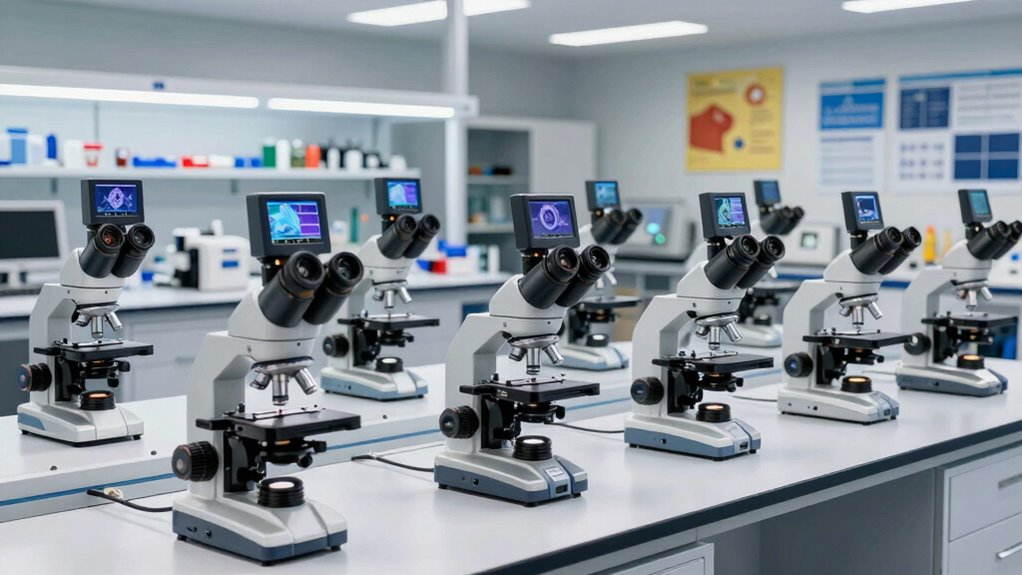

Choosing a compound microscope with a camera for engineering classrooms involves balancing image quality, ease of use, and durability. The best overall pick is the Herwicm Compound Trinocular Microscope, thanks to its research-grade features and high magnification. The SWIFT SW350T stands out as a research-grade option with excellent compatibility and a solid camera system, while the AmScope B120C-E1 offers a more budget-friendly choice without sacrificing essential features. Readers face tradeoffs between price, magnification range, and camera quality, making it critical to weigh the intended use carefully. Continue reading for a comprehensive breakdown of each option to help identify the best fit for your classroom needs.

Prime made for students and young adults
- Fast, free delivery for dorm and study essentials
- Prime Video and Amazon Music included
- Member-only deals
Key Takeaways
- Higher magnification ranges, such as 5000X, are better suited for detailed material analysis in engineering contexts.
- Research-grade models typically include advanced features like dual mechanical stages and high-quality cameras, but come at a higher cost.
- Ease of use and compatibility matter more for classrooms with students or beginners; simpler models often reduce technical frustrations.
- Durability and build quality are essential for classroom environments where equipment is heavily used and moved frequently.
- Camera resolution (measured in MP) significantly impacts the clarity of captured images, influencing the effectiveness of remote analysis or presentations.




| compound microscope with camera for engineering classroom | Lighting | Magnification |
|---|---|---|
| Trinocular Microscope 40X-5000 | LED | — |
| SWIFT Trinocular Compound Micr | — | 40X-2500X |
| Microscope for Adults and Stud | Dual LED | 100X-2000X |
| PalliPartners Compound Microsc | Top and bottom LED | 100X-2000X |
| PalliPartners 40x-2000x Biolog | — | — |
| Compound Microscope | Dual LED | 40x-2500x |
| AmScope B120C-E1 LED Binocular | LED | — |
| Herwicm Compound Trinocular Mi | — | 40x-5000x |
| PalliPartners Compound Binocul | Top & Bottom LED | 100x-2000x |
| AmScope M150C 1000X All-Metal | LED, Cordless | — |
More Details on Our Top Picks
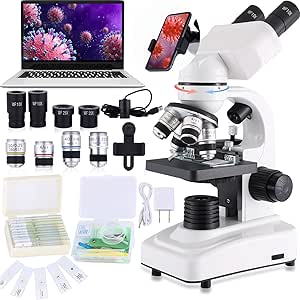
Trinocular Microscope 40X-5000X Magnification Laboratory Grade with Dual Mechanical Stage and HD USB Camera
This microscope stands out for its extensive 40X to 5000X magnification range, offering detailed views suitable for advanced biological and engineering applications. Its professional-grade optical components, including high-resolution achromatic lenses and wide-angle eyepieces, make it ideal for engineering classrooms that require precise imaging of microstructures. Compared with the SWIFT SW350T, this model has a wider magnification span, but it’s bulkier and more complex to set up. The HD USB camera and comprehensive accessory kit add versatility, allowing quick adaptation for various experiments. However, its complexity and size may be less suitable for casual classroom use or less experienced users. This pick makes the most sense for educators and students needing a robust, expandable system for detailed observation and documentation.
Pros:- Magnification range up to 5000X for detailed microstructure analysis
- Wide-angle eyepieces and adjustable focus for comfortable viewing
- Includes comprehensive accessories for diverse experiments
- Professional-grade optical components ensure clarity
Cons:- Complex setup requires some technical knowledge
- Bulky design limits portability
- Higher price point may restrict budget-conscious users
Best for: Engineering classrooms demanding high magnification, detailed observation, and professional-grade features
Not ideal for: Casual hobbyists or beginners seeking a simple, portable microscope without extensive setup
- Magnification Range:40X-5000X
- Eyepieces:WF10x, WF25x
- Objective Lens:195 achromatic
- Lighting:LED
- Stage:Double-layer, mechanical
- Camera:HD USB
- Focusing:Dual coaxial coarse and fine
- Swivel Head:306°
- Included Accessories:Slides, coverslips, Petri dishes, cell phone holder
Our verdict“This microscope suits advanced users and educators needing high magnification and versatile imaging, despite its complexity and size.”
SWIFT Trinocular Compound Microscope SW350T, 40X-2500X Magnification, Siedentopf Head, Research-Grade, Two-Layer Mechanical Stage, 2.0MP Camera, Windows & Mac Compatible
The SWIFT SW350T is designed for serious research and classroom use, offering a solid 40X to 2500X magnification with a high-resolution 2.0MP camera, making it ideal for detailed biological investigations. Its ergonomic Siedentopf head reduces strain during extended observations, and the metal body enhances durability compared to lighter, plastic models. When compared with the PalliPartners 40x-2000x Biological Microscope, it provides a higher camera resolution and a broader magnification range, but at a higher cost and increased weight. Its comprehensive bundle, including slides and software, makes it ready for immediate use in professional or academic settings. Its main tradeoff is that it might be too complex for casual or younger students, favoring experienced users instead.
Pros:- High-resolution 2.0MP digital imaging with professional software
- Wide magnification range suitable for detailed research
- Ergonomic Siedentopf head reduces user fatigue
- Durable metal construction
Cons:- Relatively high cost for basic classroom needs
- Heavy and less portable
- Setup may require some technical familiarity
Best for: Researchers, advanced students, and educators needing durable, high-quality imaging and precise control
Not ideal for: Casual hobbyists or beginners seeking a lightweight, easy-to-operate microscope
- Magnification:40X-2500X
- Camera:2.0MP USB 2.0
- Objectives:4X, 10X, 40X, 100X Oil
- Eyepieces:10X/25X
- Stage:Two-layer mechanical, X-Y coaxial
- Compatibility:Windows and Mac
- Construction:Metal body
Our verdict“Ideal for research-grade observation and digital documentation, best suited for dedicated users with technical proficiency.”
Microscope for Adults and Students, 100X-2000X Metal STEM Microscope Kit
This STEM-focused microscope offers a versatile 100X to 2000X magnification range, making it a strong choice for entry-level students and hobbyists. Its ergonomic design, with rotatable head and adjustable LED lighting, ensures comfortable extended use. Compared to the PalliPartners Compound Microscope for Adults & Students, it provides a similar magnification but emphasizes simplicity and affordability, with fewer advanced features. Its kit, complete with multiple objective lenses, a color filter disc, and accessories, makes it ideal for classroom experiments and hobby exploration. However, it might lack the durability and advanced imaging capabilities required for professional research, and its setup could be challenging for very young or inexperienced users.
Pros:- Wide 100X-2000X magnification range for detailed observation
- Adjustable dual LED lights for clarity
- Ergonomic, user-friendly design
- Complete kit with filters and accessories
Cons:- Requires power or batteries, adding setup complexity
- Limited durability for intensive use
- Setup might be tricky for very young children
Best for: Beginners and STEM educators seeking an affordable, versatile microscope for classroom activities
Not ideal for: Advanced researchers or users requiring high-end imaging or large magnification ranges
- Magnification:100X-2000X
- Objective Lenses:4X, 10X, 40X
- Eyepiece:WF25X
- Lighting:Dual LED
- Power:AC 100V-240V or 3 AA batteries
- Features:Rotatable head, tilting eyepieces, 5-color filter disc
Our verdict“A solid choice for beginners and educational settings, balancing affordability with functional versatility.”
PalliPartners Compound Microscope for Adults & Students
The PalliPartners compound microscope offers a 100X to 2000X magnification range, with a well-rounded set of features including dual LED illumination, a phone adapter, and a comprehensive slide kit. Its design emphasizes safety and ease of use for students, with SGS certification ensuring safety standards are met. Compared with the Microscope for Adults and Students, this model includes a Bluetooth remote and more accessories, making it highly adaptable for classroom and hobbyist applications. Its main tradeoff is that it’s not built for professional research or high-end imaging, and setup may be more complex for very young children. It is best suited for school projects, biological studies, and hobby microscopy.
Pros:- High magnification up to 2000X for detailed studies
- Complete kit with slides, phone adapter, and remote
- Dual LED illumination suitable for opaque and translucent specimens
- SGS safety certification for安心 use
Cons:- Setup and adjustments may be tricky for very young children
- Limited to educational and hobbyist applications
- Not designed for professional research-grade imaging
Best for: Educational settings and hobbyists needing a safe, versatile, and well-equipped microscope
Not ideal for: Advanced research or professional laboratory use requiring high precision
- Magnification:100X-2000X
- Objective Lenses:4X, 10X, 40X
- Eyepiece:WF25X
- Lighting:Top and bottom LED
- Included Slides:28 (10 pre-prepared, 18 blank)
- Accessories:Phone clip, Bluetooth remote
Our verdict“A comprehensive, safe, and adaptable microscope perfect for educational and hobbyist users, with some setup complexity.”
PalliPartners 40x-2000x Biological Compound Trinocular Microscope
This trinocular microscope offers a flexible 40X to 2000X magnification range, suitable for observation of biological specimens and educational use. The inclusion of a 5MP camera allows digital documentation, making it a versatile choice for both classroom teaching and light research. Compared with the Microscope for Adults and Students, it provides a higher magnification limit and a dedicated camera port, but details about build quality are limited, and it may be more complex to operate for beginners. Its dual LED lights and double-layer stage support clear, stable imaging, but it might be overkill for very basic use or young children. This model is best for users needing a balance of biological insight and digital capture capability.
Pros:- Wide 40X-2000X magnification range
- Includes a 5MP camera for digital capture
- Dual LED illumination for versatile lighting
- Double-layer stage for stability
Cons:- Build quality details are limited, affecting durability assumptions
- May be complex for novice users
- No detailed accessory package included
Best for: Educational settings and hobbyists looking for digital imaging and moderate magnification
Not ideal for: Complete beginners or users seeking ultra-portable or simple microscopes
- Magnification Range:40X-2000X
- Camera:5MP digital
- Illumination:Dual LED
- Stage:Double-layer
- Head:Trinocular
- Application:Educational, hobbyist
Our verdict“Suitable for basic biological observation with digital documentation, ideal for learners needing moderate magnification and imaging features.”
Compound Microscope, 40X-2500X Magnification, WF10x and WF25x Eyepieces, Dual LED Lighting, Two-Layer Mechanical Stage
This microscope stands out for its wide magnification range and dual LED lighting, making it highly versatile for engineering students needing detailed imaging. Compared to the AmScope B120C-E1, it offers a broader magnification spectrum but is heavier and bulkier, which can hinder portability. Its two-layer mechanical stage ensures precise movement, essential for delicate specimen work. The dual LED illumination allows for adjustable brightness, improving image clarity, yet the bulky design may be a drawback for frequent handling. This model is ideal for classrooms where detailed observation and stable setup are priorities, but less so where space and portability matter.
Pros:- Wide magnification range for detailed observation
- Adjustable dual LED lighting for optimal illumination
- Two-layer mechanical stage for precise movement
Cons:- Relatively heavy and bulky design
- Requires assembly and adjustment
Best for: Engineering students and educators seeking a versatile, stable microscope for detailed classroom work
Not ideal for: Those needing a lightweight or portable microscope, or for quick, casual demonstrations
- Magnification:40x-2500x
- Eyepieces:WF10x and WF25x
- Lighting:Dual LED
- Stage:Two-layer mechanical stage
- Material:Glass lenses, metal/plastic body
- Model:RM
- Brand:Herwicm
Our verdict“This is a solid choice for engineering classrooms where detailed, stable imaging is essential, and portability is less critical.”
AmScope B120C-E1 LED Binocular Compound Microscope, 40X-2500X
The AmScope B120C-E1 excels for its combination of high-quality optics and integrated digital imaging, making it ideal for engineering students who want to analyze specimens both visually and digitally. Unlike the Herwicm model, it includes a 1.0 MP USB camera, enabling straightforward image capture and sharing, though it requires a PC for analysis, adding to setup complexity. Its bright LED illumination ensures clear images at all magnifications, and the binocular head offers comfortable viewing for extended periods. However, the higher price and the need for a computer mean it suits more dedicated users rather than casual learners.
Pros:- Wide magnification range suitable for detailed work
- Bright, daylight-balanced LED illumination
- Includes a 1.0 MP USB camera for digital capture and analysis
Cons:- Requires a PC for image processing
- More expensive than basic models
- Setup can be complex for beginners
Best for: Students and professionals needing high-quality imaging and digital analysis capabilities
Not ideal for: Classrooms or users with limited budgets or no available computers for image processing
- Magnification Range:40x-2500x
- Lighting:LED
- Camera:1.0 MP USB
- Head Type:Binocular
- Suitable For:Educational, Laboratory, Professional
Our verdict“This microscope is best suited for engineering environments where digital imaging and detailed observation are both needed, despite its higher cost and setup requirements.”
Herwicm Compound Trinocular Microscope 40X-5000X Magnification, Research Grade Professional Microscope with Mechanical Stage and USB Video Camera
This professional-grade trinocular microscope offers an expansive 40X to 5000X magnification, making it suitable for advanced engineering research. Its large mechanical stage and coaxial focus give precise control, comparable to the AmScope M150C, but with a higher magnification ceiling that supports detailed microscopic analysis. The triocular head allows easy camera attachment, although the camera itself is not included, adding to the initial investment. Its complex setup and weight make it less ideal for casual classroom use, but perfect where high magnification and image quality are critical. This model is more aligned with research labs than typical classrooms.
Pros:- High magnification up to 5000x for detailed analysis
- Large, adjustable mechanical stage for ease of specimen manipulation
- Triocular head for easy camera attachment and recording
Cons:- Camera not included, additional purchase needed
- Relatively heavy and complex setup
- More expensive and requires technical knowledge
Best for: Advanced students and researchers requiring high magnification and professional imaging capabilities
Not ideal for: Basic classroom settings or casual hobbyists due to its complexity and weight
- Magnification:40x-5000x
- Objective Lenses:195 flat-field achromatic
- Viewing System:Binocular with triocular head
- Mechanical Stage:Double-layer, adjustable
- Illumination:LED
- Focus Adjustment:Coaxial coarse and fine focus
Our verdict“Best suited for research and high-end educational applications where maximum magnification and image quality are prioritized over portability or simplicity.”
PalliPartners Compound Binocular Microscope for Adults, Professionals & Kids
The PalliPartners microscope offers a flexible magnification range from 100X to 2000X, making it suitable for both biological research and classroom demonstrations. Its kit includes slides, dissecting tools, and a phone clip, providing a comprehensive setup for hands-on learning. Compared with the AmScope M150C, it offers more versatility with accessories for different experiments, but the complexity of assembly and the higher price may be challenging for very young students or casual hobbyists. Its dual LED illumination is ideal for examining biological specimens and solid objects alike. This model strikes a balance between functionality and educational flexibility.
Pros:- Versatile magnification range suitable for multiple applications
- Includes a comprehensive kit with slides and dissecting tools
- Dual LED illumination for biological and solid object viewing
Cons:- May be complex for very young children without supervision
- Higher price point compared to basic models
- Requires assembly and setup
Best for: Educational institutions and hobbyists seeking a multi-purpose, complete microscope kit
Not ideal for: Very young children or users seeking a simple, plug-and-play device
- Magnification:100x-2000x
- Objective Lenses:4x, 10x, 40x
- Eyepiece:WF25x
- Lighting:Top & Bottom LED
- Includes:28 slides, dissecting tools, phone clip, Bluetooth remote
- Safety Certification:SGS
Our verdict“This microscope provides a flexible, all-in-one solution for educational settings and hobbyists who want more than basic features.”
AmScope M150C 1000X All-Metal Optical Glass Lenses Cordless LED Microscope
The AmScope M150C delivers essential features for educational purposes at a budget-friendly price. Its 40X to 1000X magnification range covers most basic classroom needs, and the all-metal construction ensures durability. Unlike more advanced models like the Herwicm, it lacks digital imaging but compensates with cordless LED illumination, offering flexible positioning. While it doesn’t support digital capture out of the box, its simplicity and affordability make it suitable for introductory courses or casual use. The monocular head and limited magnification ceiling mean it’s less suited for detailed research but perfect for foundational learning.
Pros:- Wide magnification range suitable for general biological observations
- All-metal construction ensures durability
- Cordless LED for flexible setup
Cons:- No digital imaging capabilities included
- Limited to basic features without advanced options
- Battery-powered, may need frequent replacements
Best for: Elementary and high school students or beginners needing a reliable, simple microscope without digital imaging
Not ideal for: Advanced users or those requiring integrated digital capture and high magnification above 1000X
- Magnification Range:40x-1000x
- Optical Lenses:All-metal optical glass
- Construction:All-metal
- Lighting:LED, Cordless
- Power Source:AA batteries or AC adapter
Our verdict“This model is ideal for beginners and schools on a budget, focusing on core optical performance over advanced features.”

How We Picked
The products were evaluated based on a combination of performance, build quality, camera capabilities, ease of use, and value for money. Priority was given to models that offer clear optical clarity, reliable mechanical stages, and compatibility with common operating systems. We also considered the versatility of magnification ranges and the quality of integrated or compatible cameras, since these are vital for engineering applications. The ranking reflects a balance between professional-grade features and affordability, ensuring options suit various classroom budgets and technical levels.| compound microscope with camera for engineering classroom | Lighting |
|---|---|
| Trinocular Microscope 40X-5000 | LED |
| SWIFT Trinocular Compound Micr | — |
| Microscope for Adults and Stud | Dual LED |
| PalliPartners Compound Microsc | Top and bottom LED |
| PalliPartners 40x-2000x Biolog | — |
| Compound Microscope | Dual LED |
| AmScope B120C-E1 LED Binocular | LED |
| Herwicm Compound Trinocular Mi | — |
| PalliPartners Compound Binocul | Top & Bottom LED |
| AmScope M150C 1000X All-Metal | LED, Cordless |
Factors to Consider When Choosing Compound Microscope With Camera For Engineering Classrooms
When selecting a compound microscope with a camera for engineering classrooms, it’s important to consider several factors that impact usability and long-term value. Understanding these aspects helps avoid common pitfalls, such as overspending on features that won’t be used or choosing models that are too complex for students. A thoughtful approach ensures the equipment enhances learning and supports detailed analysis without creating unnecessary complications.Magnification and Optical Quality
Magnification range is a key factor—look for options that offer at least 100X to 2500X, which suits most engineering applications. Higher magnification allows detailed examination of materials, but it often comes with tradeoffs in image clarity and ease of focus. Optical quality, including lens clarity and illumination, directly affects image sharpness and accuracy. Investing in good optics ensures students can clearly see fine details essential for engineering analysis.
Camera Resolution and Compatibility
The camera’s resolution, measured in megapixels, impacts the detail captured in images. For classroom use, 2.0MP or higher typically provides clear, usable images for documentation and remote sharing. Compatibility with Windows and Mac is essential, especially if the classroom uses diverse systems. Consider models with user-friendly software that simplifies image capture and analysis, which reduces technical difficulties during lessons.
Build Quality and Durability
Classroom equipment faces frequent handling, so durability is a must. Metal frames and robust mechanical stages prevent damage and ensure precise movement over time. Cheaper plastic components may save money initially but often fail under regular use. Look for models with solid construction that can withstand the rigors of a busy engineering classroom environment.
Ease of Use and Ergonomics
Ease of operation, including intuitive focus controls, adjustable lighting, and comfortable eyepiece design, enhances the learning experience. Trinocular models with adjustable head angles reduce neck strain and improve viewing comfort for extended periods. Simple interfaces for camera control are also advantageous, especially for students and educators new to microscopy technology.
Price and Value
Balancing cost with features is critical. While high-end models offer professional features, they may be unnecessary for introductory or general classroom use. Conversely, very inexpensive microscopes might lack the optical quality or camera resolution needed for meaningful engineering analysis. Aim for a model that provides a good mix of performance and affordability, ensuring it remains a valuable investment over years of use.
Frequently Asked Questions
Can I use a standard microscope camera with any microscope?
While many cameras are compatible with standard microscopes, it’s important to check the camera’s mounting system and software compatibility. Some cameras require specific adapters or mounts, and software that works across different systems can vary. Choosing a camera designed for microscopy, with universal mounting options and compatible drivers, reduces setup headaches and ensures reliable image capture.
What magnification range is best for engineering classrooms?
A magnification range of roughly 100X to 2500X generally covers most engineering applications, allowing students to examine everything from basic materials to microstructures. Higher magnification, like 5000X, is useful for specialized analysis but may be unnecessary for typical classroom tasks. Focus on models that offer a balance between magnification and optical clarity to maximize educational value.
Is a trinocular microscope worth the extra cost for classrooms?
Trinocular microscopes, which include a dedicated camera port, are often worth the investment if remote sharing, documentation, or image analysis is a priority. They allow easy connection to cameras without switching eyepieces, simplifying workflow for students and teachers. However, if budget constraints are tight, binocular models with compatible cameras can also fulfill most educational needs effectively.
How important is mechanical stage quality in classroom microscopes?
The mechanical stage’s quality directly impacts precision and ease of use, especially when examining small or detailed features. Two-layer mechanical stages with smooth movement reduce frustration and improve accuracy during analysis. For engineering purposes, a sturdy, well-made stage helps students perform precise measurements and detailed work, making it a worthwhile feature to prioritize.
Should I prioritize higher camera resolution over optical features?
Both are important, but optical quality often has a more immediate impact on usability and image clarity during live viewing. A high-resolution camera enhances image quality for documentation, but if the optical system is poor, the captured images won’t be sharp or detailed, defeating the purpose. Striking a balance between good optics and camera resolution ensures the best overall experience for engineering analysis.
Conclusion
For those seeking the best all-around performer, the Herwicm Compound Trinocular Microscope offers professional-grade features ideal for serious engineering coursework. Budget-conscious educators or students will appreciate the AmScope B120C-E1 for its solid optical performance at a lower price point. Beginners or casual users should consider models like the Microscope for Adults and Students for straightforward operation without sacrificing essential features. For advanced needs, such as detailed microstructure analysis, the research-grade options like the SWIFT SW350T provide an excellent balance of quality and versatility. Ultimately, your choice depends on your specific classroom requirements, budget, and level of expertise.
Halloween Picks
halloween
As an affiliate, we earn on qualifying purchases.