Searching for the best 3D scanner in 2026? The market offers a wide array of options, from high-precision professional devices to compact, portable models suitable for hobbyists. The Creality CR-Scan Raptor stands out as the overall top pick for its combination of speed, accuracy, and versatility. For those prioritizing portability, the Revopoint POP 4 offers impressive AI features and Wi-Fi connectivity. Meanwhile, the Creality CR-Ferret SE excels in producing detailed color scans for full-body and object reconstruction. Navigating these choices involves tradeoffs between accuracy, usability, and price—keep reading for a detailed breakdown of each option to find the best fit for your needs.
Key Takeaways
- High accuracy and speed are the main differentiators for professional-grade 3D scanners like the Creality CR-Scan Raptor and Seal Lite.
- Portability and ease of use are prioritized by models like Revopoint POP 4 and Creality CR-Ferret SE, making them ideal for on-the-go scanning.
- Color fidelity and surface detail are critical for applications involving visual reconstructions, where scanners like the CR-Ferret SE excel.
- Entry-level options such as the 3DMakerpro Fox provide decent performance at lower costs but may sacrifice speed and precision.
- Connectivity features like Wi-Fi and AI-powered segmentation significantly enhance usability, especially for complex scanning tasks.
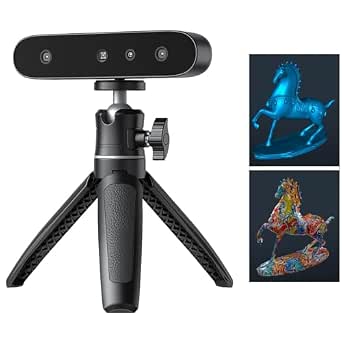


| 3d scanner | Accuracy | Object Size Range |
|---|---|---|
| Creality CR-Ferret SE 3D Scann | 0.1mm | — |
| Creality Pika Portable 3D Scan | 0.03mm | — |
| Creality CR-Scan Raptor 3D Sca | 0.02mm | 5×5×5 mm to 2000×2000×2000 mm |
| Revopoint MetroY Ultra 3D Scan | 0.01mm | 5×5×5mm to 2000×2000×2000mm |
| Revopoint POP 4 3D Scanner | 0.03mm | — |
| 3DMakerpro Fox 3D Scanner | 0.07mm | 40mm to 1200mm |
| Creality CR-Scan Ferret Pro 3D | 0.1mm | — |
| 3DMakerpro Fox Entry-Level Med | 0.07mm | — |
| Creality 3D Scanner CR-Scan Fe | 0.1mm | 50mm to 2000mm |
| 3DMakerpro Seal Lite 3D Scanne | 0.02mm | 10-300mm |
More Details on Our Top Picks
Creality CR-Ferret SE 3D Scanner for 3D Printing, Anti-Shake, 0.1mm Precision, 30FPS, Full-Color, Desktop 3D Scanner for Body, Hair, Black Metal, Non-Reflective Objects
The Creality CR-Ferret SE stands out for delivering high precision at 0.1mm accuracy combined with rapid 30FPS scanning, making it ideal for capturing intricate details on medium to large objects. Its ability to scan black and metal surfaces without spray, thanks to effective technology, sets it apart from more basic models like the 3DMakerpro Fox, which struggles with reflective surfaces. The vivid color capture enhances texture detail, but this scanner’s setup and operation can be complex for beginners, and its object size range (150mm to 2000mm) limits smaller or very large objects outside that window. Overall, this scanner makes the most sense for users who need detailed, quick, and color-rich scans of non-reflective items in a desktop setting, accepting some learning curve.
Pros:- High accuracy of 0.1mm and fast 30FPS speed
- Effective scanning of black and metallic surfaces without spray
- Vivid color capture for realistic textures
- Anti-shake technology for smooth scans
Cons:- Complex setup may intimidate beginners
- Limited to objects within specific size range
- Requires proper calibration for best results
Best for: Intermediate to advanced hobbyists and professionals needing detailed scans of medium to large, non-reflective objects
Not ideal for: Complete beginners or those scanning very small or extremely large objects outside the specified range
- Accuracy:0.1mm
- Resolution:0.16mm
- Scanning Speed:30FPS
- Color Camera Resolution:2MP
- Scanning Range:150mm to 2000mm
- Single Capture Range:560*820mm
Our verdict“This scanner suits experienced users seeking precise, colorful, and fast medium-sized object scans with versatile material compatibility.”
Creality Pika Portable 3D Scanner, 0.03mm High Accuracy, Dual-Mode Blue Laser & NIR Structured Light, AI-Powered Body Completion & Retexturing, Wi-Fi 6, 3″ Touchscreen
The Creality Pika offers a remarkable 0.03mm accuracy, leveraging dual-mode blue laser and NIR structured light for versatile, detailed scans from tiny objects to full-body captures. Its AI-powered features for body completion and retexturing, combined with Wi-Fi 6 connectivity and a 3-inch touchscreen, make it highly portable and user-friendly. Compared to the larger, desktop-focused CR-Ferret SE, Pika emphasizes mobility and outdoor usability, though its advanced features come at a higher cost and depend on compatible software and devices. Its compact size and wireless operation make it perfect for professionals or hobbyists who need flexibility and high detail in diverse environments, but it may be overkill if only scanning small objects indoors.
Pros:- Exceptional 0.03mm accuracy for detailed models
- Dual-mode laser and NIR structured light for versatility
- AI-powered body completion and retexturing features
- Wireless, portable with outdoor scanning support
Cons:- Higher price point for advanced features
- Requires compatible devices and software
- Battery life may limit extended outdoor use
Best for: Professionals or serious hobbyists needing portable, high-precision scans, especially for body modeling and outdoor applications
Not ideal for: Casual users or those with limited budgets who only need basic, indoor object scanning
- Accuracy:0.03mm
- Resolution:0.1mm
- Frame Rate:110 FPS
- Size:100x60x35mm
- Connectivity:Wi-Fi 6
- Supported Formats:STL, OBJ, PLY, ASC
Our verdict“This scanner excels for mobile, high-precision body and object scans, suitable for professional or advanced hobbyist use outside the lab.”
Creality CR-Scan Raptor 3D Scanner, 60fps Blue Laser & NIR, 0.02mm Accuracy, 24-Bit Color, Scans 5-2000mm Objects, Anti-Shake Tracking for Windows & macOS
The Creality CR-Scan Raptor offers an impressive 0.02mm accuracy with dual blue laser and NIR modes, making it suitable for demanding applications from small detailed parts to large objects up to 2000mm. Its 60fps speed in blue laser mode allows for quick, high-detail scans, while the 24-bit color depth captures rich textures. Compared to the Pika, Raptor emphasizes versatility with a broader object size range and high-speed performance, though it demands a more powerful PC and can be heavier at over 8 pounds. Its complex setup may challenge newcomers, but professionals will appreciate the precision and multi-mode flexibility for industrial or creative projects.
Pros:- Exceptional 0.02mm accuracy for detailed modeling
- Fast 60fps scanning speed for efficiency
- Dual blue laser and NIR modes for versatility
- Rich 24-bit color capture
Cons:- Requires a high-performance PC for best results
- Relatively heavy and bulky at over 8 pounds
- Complex calibration process
Best for: Industrial professionals and advanced hobbyists needing versatile, high-precision scans of large and small objects
Not ideal for: Beginners or casual users seeking simple, plug-and-play solutions due to its setup complexity
- Accuracy:0.02mm
- Color Depth:24-bit
- Scanning Speed:60fps
- Object Size Range:5×5×5 mm to 2000×2000×2000 mm
- Compatibility:Windows, macOS
- Laser Technology:Blue laser and NIR
Our verdict“This scanner is best suited for demanding applications where precision and versatility across object sizes are priorities, accepting some setup complexity.”
Revopoint MetroY Ultra 3D Scanner, Up to 90 FPS, for 3D Printing
The Revopoint MetroY Ultra offers an impressive combination of 0.01mm single-frame accuracy and rapid 90FPS capture speed, making it suitable for industrial inspection, reverse engineering, and 3D printing. Its ability to scan shiny, metallic, and dark surfaces without spray mirrors the capabilities of the higher-end POP 4 but with a focus on speed and versatility. Unlike the CR-Ferret SE, MetroY Ultra emphasizes larger object sizes and outdoor usability, supported by Wi-Fi 6 and a 2.5-hour battery life. Its feature set caters well to professionals needing quick, accurate results in challenging environments, though it requires compatible hardware and software to unlock full potential.
Pros:- Exceptional 0.01mm accuracy for detailed work
- High scanning speed of 90 FPS for quick results
- No-spray scanning for reflective surfaces
- Wireless operation with Wi-Fi 6
Cons:- Requires compatible hardware and software setup
- Battery life limits extended outdoor use
- Relatively complex operation for newcomers
Best for: Industrial users and professionals requiring fast, high-accuracy scans of reflective or shiny surfaces in field settings
Not ideal for: Entry-level hobbyists or casual users who do not need such high speed or precision, or lack compatible hardware
- Accuracy:0.01mm
- Scanning Speed:90 FPS
- Surface Compatibility:Dark, shiny, metallic
- Object Size Range:5×5×5mm to 2000×2000×2000mm
- Wireless:Wi-Fi 6
- Battery Life:2.5 hours
Our verdict“This scanner is tailored for professionals demanding rapid, precise scans of challenging surfaces and larger objects in various environments.”
Revopoint POP 4 3D Scanner, AI Segmentation, for 3D Printing, Premium
The Revopoint POP 4 combines industrial-grade accuracy of 0.03mm with rapid scanning at up to 105 fps, supporting large objects from tiny parts to full-scale scenes up to 2 meters in size. Its AI segmentation and all-weather outdoor capability, including use in bright sunlight, differentiate it from earlier models like the CR-Ferret SE, which are more indoor-focused. The high frame rate and large point cloud speed make it suitable for construction, reverse engineering, and detailed 3D printing workflows, with wireless connectivity simplifying fieldwork. However, some advanced features need paid software, and Windows-only support can limit flexibility for some users.
Pros:- High accuracy of 0.03mm suitable for detailed models
- Fast frame rate for efficient large-area scanning
- AI segmentation for complex object differentiation
- All-weather outdoor performance
Cons:- Limited software compatibility (Windows only)
- Paid software options for some features
- Requires compatible hardware for optimal results
Best for: Construction, fieldwork, and professionals needing robust outdoor scanning with high speed and accuracy
Not ideal for: Casual users or those primarily working indoors without the need for large-scale outdoor capabilities
- Accuracy:0.03mm
- Frame Rate:up to 105 fps
- Range:10x10x10mm to 2x2x2m
- Point Cloud Speed:5,000,000 points/sec
- Battery Life:up to 4 hours
- Connectivity:Wi-Fi 6
Our verdict“This scanner is best suited for professional outdoor and large-scale applications where speed, accuracy, and weather resilience are essential, accepting some software limitations.”
3DMakerpro Fox 3D Scanner, 0.07mm Accuracy, Entry-Level for Small to Large Objects
The 3DMakerpro Fox stands out for its impressive 0.07mm accuracy, which makes it a strong choice for detailed 3D printing, prototyping, and educational projects. Compared with the 3DMakerpro Seal Lite, which offers even higher precision of 0.02mm, the Fox provides a broader object size range (40mm to 1200mm), making it more adaptable for different project sizes. Its markerless tracking and anti-shake technology simplify setup, but it does demand some familiarity with CAD or 3D modeling to reach optimal results. The need for a capable PC with a dedicated GPU is a common requirement in this class, and the learning curve can be steep for beginners. Overall, this scanner balances precision and versatility, but patience and technical skills are necessary to fully utilize its capabilities.
Pros:- High accuracy of 0.07mm for detailed scans
- Markerless tracking and anti-shake technology simplify setup
- Supports multiple export formats for versatile applications
- Suitable for a wide object size range from small to medium
Cons:- Requires some CAD/3D experience and learning curve
- Performance depends heavily on a capable PC with a dedicated GPU
- Budget-friendly but may need patience to achieve high-quality results
Best for: Professionals and hobbyists who want a reliable, high-accuracy scanner for a variety of object sizes and are comfortable with some technical setup.
Not ideal for: Absolute beginners or users with limited technical skills, as it requires learning and a powerful PC for best results.
- Accuracy:0.07mm
- Object Size Range:40mm to 1200mm
- Optimal Working Distance:150–400mm
- Software:JMStudio
- Supported Export Formats:OBJ, STL, PLY, ASC
- Power Supply:65W Charger
Our verdict“A well-rounded choice for users needing precise, versatile scanning with a willingness to learn the software and hardware requirements.”
Creality CR-Scan Ferret Pro 3D Scanner for 3D Printing with Wireless Handheld Design
The Creality CR-Scan Ferret Pro offers a compelling combination of accuracy (0.1mm) and speed (30FPS), making it ideal for quick, handheld scanning tasks. Its wireless WiFi6 transmission stands out, providing rapid data transfer and enabling outdoor scans—something the 3DMakerpro Fox lacks. While its accuracy is slightly lower than the Fox’s, the convenience of portability and full-color, high-resolution scans compensate for many indoor and outdoor applications. However, reflective or dark surfaces can disrupt the scan quality, and it demands compatible devices with specific hardware. This device excels for users who prioritize mobility and ease of use over ultra-high precision, especially in dynamic environments.
Pros:- Wireless WiFi6 transmission for fast data transfer
- High accuracy of 0.1mm with full-color detail
- Portable design suitable for outdoor or on-the-move scanning
- Supports multiple file formats and device compatibility
Cons:- Performance affected by reflective or dark surfaces
- Requires compatible hardware and may need software updates
- Slightly lower accuracy compared to stationary high-end scanners
Best for: Enthusiasts and professionals needing portable scanning solutions for outdoor or on-location projects with decent accuracy.
Not ideal for: Users requiring ultra-fine detail or working with highly reflective or dark objects, due to susceptibility to surface issues.
- Accuracy:0.1mm
- Resolution:0.16mm
- Frame Rate:30FPS
- Wireless Technology:WiFi6
- Supported File Formats:OBJ, STL, PLY
- Compatibility:Windows, Mac, Android, iOS
Our verdict“A strong choice for mobile scanning needs where convenience and decent detail outweigh ultra-high precision.”
3DMakerpro Fox Entry-Level Medium-Format 3D Scanner for 3D Printing
The 3DMakerpro Fox entry-level model caters to hobbyists and newcomers with medium-format scanning capabilities and high precision of 0.07mm. Its markerless AI visual tracking makes scanning easier for those without extensive experience, and the integrated JMStudio software streamlines editing and optimization. While it offers impressive precision for an entry-level device, it’s limited to objects within a medium size range, making it less suitable for larger projects. It lacks advanced features found in more professional scanners, but this tradeoff makes it more accessible for beginners seeking high-quality results without complexity. This model is an excellent starting point for hobbyists eager to learn 3D scanning and printing workflows.
Pros:- High precision of 0.07mm suitable for detailed hobby projects
- Markerless AI tracking simplifies scanning process
- Integrated software for seamless editing and optimization
- User-friendly for beginners and hobbyists
Cons:- Limited to medium-sized objects, not large projects
- Performance may vary with rapid or complex movements
- Lacks advanced features found in professional scanners
Best for: Beginners, hobbyists, and students starting in 3D printing and modeling who need a straightforward, high-precision device for medium-sized objects.
Not ideal for: Users working with large objects or requiring advanced scanning features, as it’s designed for entry-level use and medium objects only.
- Accuracy:0.07mm
- Resolution:0.10mm
- Software:JMStudio
- Tracking:Markerless AI
Our verdict“An accessible, high-precision scanner perfect for newcomers and hobbyists focusing on medium-sized objects.”
Creality 3D Scanner CR-Scan Ferret Pro for 3D Printing, Handheld Wireless Scanner with Full-Color and 0.1mm Accuracy
The Creality CR-Scan Ferret Pro combines portability with high-quality color scanning, delivering 0.1mm accuracy and full-color textures, making it ideal for enthusiasts and on-site applications. Its lightweight design (105g) and included accessories like a tripod and power bank make it excellent for outdoor or mobile projects. Compared to the 3DMakerpro Fox, which is more stationary and suited for detailed medium-sized objects, the Ferret Pro emphasizes ease of use and color capture, though it sacrifices some detail resolution. Dark or reflective surfaces can hinder scan quality, and setup requires compatible hardware. This device is perfect for users who want quick, colorful models in the field or at events, with less concern for ultra-fine detail.
Pros:- Lightweight, portable design for on-the-go use
- Wireless with fast Wi-Fi 6 connectivity
- Full-color, high-quality 3D models at 0.1mm accuracy
- Includes accessories for varied scanning scenarios
Cons:- Less suitable for very small or highly detailed objects
- Surface issues with reflective or dark materials
- Dependent on compatible hardware and software setup
Best for: Beginners and DIY creators who want portable, colorful scans without extensive setup or post-processing.
Not ideal for: Users needing extremely high detail or scanning very small or highly reflective objects, due to surface limitations and resolution constraints.
- Accuracy:0.1mm
- Color Depth:24-bit
- Object Size Range:50mm to 2000mm
- Weight:105g
- Connectivity:Wi-Fi 6
- Included Accessories:WiFi box, tripod, power bank, phone holder, carrying case
Our verdict“Ideal for users seeking quick, full-color 3D scans in portable form, especially for outdoor or mobile applications.”
3DMakerpro Seal Lite 3D Scanner – Small-Format, Blue LED Light Source, Up to 0.02mm Accuracy
The 3DMakerpro Seal Lite is tailored for users who need highly detailed scans of small items, achieving an exceptional accuracy of 0.02mm with a blue LED light source. Its small object size range (10-300mm) makes it ideal for jewelry, miniature models, or intricate parts. The mono texture scanning and anti-shake features ensure stable results, even during handheld operation. Compared to larger, more versatile scanners like the Fox, the Seal Lite is specialized for tiny, detailed objects, but it cannot handle larger items or fast movements effectively. It requires a powerful PC and a learning curve, making it less suitable for casual users or those working with bigger projects.
Pros:- Extremely high accuracy of 0.02mm for tiny details
- Supports mono texture scanning with stable features
- Compatible with Windows and macOS
- Designed for small object scanning
Cons:- Limited to small objects, not suitable for larger projects
- Requires a powerful PC and learning curve
- Indoor use only due to light source constraints
Best for: Professionals or hobbyists needing ultra-detailed scans of small objects like jewelry or miniatures, with a focus on precision and stability.
Not ideal for: Scanning larger objects or fast-moving items, as its size and speed limitations restrict broader applications.
- Light Source:Blue LED
- Accuracy:0.02mm
- Object Size Range:10-300mm
- Scanning Frame Rate:10fps
- Supported Formats:OBJ, STL, PLY, ASC
- Compatibility:Windows, macOS
Our verdict“A specialized scanner for tiny, highly detailed objects where maximum precision is paramount.”
How We Picked
Our evaluation focused on key factors that matter to different user needs: scanning accuracy, speed, usability, build quality, and value. We prioritized devices that deliver consistent results across a range of object sizes and surface types, assessing how well they handle reflective or textured surfaces. Ease of setup and interface usability also played a role, along with connectivity options like Wi-Fi and Bluetooth. Price-to-performance ratios helped us distinguish between budget-friendly options and premium models. Ultimately, the ranking reflects a balance between professional-grade features and accessible usability for hobbyists and newcomers alike.
Factors to Consider When Choosing 3d Scanner
Choosing the right 3D scanner depends on understanding your specific needs and how each device’s features align with those. Beyond the specifications, consider the environment you’ll scan in, the objects’ surfaces, and your budget. Making mistakes such as overpaying for unnecessary high precision or buying a scanner that’s too complex for your skill level can hinder your experience. Carefully weighing these factors will help you find a device that offers the best value while meeting your expectations.
Accuracy and Resolution
The level of detail a scanner can capture is fundamental, especially if your projects demand precise measurements or high-quality models. Higher accuracy models like the CR-Scan Raptor and Seal Lite deliver fine details, but often come with a higher price tag. For casual or hobbyist use, mid-range options like the 3DMakerpro Fox can suffice, but they may not capture surface intricacies or small features reliably. Consider your intended application—if you need precise prototypes or detailed visual models, investing in a high-accuracy scanner makes sense.
Speed and Workflow
Speed matters when scanning larger objects or multiple items regularly. Devices like the Revopoint POP 4 and CR-Scan Raptor offer fast capture rates, reducing time spent on each scan. Slow scanners may require multiple passes and extensive post-processing, which can be frustrating for projects with tight deadlines. If efficiency is a priority, look for models with higher frame rates and quick processing capabilities. However, remember that faster scans sometimes come at the expense of lower resolution, so balance speed with the level of detail needed.
Usability and Interface
An intuitive interface and straightforward setup can dramatically improve your scanning experience, especially if you’re new to 3D scanning. Wireless connectivity, touchscreens, and AI features simplify workflows, reducing the learning curve. Models like the Creality CR-Ferret SE with full-color capture or the CR-Scan Ferret Pro with wireless design cater to users who prefer minimal fuss. Be cautious with overly complex interfaces or proprietary software that might limit flexibility or require steep learning curves—clarity and compatibility are key.
Surface Compatibility and Post-Processing
Some surfaces pose challenges for 3D scanners, such as reflective or transparent materials. Many high-end models include features like structured light or anti-shake tracking to mitigate these issues, but no scanner is completely foolproof. Post-processing software can help improve scan quality, but compatibility and ease of editing are important. If your objects vary widely in surface properties, look for scanners with AI segmentation or multi-mode operation that can adapt to different conditions.
Price and Future-Proofing
While budget options may seem attractive initially, they can fall short over time if your needs evolve. Investing in a mid-range or premium scanner ensures better longevity, software updates, and support. Consider what features are truly necessary now, but also think about potential future uses—upgrading later can be costly. Balance your current budget with the potential for growth in your projects to avoid outgrowing your device quickly.
Frequently Asked Questions
Can a 3D scanner accurately capture reflective surfaces?
Reflective surfaces are a common challenge for many 3D scanners because they can distort the scanning process. Some advanced models include anti-shake or multi-mode scanning that can help, but often, applying a matte spray or coating to reflective objects yields better results. For highly reflective or transparent objects, specialized scanners with structured light or laser technologies may perform better. Ultimately, understanding surface limitations and preparing objects accordingly can improve scan quality significantly.
Is a portable 3D scanner suitable for detailed industrial work?
Portable 3D scanners can be quite capable for many industrial applications, especially when mobility is a priority. However, they often trade off some accuracy and resolution compared to fixed, high-end models. Devices like the Revopoint POP 4 and CR-Ferret SE are suitable for on-site scanning of larger objects or environments but might not capture ultra-fine details needed for precision engineering. For critical industrial tasks, investing in a dedicated, professional-grade scanner might be necessary, but portable options are increasingly capable for many field applications.
How important is software compatibility when choosing a 3D scanner?
Software compatibility is vital because it impacts how easily you can process, edit, and utilize your scans. Some scanners come with proprietary software, which may limit flexibility or require ongoing subscriptions. Others support popular CAD or 3D modeling platforms, offering greater interoperability. A scanner with robust, user-friendly software and regular updates can save significant time and frustration, ensuring your workflow remains smooth and adaptable to different project needs.
What should I consider if I want to scan large objects?
Scanning large objects requires a scanner with a wide field of view, high accuracy, and fast capture speeds to minimize the time and effort involved. Handheld or portable models like the CR-Scan Raptor or CR-Ferret Pro are designed with these needs in mind, often featuring multiple scan modes to handle different sizes. Keep in mind that larger objects may need multiple scans stitched together, so software with good alignment and editing tools is essential. Additionally, ensure your workspace is suitable for accommodating large scans without obstructions.
Is it worth paying more for higher accuracy models?
Higher accuracy models generally provide more detailed and precise scans, which are essential for professional applications like engineering, reverse engineering, or detailed visualizations. However, they also come with higher costs and often require more expertise to operate effectively. If your work depends on exact measurements or detailed surface features, investing in a high-accuracy scanner makes sense. Conversely, for casual use or prototyping, mid-range options often deliver sufficient results at a lower price point.
Conclusion
For those seeking the best overall performance, the Creality CR-Scan Raptor offers a balanced mix of speed, accuracy, and versatility suitable for professionals. Hobbyists or small business owners who prioritize portability and ease of use might find the Revopoint POP 4 to be the best value, thanks to its AI features and Wi-Fi connectivity. If budget is your primary concern, entry-level options like the 3DMakerpro Fox can deliver decent results without a hefty price tag. Newcomers should aim for models with intuitive interfaces and good software support, while advanced users should consider high-end devices for maximum detail. Tailoring your choice to your specific needs ensures you get the best scanner for your budget and projects.