
Among these digital microscopes for students, I’d choose the TOMLOV DM301 Max as the best overall fit for learners who want a large screen and flexible specimen viewing. The AmScope B120 Series is a stronger match for students studying prepared slides, while the BMDSAE handheld microscope suits younger beginners who benefit from a simple, portable design. The main choice is between an easy-to-view digital screen and a compound microscope built for traditional slide work; higher magnification claims alone do not settle that question. I also weigh controls, stability, camera use, and whether the microscope fits school assignments. Read on for the full breakdown and a pick for each kind of student.

Prime made for students and young adults
- Fast, free delivery for dorm and study essentials
- Prime Video and Amazon Music included
- Member-only deals
Key Takeaways
- The DM301 Max leads for all-around screen-based learning: its 7-inch display makes shared viewing easier than the smaller-screen options, though it is not a substitute for a compound microscope in slide-focused coursework.
- Compound models serve a different classroom task: the AmScope B120 and Woehrsh are better aligned with prepared slides and structured lab work than the coin and inspection scopes.
- Screen size and specimen type matter more than headline magnification: a large display helps groups observe together, while usable focus and suitable optics matter most for seeing slide details.
- Coin microscopes are specialized, not general-purpose school scopes: the TOMLOV DM4W Max adds an integrated weighing scale, and the Elikliv EDM4 offers a smaller-display coin-inspection setup.
- Beginner-friendly portability has a tradeoff: the BMDSAE handheld model is easier to carry and approach, but its small screen and handheld format are less suited to careful, repeatable lab observations.
| TOMLOV DM301 Max Digital Microscope |  | Best Overall for Shared Student Viewing | Display: 7-inch IPS screen | Magnification: Up to 1200X | Image capture: 8MP | VIEW LATEST PRICE | See Our Full Breakdown |
| TOMLOV DM4W Max Digital Coin Microscope with Weighing Scale, 7-Inch Screen |  | Best for Coin and Specimen Projects | Screen: 7 inches; 800 × 480 resolution | Video resolution: 2K | Photo resolution: Up to 5440 × 3060 (16MP) | VIEW LATEST PRICE | See Our Full Breakdown |
| OOZSTAR Digital Microscope with 4.3-Inch Display and 5 MP Camera |  | Best for Beginner Lab Kits | Display: 4.3-inch | Camera: 5MP | Listed maximum magnification: 2500x | VIEW LATEST PRICE | See Our Full Breakdown |
| Elikliv EDM4 Digital Coin Microscope with 4.3-Inch Display |  | Best for Computer-Connected Inspections | Display: 4.3-inch LCD | Display resolution: 720p HD | Magnification: Up to 1000x; actual magnification varies | VIEW LATEST PRICE | See Our Full Breakdown |
| Microscope 40X-2500X Magnification with 4.3-inch Display, Wide-Angle 10X and 25X Eyepieces, Built-in 5-Megapixel Camera for School Labs (Black) | 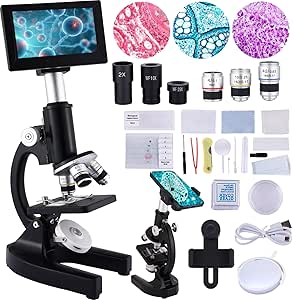 | Best for Eyepiece-Based Classroom Experiments | Magnification range: 40X–2500X | Display: 4.3 inches | Camera: 5MP | VIEW LATEST PRICE | See Our Full Breakdown |
| Woehrsh Trinocular Compound Microscope, 40X–5000X, with Mechanical Stage and USB Camera |  | Best for Advanced Student Lab Work | Microscope type: Compound trinocular | Magnification: 40X–5000X | Objective lens: 195 achromatic | VIEW LATEST PRICE | See Our Full Breakdown |
| BMDSAE 1000X Handheld Digital Microscope for Kids with 2-Inch IPS Screen |  | Best for Young Beginners | Magnification: Up to 1000X | Screen: 2-inch IPS | Camera: 2MP | VIEW LATEST PRICE | See Our Full Breakdown |
| TOMLOV DM301 Pro Digital Microscope with 7-Inch Screen |  | Best for Classroom Sharing | Model: DM301 Pro | Display: 7-inch IPS screen | Magnification: Up to 1200x | VIEW LATEST PRICE | See Our Full Breakdown |
| AmScope B120 Series LED Binocular Compound Microscope with 5MP Camera |  | Best for Documented Lab Assignments | Model: B120C-E5 | Microscope type: Binocular compound | Magnification: 40X–2500X | VIEW LATEST PRICE | See Our Full Breakdown |
| digital microscopes for student | Magnification | Lighting | Display | Camera |
|---|---|---|---|---|
| TOMLOV DM301 Max Digital Micro | Up to 1200X | Adjustable top and bottom LED lights | 7-inch IPS screen | — |
| TOMLOV DM4W Max Digital Coin M | — | LED | — | — |
| OOZSTAR Digital Microscope wit | — | — | 4.3-inch | 5MP |
| Elikliv EDM4 Digital Coin Micr | Up to 1000x; actual magnification varies | 8 adjustable LED lights | 4.3-inch LCD | — |
| Microscope 40X-2500X Magnifica | — | — | 4.3 inches | 5MP |
| Woehrsh Trinocular Compound Mi | 40X–5000X | LED | — | — |
| BMDSAE 1000X Handheld Digital | Up to 1000X | 8 adjustable LEDs with 3 brightness modes | — | 2MP |
| TOMLOV DM301 Pro Digital Micro | Up to 1200x | Adjustable dual LED lighting | 7-inch IPS screen | 8MP photos; 1080p videos |
| AmScope B120 Series LED Binocu | 40X–2500X | — | — | 5MP USB microscope camera |
More Details on Our Top Picks
TOMLOV DM301 Max Digital Microscope
I’d rank the TOMLOV DM301 Max first for students who need a desktop setup that supports both close observation and group discussion. Its 7-inch IPS display is larger than the screens on the OOZSTAR RM and Elikliv EDM4, making it easier for a student and instructor to view a specimen together. The metal X-Y stage adds useful control when scanning across a slide, while adjustable top and bottom lights help accommodate different specimens. It also captures 8MP images and 1080P video, with Wi-Fi app viewing and USB or HD output for sharing work. The tradeoff is portability: battery life is up to three hours, and some sharing options need a compatible phone or external display. Students who mainly need a microscope for coin inspection may prefer the TOMLOV DM4W Max’s built-in scale.
Pros:- 7-inch IPS display gives a group a more comfortable viewing area than the smaller screens on the OOZSTAR models.
- Metal X-Y stage with 1.0 mm scale divisions supports controlled movement across specimens.
- Captures 8MP images and 1080P video, with Wi-Fi app viewing and USB or HD output.
- Includes prepared and blank slides, a Micro SD card, carrying case, and other classroom-ready accessories.
Cons:- Battery life is limited to up to three hours.
- Some viewing and sharing features depend on a compatible phone or external display.
Best for: Students and families who want a desktop microscope with a large screen, a precision stage, and options for sharing observations.
Not ideal for: Students who need a lightweight field microscope or a setup that runs all day without recharging.
- Display:7-inch IPS screen
- Magnification:Up to 1200X
- Image capture:8MP
- Video:1080P
- Stage:Metal X-Y stage with 1.0 mm scale divisions
- Lighting:Adjustable top and bottom LED lights
- Connectivity:Wi-Fi app control; USB and HD output
- Battery life:Up to 3 hours
- Included accessories:8GB Micro SD card, carrying case, power cable, TV cable, power adapter, 5 prepared slides, and 5 blank slides
Our verdict“Choose the DM301 Max if a large shared display and guided slide movement matter more than extended battery life or compact portability.”
TOMLOV DM4W Max Digital Coin Microscope with Weighing Scale, 7-Inch Screen
The TOMLOV DM4W Max is the specialist pick here: it pairs a digital microscope with a built-in scale, which suits students working on coin collections, materials, or small-object comparison projects. Its 7-inch screen matches the DM301 Max’s viewing size, but the DM301 Max is better equipped for slide work with its metal X-Y stage and top-and-bottom lighting. The DM4W Max instead adds weighing in four units and captures 16MP photos or 2K video, useful when students need visual records alongside measurements. The scale’s ±0.5 g accuracy limits its value for precise lab measurements, and objects over 32 mm may need repositioning for close inspection. I’d skip it for biology classes centered on prepared slides; the OOZSTAR RM is a more conventional student microscope kit.
Pros:- Combines close-up viewing and weighing in one device.
- Weighs in grams, ounces, carats, and troy ounces.
- Captures up to 16MP photos and 2K video.
- 7-inch screen and USB output support viewing and sharing with a computer.
Cons:- Weighing accuracy is ±0.5 g, which limits fine measurement work.
- Objects wider than 32 mm may need repositioning for detailed viewing.
- Its coin-focused scale feature is less useful for students who mainly examine prepared slides.
Best for: Students studying coins, jewelry, gemstones, or small objects who want to record visual details and weight in one setup.
Not ideal for: Students focused on routine slide-based biology work or precise measurements that require tighter weighing accuracy.
- Screen:7 inches; 800 × 480 resolution
- Video resolution:2K
- Photo resolution:Up to 5440 × 3060 (16MP)
- Weighing resolution:0.1 g
- Weighing accuracy:±0.5 g
- Weighing units:g, oz, ct, ozt
- Full-view coin size:Up to 32 mm
- Connectivity:USB output; Win/Mac compatible
- Lighting:LED
Our verdict“Pick the DM4W Max for student projects that combine close inspection with weighing, but choose a slide-oriented model for general biology lessons.”
OOZSTAR Digital Microscope with 4.3-Inch Display and 5 MP Camera
For a student starting basic specimen work, the OOZSTAR RM has a practical advantage over the more specialized TOMLOV DM4W Max: it arrives with slides, specimens, coverslips, and lab tools rather than a weighing scale. Its 4.3-inch display and 5MP camera offer a direct way to view and capture observations, while USB-cable or battery power gives students some flexibility away from a desk. The three achromatic objectives and WF10x/WF16x eyepieces give it a more traditional microscope setup than the digital-screen-first Elikliv EDM4. However, the listed magnification range and settings conflict, so I wouldn’t choose it based on the stated maximum alone. Battery type and runtime are also unspecified. Students needing a larger display and clearer stage precision should look at the TOMLOV DM301 Max.
Pros:- Includes specimens, slides, 100 coverslips, and laboratory tools for getting started.
- Built-in 4.3-inch display and 5MP camera support viewing and image capture.
- Interchangeable WF10x and WF16x eyepieces pair with three achromatic objectives.
- Can be powered by a data cable or batteries.
Cons:- Listed magnification range and settings are inconsistent.
- Battery type and runtime are not specified.
- Its 4.3-inch screen is smaller than the 7-inch display on the TOMLOV DM301 Max.
Best for: New student microscopists who want a starter kit with specimens, slides, coverslips, and basic lab tools included.
Not ideal for: Students who need dependable magnification specifications, a large group-viewing screen, or a stated battery runtime.
- Display:4.3-inch
- Camera:5MP
- Listed maximum magnification:2500x
- Listed magnification settings:100x, 250x, 1000x, 200x, 500x, 2000x
- Eyepieces:WF10x and WF16x wide-angle
- Objective lenses:4x, 10x, 40x achromatic
- Light source:LED
- Power:Data cable or batteries
- Included accessories:Cell phone holder, 5 specimens, 5 slides, 100 coverslips, and laboratory tools
Our verdict“Choose the OOZSTAR RM for its ready-to-use beginner lab accessories, but not if you need clearly verified magnification or long battery sessions.”
Elikliv EDM4 Digital Coin Microscope with 4.3-Inch Display
The Elikliv EDM4 makes sense for students inspecting coins, circuit boards, or other small objects who want a simple screen-based view and a connection to a Windows or Mac computer. Its 4.3-inch 720p display is more compact than the 7-inch screen on the TOMLOV DM301 Max, but the EDM4’s stand and adjustable eight-LED lighting provide a straightforward tabletop inspection setup. It can capture photos and video, though a memory card must be purchased separately. The stated magnification reaches 1000x, but actual magnification varies with working distance and screen size, so the number is less useful as a direct comparison with the OOZSTAR RM’s listed range. With up to three hours of battery life, it works for shorter sessions, not extended classes without charging.
Pros:- Connects to Windows and Mac computers for a larger viewing or sharing setup.
- Eight adjustable LED lights help illuminate objects during inspection.
- Rechargeable battery supports portable sessions of up to three hours.
- Stand and adjustable bracket provide a stable tabletop arrangement.
Cons:- Memory card for photo and video capture is not included.
- Actual magnification varies with viewing distance and screen size.
- Its 4.3-inch display is smaller than the TOMLOV DM301 Max’s 7-inch screen.
Best for: Students inspecting coins, electronics, or small materials who want a stand-mounted microscope that connects to a Windows or Mac computer.
Not ideal for: Students who need a ready-to-record kit, a large screen for group viewing, or a microscope primarily designed for prepared slides.
- Display:4.3-inch LCD
- Display resolution:720p HD
- Magnification:Up to 1000x; actual magnification varies
- Lighting:8 adjustable LED lights
- Battery life:Up to 3 hours
- Computer compatibility:Windows and Mac
- Media capture:Photos and videos; memory card not included
- Included items:Microscope, adjustable bracket, plastic base, USB cable, and English user manual
- Warranty:1 year
Our verdict“Choose the EDM4 for computer-connected inspection of small objects, but plan to supply a memory card and don’t rely on its magnification figure as a fixed value.”
Microscope 40X-2500X Magnification with 4.3-inch Display, Wide-Angle 10X and 25X Eyepieces, Built-in 5-Megapixel Camera for School Labs (Black)
This black OOZSTAR model is the better fit for students who want a more traditional eyepiece-and-objective arrangement alongside a digital screen. Its 4x, 10x, and 40x achromatic objectives and wide-angle 10x and 25x eyepieces give it a more conventional lab feel than the stand-mounted Elikliv EDM4. The 4.3-inch display and 5MP camera still let students view and document specimens without relying only on an eyepiece. USB or battery power adds flexibility, and the accessory kit is described as ready for school or home experiments. The stated 40x–2500x range is broad, but the screen remains much smaller than the TOMLOV DM301 Max’s 7-inch display. Battery runtime is not provided, making it harder to plan longer lessons.
Pros:- Achromatic 4x, 10x, and 40x objectives support a traditional microscope-style setup.
- Wide-angle 10x and 25x eyepieces provide viewing options beyond the built-in screen.
- Built-in 5MP camera and 4.3-inch display support viewing and documenting specimens.
- USB or battery power offers flexibility for indoor and portable use.
Cons:- The 4.3-inch display is substantially smaller than the 7-inch screen on the TOMLOV DM301 Max.
- Battery life is not specified.
- At 1.66 kg, it is less suited to students seeking a particularly light portable microscope.
Best for: Students who want objective-lens and eyepiece choices, a built-in camera, and a digital display for school or home experiments.
Not ideal for: Classes that need a large shared viewing screen or students who require a specified battery runtime for off-grid use.
- Magnification range:40X–2500X
- Display:4.3 inches
- Camera:5MP
- Objective lenses:Achromatic 4x, 10x, and 40x
- Eyepieces:Wide-angle 10x and 25x
- Light source:LED
- Power:USB data cable or batteries
- Weight:1.66 kg
- Color:Black
Our verdict“Choose this OOZSTAR if eyepiece-based lab work and a built-in camera matter more than a large display or known battery endurance.”
Woehrsh Trinocular Compound Microscope, 40X–5000X, with Mechanical Stage and USB Camera
The Woehrsh trinocular suits students who need a conventional compound microscope with room to explore higher magnification. Its dual mechanical stage helps move slides in controlled increments, while coaxial coarse and fine focus makes locating a specimen and sharpening the image a more deliberate process than on handheld models such as the BMDSAE 1000X. The 306-degree swivel head can also make sharing the eyepieces easier during group work. It includes a USB electronic eyepiece and a broad accessory set, but the camera’s resolution and software compatibility are not specified, making digital documentation harder to judge than the AmScope B120C-E5, which lists a 5MP camera and analysis software. Its many accessories may take time to sort, and the stated 5000X maximum does not by itself establish useful image detail at that level.
Pros:- 40X–5000X stated magnification range with wide-angle eyepieces
- Mechanical stage and coaxial coarse and fine focus support controlled slide examination
- Includes a USB electronic eyepiece, slides, coverslips, and specimen accessories
- Swivel viewing head can help when students share the instrument
Cons:- USB camera resolution and compatibility are not specified
- The extensive accessory set may require extra setup and organization
- A high stated maximum magnification does not guarantee useful detail at the upper end
Best for: Students in a home or school lab who want a compound microscope, controlled slide movement, and a USB camera for basic digital viewing.
Not ideal for: Beginners seeking a simple, ready-to-use screen microscope, or students who need confirmed camera resolution and software compatibility for assignments.
- Microscope type:Compound trinocular
- Magnification:40X–5000X
- Objective lens:195 achromatic
- Eyepieces:2 WF10X and 2 WF25X
- Lighting:LED
- Stage:Dual mechanical, double-layer
- Focus:Dual coaxial coarse and fine
- Viewing head:306° swivel
- Included accessories:USB electronic eyepiece, slides, coverslips, specimens, and cell phone holder
Our verdict“Choose this Woehrsh for hands-on compound-microscope practice and a wide stated magnification range, but favor the AmScope if documented camera capability matters more.”
BMDSAE 1000X Handheld Digital Microscope for Kids with 2-Inch IPS Screen
The BMDSAE handheld microscope is the simplest pick here for young students who want to inspect objects without setting up a lab-style instrument. Its 2-inch IPS screen shows the view directly, and the built-in camera can save photos and videos, unlike the eyepiece-first Woehrsh and AmScope compound microscopes. At 200g with a lanyard, it is suited to supervised exploring around the home or classroom rather than keeping every observation on a fixed stage. The tradeoff is control: manual focus takes practice, and its 2MP camera and small display are less suited to detailed class presentations than the TOMLOV DM301 Pro, with its larger screen and 8MP photos. Battery life is listed at up to two hours, so longer sessions may need a charging break.
Pros:- Built-in 2-inch IPS screen allows viewing without a separate phone or computer
- Captures photos and AVI videos to internal storage
- Eight adjustable LEDs with three brightness modes help adapt illumination
- Lightweight 200g body and included lanyard suit portable exploration
Cons:- Battery is specified for up to two hours per charge
- Manual focus may frustrate younger users until they develop steady handling
- Small screen and 2MP camera are less suited to group viewing and detailed documentation
Best for: Young students and families who want a lightweight, screen-based microscope for short, supervised explorations and saved snapshots.
Not ideal for: Students doing extended slide-based lab work or anyone who needs a larger shared display, more detailed media capture, or long untethered sessions.
- Magnification:Up to 1000X
- Screen:2-inch IPS
- Camera:2MP
- Lighting:8 adjustable LEDs with 3 brightness modes
- Battery:600mAh; up to 2 hours
- Storage:32M; supports 200+ photos or AVI videos
- Weight:200g
- Connectivity:USB-C
- Recommended age:Over 3 years
Our verdict“Pick the BMDSAE for portable, beginner-friendly discovery, but choose the TOMLOV DM301 Pro for a larger teaching display and stronger image capture.”
TOMLOV DM301 Pro Digital Microscope with 7-Inch Screen
The TOMLOV DM301 Pro is the strongest fit in this group when several students need to see the same specimen. Its 7-inch adjustable-angle display avoids the one-at-a-time eyepiece experience of the Woehrsh and AmScope compound models, while TV, computer, and projector connections can extend viewing to a class. The listed 8MP photos and 1080p video also give students a practical way to save observations; Wi-Fi app support adds another viewing route. Prepared and blank slides, a carrying case, and adjustable dual LEDs make the kit more ready for varied school activities than the screen-free AmScope. The tradeoff is a three-hour maximum battery life, and its digital screen-centered format differs from a traditional binocular microscope’s eyepiece-based study. Choose it for shared demonstrations, not for students who specifically want conventional microscope handling.
Pros:- Large 7-inch IPS display supports shared viewing without crowding around an eyepiece
- Captures 8MP photos and 1080p video for school records and presentations
- Wi-Fi app support plus USB and HD output offers several viewing and display options
- Includes prepared and blank slides, a carrying case, and adjustable dual LED lighting
Cons:- Battery life is listed as up to three hours, which may limit longer sessions
- Digital display-centered viewing does not provide the same eyepiece practice as the AmScope B120C-E5
- Wireless app support may add setup steps compared with viewing directly on the screen
Best for: Teachers, families, and student groups who want a large shared display, recorded observations, and connections to classroom screens.
Not ideal for: Students seeking the hands-on eyepiece experience of a conventional compound microscope, or users who need longer battery sessions away from power.
- Model:DM301 Pro
- Display:7-inch IPS screen
- Magnification:Up to 1200x
- Lenses:Three achromatic lenses
- Camera:8MP photos; 1080p videos
- Lighting:Adjustable dual LED lighting
- Connectivity:Wi-Fi app support; USB and HD output
- Battery life:Up to 3 hours
- Included accessories:Carrying case, microSD card, cables, power adapter, 5 prepared slides, and 5 blank slides
Our verdict“Choose the DM301 Pro when shared viewing and digital documentation matter more than practicing with a traditional binocular microscope.”
AmScope B120 Series LED Binocular Compound Microscope with 5MP Camera
The AmScope B120C-E5 is the more focused choice for students whose assignments require clear digital records alongside traditional microscope work. Its 5MP USB camera and image analysis software are specified, giving it a documentation advantage over the Woehrsh trinocular, whose camera resolution and compatibility are unstated. The binocular head and 40X–2500X range make it a conventional compound microscope rather than an all-in-one screen unit like the TOMLOV DM301 Pro; students view through eyepieces and use a connected computer for digital capture. Daylight-balanced LED illumination is suited to routine slide study, and the five-year warranty is a substantial listed support term. Its tradeoff is that the product details do not list a built-in screen, prepared slides, or a mechanical-stage specification, so buyers should check the setup needs for their course.
Pros:- 5MP USB camera and image analysis software are specified for digital documentation
- 40X–2500X magnification range supports standard compound-microscope study
- Daylight-balanced LED illumination is suited to routine slide viewing
- Five-year warranty is listed
Cons:- No built-in display is specified, so digital viewing requires a connected computer
- Prepared slides and mechanical-stage details are not listed in the product data
- Its traditional eyepiece setup is less convenient for group viewing than the TOMLOV DM301 Pro
Best for: Students and school labs that need a conventional binocular microscope with a specified USB camera and image analysis software for assignments.
Not ideal for: Younger beginners who want a self-contained screen microscope, or students who need a ready-to-use slide kit and detailed stage specifications in the listing.
- Model:B120C-E5
- Microscope type:Binocular compound
- Magnification:40X–2500X
- Camera:5MP USB microscope camera
- Image software:Image capture and analysis software included
- Illumination:Daylight-balanced LED
- Head:Adjustable Siedentopf binocular
- Warranty:5 years
Our verdict“Choose the AmScope for student lab work that pairs eyepiece study with specified camera and analysis tools, rather than for a self-contained display experience.”

How We Picked
I ranked these nine options by how well each fits student learning tasks, not by magnification figures alone. I compared the screen and viewing setup, focusing and specimen handling, camera or computer connectivity, stability, and how easily a student can share or document observations. I also distinguished models built for prepared slides from digital inspection microscopes aimed at coins, surfaces, or general close-up viewing, since those designs are not interchangeable in a classroom.
The ranking favors versatile, straightforward options that suit a broad range of school use, followed by models with clear strengths for a narrower age group or assignment. A 7-inch screen can make group viewing more comfortable, but it does not replace the optics and stage control of a compound microscope. Specialized coin models rank for that use rather than broad science coursework, while handheld and smaller-screen choices trade viewing comfort or stability for portability and approachability. I also account for practical limitations: a camera is useful only if its workflow suits the student, and high advertised magnification is not a promise of equally useful detail.
Factors to Consider When Choosing Digital Microscopes For Students
Before choosing a student microscope, I’d start with the work the student will actually do. These products fall into distinct groups, and buying the most impressive-sounding specification can lead to a poor classroom fit. The following checks help separate a useful learning tool from a specialized gadget.
Match the Microscope to the Assignment
Ask whether the student will examine prepared slides, everyday objects, coins, or surfaces such as circuit boards. Compound microscopes are designed around slide viewing, while screen-based digital inspection models often work best with solid objects placed beneath a camera. A coin microscope may be engaging for collecting but can leave a biology student without the familiar slide workflow their class requires. Check the course syllabus or ask the teacher before choosing a type. If the student expects to move between slides and objects, prioritize a model whose included optics and stage support both jobs rather than assuming every digital microscope does.
Treat Magnification Claims as a Starting Point
Magnification numbers can be difficult to compare across digital and compound microscopes because the image may be enlarged optically, on a screen, or through software. More enlargement does not automatically reveal more detail; image quality also depends on optics, lighting, focus, and specimen preparation. For classwork, usable focus across the range matters more than a very high maximum figure. Ask what magnification is optical and what comes from digital enlargement, particularly when the listing gives a broad range. A stable, clear view at the magnification a student needs is more useful than a large number that is hard to focus.
Choose Screen Size for the Learning Setup
A built-in screen lets students view an image without keeping one eye at an eyepiece, and a larger display can make shared observation easier during group work. A compact screen can keep the device portable, but classmates may have to take turns or lean close to see details. Also check whether the display tilts, how controls are placed, and whether the microscope can connect to a computer or external display if lessons call for it. A screen is not automatically better for every learner: traditional eyepieces may suit a lab that teaches conventional microscope technique. Choose the viewing setup that matches both comfort and classroom practice.
Plan for Stability and Student Handling
Focus becomes frustrating when a microscope shifts as a student adjusts it, so look for a steady base, manageable controls, and a stage suited to the specimens being used. Handheld models are convenient to carry and can inspect objects that do not fit neatly on a stage, but keeping the view still may take practice. Larger bench models take more room and can be less convenient to transport, yet their fixed setup can make repeat observations easier. Consider who will set up and put away the equipment, especially for younger students. A simple operating routine can matter more than extra features when the microscope is used independently.
Check How Images Are Saved and Shared
A built-in camera can support lab notes, presentations, and comparisons over time, but confirm how images move from the microscope to the device the student actually uses. Check for included cables, compatible operating systems, storage options, and whether the product needs separate software. A camera specification alone does not promise an easy classroom workflow. If assignments require digital evidence, test the connection process early and confirm that the saved image resolution is adequate for the task. For a student who mainly observes live specimens, a simple display may be more useful than a camera setup that adds steps.
Buy for the Student’s Next Few Years
A beginner may benefit from a compact, straightforward device, while a student taking more advanced biology may need a compound microscope with a mechanical stage and a familiar eyepiece setup. Paying more makes sense when a student will use the added control, stability, or documentation features regularly. It is less useful to pay for a specialized coin scale or elaborate connectivity if coursework does not call for it. Think about storage space, accessories, specimen supplies, and who will maintain the equipment as well as the microscope itself. The right choice should fit the student’s current assignments without setting them up to outgrow it immediately.
Frequently Asked Questions
Should I buy a digital screen microscope or a compound microscope for school biology?
Start with the kind of specimens and techniques used in class. A compound microscope is generally the closer fit for prepared slides and lessons that teach traditional eyepiece viewing, while a screen-based model can make group observation and image sharing simpler. Some digital models are aimed mainly at solid objects, so their high magnification claims do not make them replacements for slide microscopes. Check the course requirements before buying, especially if students must use a mechanical stage or practice conventional focusing. If the class has no fixed requirements, prioritize the work the student will do most often.
Is a 7-inch microscope screen worth choosing over a smaller display?
A larger display can make it easier for more than one student to view an observation and can reduce the need to position an eye at an eyepiece. That advantage is useful for demonstrations and shared projects, but the screen does not improve the microscope’s underlying optics by itself. Larger units can also take up more desk and storage space. For solo work or a student who needs a portable tool, a smaller screen may be a sensible compromise. Decide based on viewing comfort and classroom use, not screen size alone.
Can a coin microscope work for general science assignments?
It can help with close-up observations of coins and other solid surfaces, but a coin-focused design may not provide the stage, optics, or workflow needed for prepared slides. Features such as an integrated scale are useful for collecting projects but add little to many biology assignments. Before choosing one, check whether the student needs to observe transparent specimens or follow a school lab procedure. If both coin inspection and slide study matter, a specialized coin model may require a second microscope. For a single school instrument, match the choice to the teacher’s required specimen types.
Does a high advertised magnification mean a student will see more detail?
No. The final view depends on the optics, lighting, focus, specimen quality, and whether enlargement is optical or digital. Digital zoom can make an image appear larger without revealing additional detail. A microscope that focuses reliably at the magnification used for class is often more useful than one with a much higher advertised maximum. Ask how the magnification is produced and look for a clear description of the included objectives or eyepieces. Students should also learn that slide preparation and lighting affect what they can see.
What should I prioritize for a younger student who will use the microscope independently?
Favor manageable controls, a stable setup, an understandable viewing method, and a size the student can handle without frequent adult adjustment. A handheld option can be easy to carry but may require practice to keep the image steady; a bench model can be steadier but takes more space. Check whether the student can position specimens, focus, and save images without a complicated computer setup. A simple microscope that gets used regularly can serve a beginner better than a feature-heavy one that is difficult to operate. If the child’s school has a preferred microscope type, follow that guidance first.
Conclusion
For the broadest mix of student-friendly screen viewing and versatility, I’d choose the TOMLOV DM301 Max as best overall. The best value depends on the assignment: the OOZSTAR’s compact display and 5 MP camera make a practical starting point for students who want a straightforward digital setup, while the AmScope B120 is the stronger investment for slide-centered coursework. For a premium screen-based pick, the TOMLOV DM301 Pro suits buyers who want a larger-display format; beginners who prize portability should look at the BMDSAE handheld, accepting its smaller view and less stable handling. For specific needs, choose the Woehrsh for compound lab work or the TOMLOV DM4W Max for coin inspection and weighing. I’d make the final call by checking the student’s actual assignments first: screen-based convenience, slide-study capability, and portability are different strengths, not one universal ladder of better and worse.
Halloween Picks
halloween
As an affiliate, we earn on qualifying purchases.