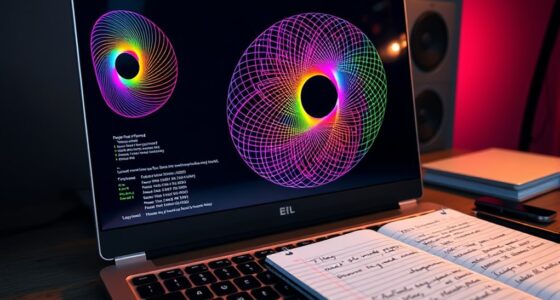
Creating incredible fractal patterns in Python is easier than you might think. Using simple recursive algorithms and visualization tools like Matplotlib, you can generate stunning, self-similar designs such as Mandelbrot and Julia sets. Python’s straightforward syntax makes it accessible for experimenting with colors, zoom levels, and detail. As you explore these techniques, you’ll discover the mathematical beauty behind fractals and discover how to craft your own mesmerizing patterns—keep going to uncover more tips and tricks.

Prime made for students and young adults
- Fast, free delivery for dorm and study essentials
- Prime Video and Amazon Music included
- Member-only deals
Key Takeaways
- Utilize Python libraries like matplotlib and NumPy to generate and visualize complex fractal patterns easily.
- Implement recursive algorithms to create self-similar, intricate fractal designs with minimal code.
- Explore interactive tools such as Jupyter notebooks for real-time experimentation and customization.
- Enhance fractal images with vibrant color schemes to reveal hidden details and improve visual appeal.
- Generate a variety of fractals, including Mandelbrot, Julia, and Sierpinski, by adjusting parameters and recursion depth.

Fractals are intricate patterns that reveal complex structures emerging from simple mathematical rules, and Python provides an accessible way to explore and generate them. When you immerse yourself in fractal creation, you’ll find that visualizing these patterns becomes easier and more engaging with tools like matplotlib. This powerful library allows you to turn your mathematical ideas into vivid, detailed images that showcase the beauty of fractals. Using matplotlib visualization, you can experiment with different color schemes, zoom levels, and detail levels to truly appreciate the complexity hidden within simple formulas.
Explore and visualize complex fractal patterns easily with Python and matplotlib.
A core concept in generating fractals is the use of recursive algorithms. These algorithms repeatedly apply a set of rules to create self-similar patterns at different scales. For example, when you generate a Mandelbrot set or a Julia fractal, you’re fundamentally running a recursive process that determines whether each point belongs to the set based on its mathematical properties. The beauty of recursion here lies in its simplicity—each step builds on the previous one, resulting in intricate, layered designs that seem to extend infinitely. With Python, implementing recursive algorithms becomes straightforward, thanks to its clean syntax and versatility.
As you work through fractal generation, you’ll notice that recursion allows you to produce highly detailed images with relatively little code. For instance, you can write a recursive function that draws a fractal tree by repeatedly branching lines at specific angles and lengths. Each recursive call adds a new layer of complexity, and matplotlib visualization helps you see the results in real time, making it easier to tweak parameters for desired effects. This process not only enhances your understanding of the mathematical principles behind fractals but also sharpens your programming skills.
Python’s ecosystem offers many tools to refine your fractal creations. Combining matplotlib with other libraries like NumPy enables you to manipulate data efficiently, while interactive environments like Jupyter notebooks facilitate experimentation. Whether you’re generating classic fractals like the Sierpinski triangle or designing your own, recursive algorithms serve as the backbone for creating detailed, self-similar patterns. Visualizing these structures with matplotlib transforms abstract formulas into stunning images, giving you a tangible sense of the mathematical harmony involved. Additionally, understanding the importance of color accuracy can enhance the visual appeal of your fractal images by allowing you to better represent the depth and complexity within the patterns.
Python fractal visualization software
As an affiliate, we earn on qualifying purchases.
As an affiliate, we earn on qualifying purchases.
Frequently Asked Questions
Can Fractals Be Generated in Real-Time With Python?
Yes, you can generate fractals in real-time with Python. It’s possible through efficient algorithms that enhance performance and enable real-time rendering. By using libraries like Pygame or PyOpenGL, you can improve performance and create smooth visualizations. However, achieving ideal speed requires performance optimization techniques, such as reducing calculations or leveraging hardware acceleration, so your fractals display seamlessly without lag.
What Are the Best Libraries for Fractal Visualization?
You’re about to open the universe of fractal visualization, and the best libraries make it feel like magic! With libraries like Matplotlib and Plotly, you can craft stunning visuals using fractal algorithms effortlessly. For more dynamic, interactive images, try Bokeh or PyQtGraph. These tools turn complex patterns into mesmerizing displays, making your Python projects explode with vibrant, detailed fractal art that’ll blow minds!
How to Optimize Python Code for Complex Fractal Calculations?
To optimize Python code for complex fractal calculations, focus on algorithm optimization and efficient recursion strategies. You can reduce computation time by implementing memoization or iterative approaches instead of deep recursion, which avoids stack overflow. Use libraries like NumPy for vectorized operations, and consider parallel processing with multiprocessing or joblib to distribute calculations. Profiling your code helps identify bottlenecks, allowing you to fine-tune your algorithms for faster, more efficient fractal rendering.
Are There 3D Fractal Generation Options in Python?
You might wonder if Python offers 3D fractal generation options. Research shows that it does, especially with libraries like Mayavi, Plotly, and Matplotlib’s mplot3d for 3D visualization. These tools enable you to implement complex fractal algorithms and visualize intricate 3D structures. By leveraging these libraries, you can explore the fascinating world of 3D fractals, turning abstract algorithms into stunning visual representations right within Python.
How Can I Animate Fractals Using Python?
You can animate fractals in Python by combining libraries like Matplotlib, Pygame, or Plotly with creative animation techniques. Start by defining your fractal function and update parameters over time to create motion. Use color schemes to enhance visual appeal, and animate the changes frame by frame. This approach allows you to produce dynamic visuals that highlight the intricate beauty of fractals and bring your patterns to life effectively.
Matplotlib plotting library for fractals
As an affiliate, we earn on qualifying purchases.
As an affiliate, we earn on qualifying purchases.
Conclusion
Now that you’ve mastered creating stunning fractals in Python, you might think you’re a digital artist. But don’t get too confident—you’ve only scratched the surface of infinite complexity. With just a few lines of code, you’ve revealed mesmerizing patterns that seem to go on forever. So, go ahead, impress your friends with your newfound skills—just remember, the real magic is that you can create worlds of chaos and beauty, all at your fingertips.
recursive algorithm programming books
As an affiliate, we earn on qualifying purchases.
As an affiliate, we earn on qualifying purchases.
Jupyter notebook for fractal experiments
As an affiliate, we earn on qualifying purchases.
As an affiliate, we earn on qualifying purchases.
Fall Picks
fall essentials
As an affiliate, we earn on qualifying purchases.