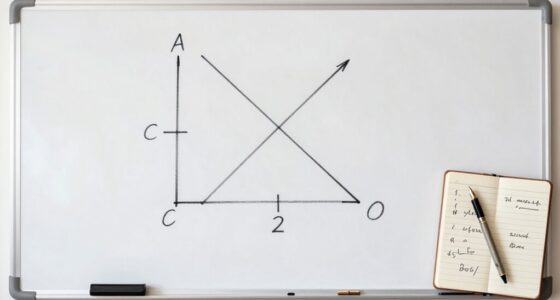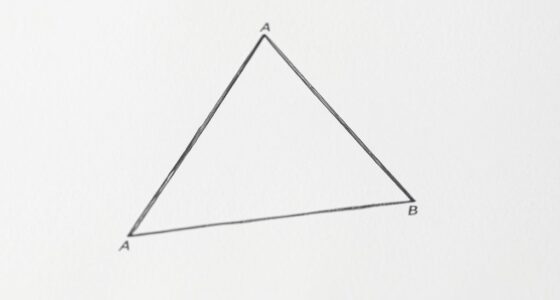
You might think that accurate diagrams always aid your proof, but they can actually mislead you if relied upon blindly. Simplified or slightly distorted visuals may suggest false relationships or hide subtle details, causing you to draw incorrect conclusions. Visual intuition is helpful, but it can deceive, especially when it overrides careful logical analysis. To truly guarantee your proof’s validity, you need to verify diagrams through formal reasoning—something you’ll discover more about as you explore further.

Prime made for students and young adults
- Fast, free delivery for dorm and study essentials
- Prime Video and Amazon Music included
- Member-only deals
Key Takeaways
- Simplified diagrams may omit crucial details, leading to misinterpretation of relationships.
- Visual patterns can create false assumptions if not verified through formal reasoning.
- Over-reliance on diagrams can cause overlooked subtle aspects essential for proof validity.
- Inaccurate diagrams can suggest incorrect connections, misleading the logical flow of the proof.
- Visual intuition may fill gaps with familiar shapes, risking errors if not checked against formal logic.
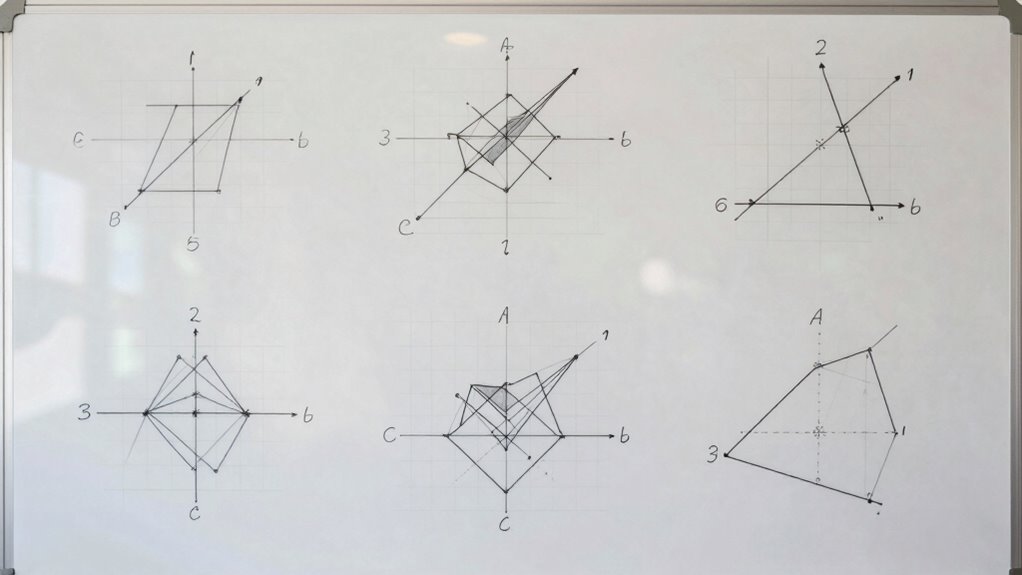
Have you ever wondered how much a diagram can influence the clarity of a proof? Visual intuition plays a significant role in how you understand complex mathematical ideas, often making abstract concepts feel more tangible. When you’re working through a proof, a well-crafted diagram can clarify relationships and highlight key steps. However, relying solely on visual intuition can be misleading if the diagram isn’t accurate. This is where diagram simplification becomes a double-edged sword. Simplifying a diagram helps you focus on the core idea without getting lost in extraneous details, but it can also distort the original relationships, leading you astray.
Simplified diagrams clarify ideas but risk distorting relationships; always verify to ensure accuracy in your proofs.
In proof writing, accuracy in diagrams isn’t just about neatness; it’s about faithfully representing the mathematical structure you’re trying to communicate. When you simplify a diagram too aggressively, you risk omitting critical details or misrepresenting connections. These inaccuracies can create a false sense of understanding, causing you to overlook subtle but important aspects of the proof. For instance, a simplified diagram might suggest that two geometric figures are congruent when they’re not, or it might imply a relationship that doesn’t hold in the actual problem. Such misconceptions, if left unchecked, can undermine the rigor of your entire argument. Recognizing the importance of diagram accuracy can help prevent these issues from arising. Additionally, understanding how visual aids influence perception can help you develop better strategies for verifying their correctness. Furthermore, being aware of the potential for visual misrepresentation emphasizes the need for careful validation of diagrams against formal reasoning.
You might think that a diagram’s visual intuition always supports your reasoning, but it can sometimes be deceiving. Your brain tends to fill in gaps and assume relationships based on familiar shapes or patterns, especially when diagrams are overly simplified. This natural tendency can lead you to accept incorrect assumptions without thorough verification. To avoid this trap, you need to balance the power of visual intuition with meticulous checking of the underlying logic and equations. Always ask yourself whether the diagram accurately reflects the conditions and relationships described in your proof. If it doesn’t, don’t be tempted to rely on it blindly. Moreover, understanding the role of visual aids in mathematical reasoning can enhance your capacity to interpret diagrams correctly.
Furthermore, it’s vital to remember that diagrams are tools, not substitutes for rigorous reasoning. They serve as guides, but they shouldn’t replace precise algebraic or logical arguments. When you recognize that diagram simplification might distort the original problem, you can take steps to verify the relationships through calculations or formal proofs. Doing so ensures that your visual representations support, rather than undermine, the correctness of your proof. Ultimately, maintaining accuracy in your diagrams safeguards your proofs from being misled by visual pitfalls, allowing you to communicate ideas clearly and confidently. Understanding the importance of accuracy in diagrams helps prevent misinterpretations that could compromise the integrity of your mathematical reasoning.
mathematical proof diagram tools
As an affiliate, we earn on qualifying purchases.
As an affiliate, we earn on qualifying purchases.
Frequently Asked Questions
How Can I Verify the Accuracy of a Diagram?
You can verify a diagram’s accuracy through visual verification, comparing it against the original data or description. Perform diagram validation by checking key features, labels, and proportions to guarantee they align with the known facts or proofs. Use multiple sources or tools to cross-verify details. This process helps you catch errors early, preventing misleading conclusions, and ensures your diagram truly represents the concept or proof you’re working with.
Do Diagrams Always Improve Understanding in Proofs?
Diagrams don’t always improve understanding in proofs because they rely on your visual intuition, which can sometimes be misleading. While they offer quick insights, their limitations mean they might oversimplify complex concepts or omit essential details. You should use diagrams as helpful tools, but always verify their accuracy and complement them with rigorous reasoning, ensuring your understanding isn’t solely dependent on visual cues that might distort the proof’s true structure.
What Are Common Mistakes in Diagram Interpretation?
Picture a shaky mirror distorting your reflection—that’s how common mistakes in diagram interpretation can mislead you. You might fall for visual misinterpretations, assuming accuracy where there’s oversimplification. Relying too heavily on diagrams can cause you to overlook essential details, leading to errors. Always cross-check with algebraic reasoning, and remember that diagrams are guides, not infallible truths—don’t let them distort your understanding.
Should Diagrams Be Included in Formal Proof Submissions?
Yes, diagrams should be included in formal proof submissions, but you need to be cautious of visual misinterpretation and diagram bias. They can clarify complex ideas but might also mislead if not accurate or interpreted correctly. Use diagrams as supportive tools, ensuring they’re precise and clear. Always cross-check with written proof to avoid relying solely on visual cues, which can sometimes distort the actual logical structure.
How Can I Avoid Relying Too Heavily on Diagrams?
You can avoid relying too heavily on diagrams by balancing visual intuition with rigorous reasoning. Don’t let diagram simplification distract you from the actual logic; instead, use visuals as a helpful guide, not the final authority. Always double-check your proof steps with precise definitions and algebraic details. This way, you keep your reasoning solid and prevent diagrams from leading you astray, making your proofs both clear and trustworthy.
geometric diagram accuracy software
As an affiliate, we earn on qualifying purchases.
As an affiliate, we earn on qualifying purchases.
Conclusion
So, next time you rely on a diagram to guide your proof, ask yourself: is that visual truly accurate or just a helpful illusion? Remember, diagrams can simplify complex ideas, but they can also mislead if taken at face value. Don’t let a convincing image replace careful reasoning. Always double-check the details and trust your logic more than the picture. After all, isn’t the truth worth more than just a pretty diagram?
As an affiliate, we earn on qualifying purchases.
As an affiliate, we earn on qualifying purchases.
Halloween Picks
halloween
As an affiliate, we earn on qualifying purchases.