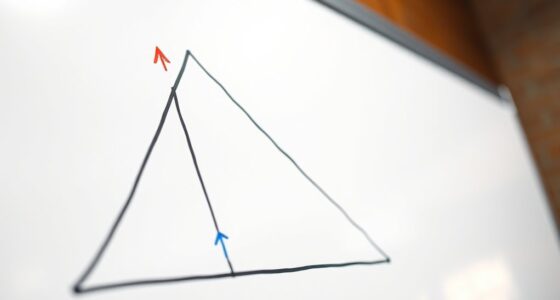

To see why the angles of a triangle sum to 180°, try extending two sides of your triangle. The outside angles at the extended points are supplementary to the interior angles at those vertices. Since straight lines measure 180°, the interior angles inside the triangle along with these outside angles add up accordingly. This simple relationship works because of Euclidean geometry’s rules. Keep exploring, and you’ll discover even more fascinating facts about triangles and their properties.
Key Takeaways
- Extending two sides of a triangle creates supplementary exterior angles with the interior angles at the base points.
- These exterior angles form straight lines measuring 180°, linking interior angles to the total sum.
- The sum of the interior angles inside a straight line is always 180°, proving the triangle’s angles sum to 180°.
- The proof relies on Euclidean geometry assumptions, valid only on flat, two-dimensional surfaces.
- This fundamental property helps us understand the structure of triangles and the nature of flat surfaces.
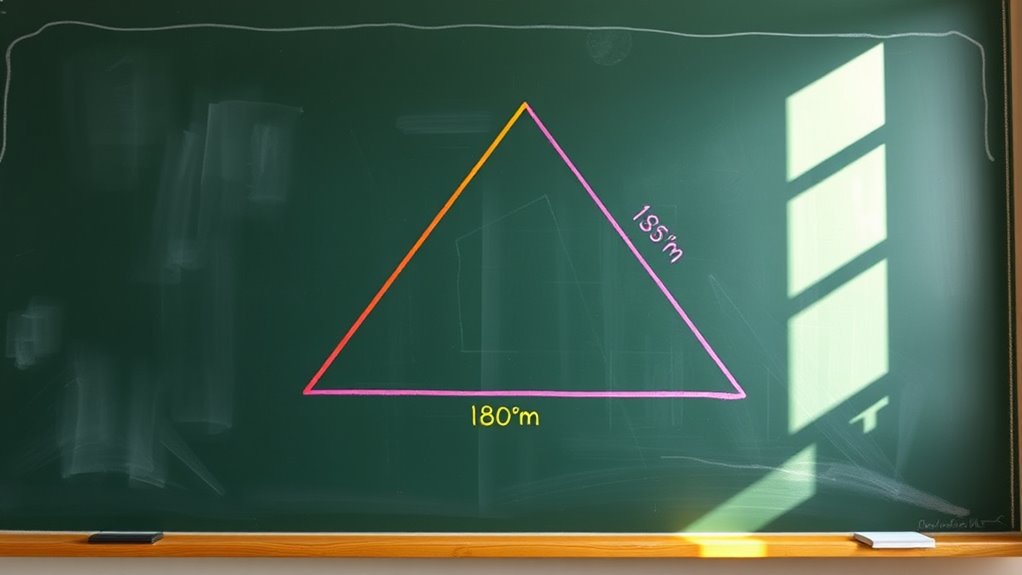
The sum of the interior angles of any triangle always equals 180 degrees. This fundamental fact is a cornerstone of Euclidean geometry and helps you understand the properties of triangles more deeply. When you look at a triangle, whether it’s drawn on paper or visualized in your mind, the measure of its three interior angles will always add up to a straight line, or 180 degrees. Understanding why this is true isn’t just about memorization; it’s about grasping a simple, elegant proof that reveals the nature of Euclidean space.
The interior angles of a triangle always add up to 180 degrees.
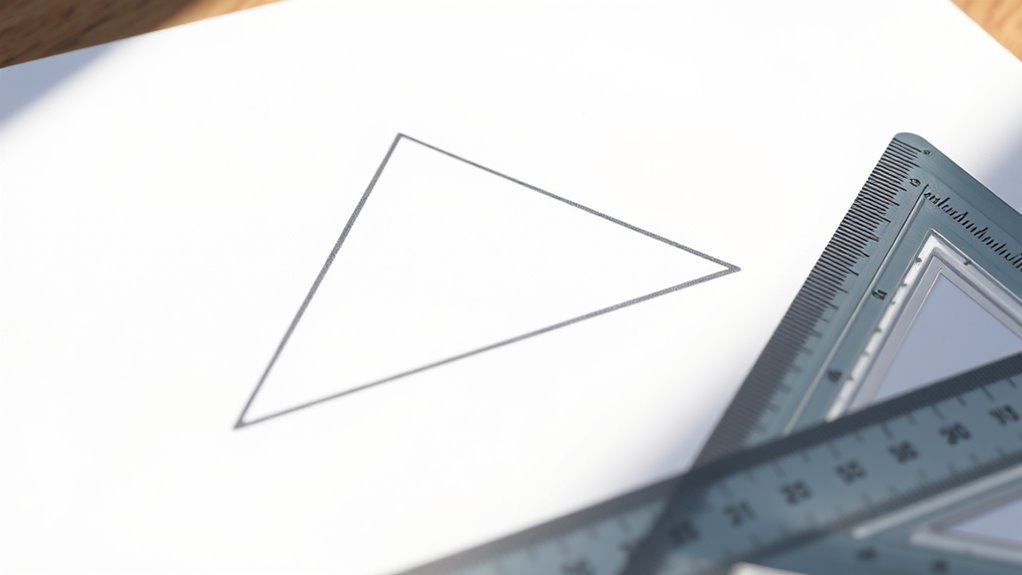
To see why, consider a triangle drawn on a flat surface, which is the typical setting for Euclidean geometry. Suppose you have a triangle ABC, and you want to find the sum of its triangle interior angles. First, extend the sides of the triangle at points A and C, creating a straight line that passes through these points. Now, focus on the angles formed at points A and C by the extended lines. These angles, along with the interior angles at B, are what you’ll analyze to understand the sum.
Next, observe that the two angles you extended from A and C are supplementary to the interior angles at those points because they form straight lines. In Euclidean geometry, a straight line measures exactly 180 degrees. So, the angle at A, plus the exterior angle formed when you extend the side, sums to 180 degrees; likewise for the angle at C. Since the exterior angles are supplementary to the interior angles at A and C, you can see that the interior angles at A, B, and C must sum to 180 degrees to fit neatly within the straight line. This is a key insight: the interior angles on a flat plane always add up to a straight line, which measures 180 degrees. This property is fundamental to understanding the structure of triangles and their angles.
This proof relies on the axioms of Euclidean geometry, which assume a flat, two-dimensional space. It shows you that in such a space, the triangle interior angles are always constrained by the geometry’s fundamental properties. If you move into non-Euclidean geometries, like spherical or hyperbolic geometry, this rule no longer applies in the same way, but within Euclidean geometry, it’s a universal truth. When you understand this simple proof, you gain a clearer perspective on the structure of triangles and the underlying principles that govern all flat surfaces.
Frequently Asked Questions
Can the Sum of Angles in a Triangle Ever Be More Than 180°?
No, the angle sum in a triangle can never be more than 180°. This is a fundamental triangle property, meaning the total of all interior angles always equals exactly 180°. When you draw a triangle, you’ll see that the angles always add up to this sum, no matter the shape or size. So, you can’t have a triangle with an angle sum exceeding 180°, as that defies this basic geometric rule.
Does This Proof Apply to All Types of Triangles?
Think of this proof as a universal map; it applies to all triangles, no matter their shape or size. The proof relies on angle preservation, meaning the sum of angles stays consistent regardless of the triangle type—equilateral, isosceles, or scalene. Its universality guarantees you can confidently apply it to any triangle, confirming that the interior angles always sum to 180°, no exceptions.
How Does the Proof Change With Irregular Triangles?
When dealing with irregular triangles, the proof still holds because the principle relies on drawing a parallel line through the triangle’s vertex, creating alternate interior angles. Despite angle variation and irregular polygons, the sum of the interior angles remains 180°. You just need to focus on the properties of parallel lines and transversals, which apply universally, ensuring that the proof is valid for all triangle types regardless of their irregularity.
Is There a Real-World Application of This Triangle Property?
Imagine you’re designing a building or steering through a complex city; knowing that triangle angles sum to 180° becomes your secret weapon. In architectural design, this property ensures precise angles for sturdy structures. In navigation techniques, it helps you calculate routes and positions accurately. Without realizing it, you rely on this fundamental math principle daily—making your constructions safe and your journeys successful. It’s a simple truth with powerful real-world applications.
Can This Proof Be Adapted for Three-Dimensional Shapes?
Yes, you can adapt the angle sum proof for three-dimensional shapes like polyhedra. In three dimensions, instead of a simple angle sum, you examine dihedral angles and solid angles. For example, the sum of face angles around a vertex in a polyhedron helps understand its geometry. This approach extends the concept of angle sum from triangles to more complex shapes, giving insight into how angles behave in three dimensions.
Conclusion
Just like the ancient Greeks discovered with their wisdom, understanding that the angles of a triangle add up to 180° reminds us that some truths are timeless. When you see a triangle, remember it’s more than just shapes; it’s a symbol of balance and harmony rooted in fundamental principles. Keep exploring these ideas, and you’ll find that many mysteries of geometry are as simple and elegant as this proof—proof that echoes through history, guiding your learning.