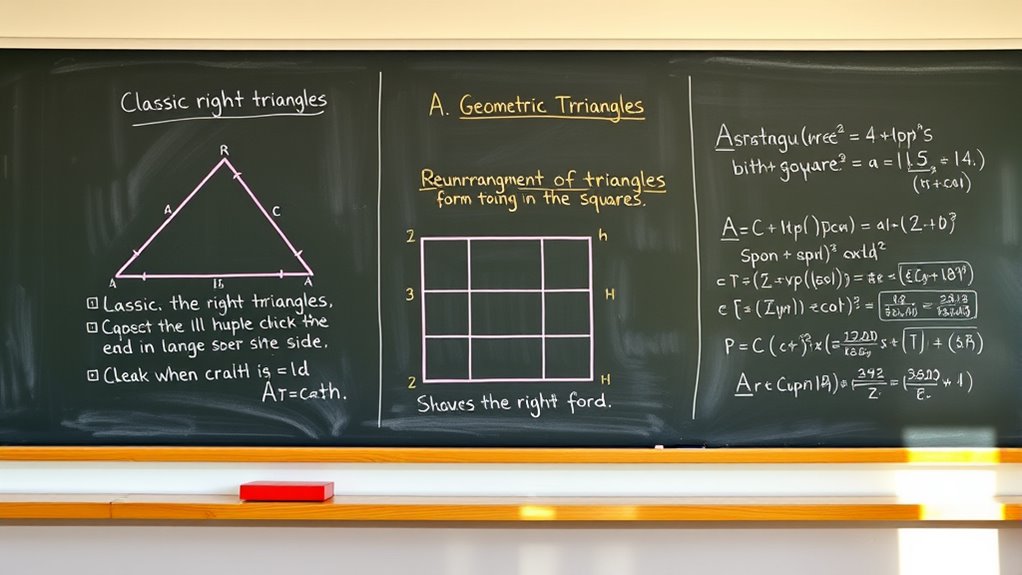

There are three common methods to prove the Pythagorean theorem. You can explore a geometric proof that uses area rearrangements to show how the squares on the legs combine into the square on the hypotenuse. Another approach involves algebraic proof with coordinate geometry, applying the distance formula. finally, similarity of triangles offers an intuitive way by comparing proportional sides. Keep exploring these methods to deepen your understanding of this fundamental theorem.
Key Takeaways
- Geometric proofs visualize the theorem by rearranging areas within squares and triangles to demonstrate (a^2 + b^2 = c^2).
- Algebraic approaches use coordinate geometry and the distance formula to derive the relationship step-by-step.
- Similar triangles within the right triangle establish proportionality, confirming the Pythagorean theorem through side ratios.
- Visual and intuitive methods manipulate shapes and areas to provide straightforward understanding of the theorem.
- Exploring various proof techniques, including geometric and algebraic, deepens comprehension of the theorem’s validity.
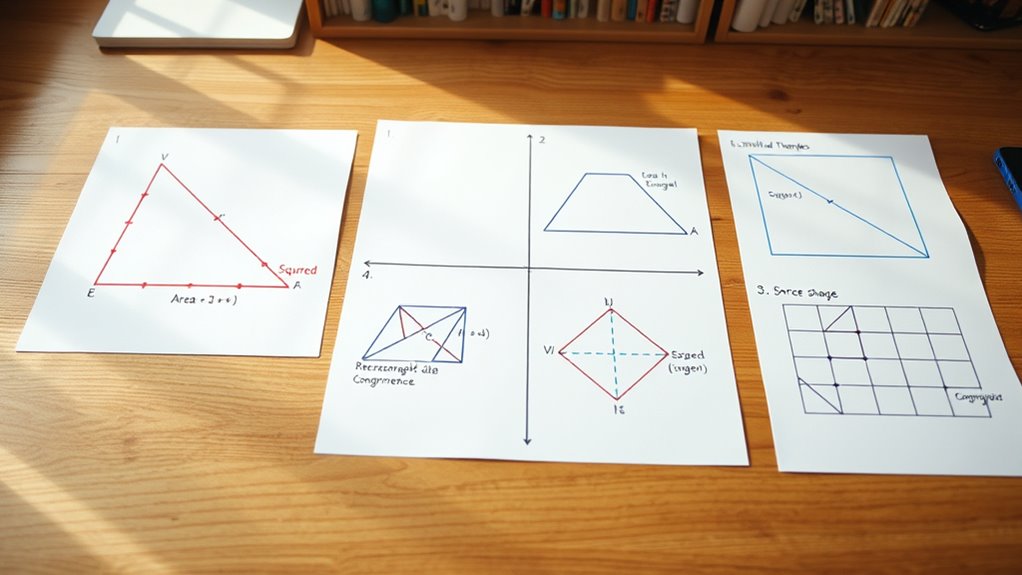
The Pythagorean Theorem is a fundamental principle in geometry that relates the lengths of the sides of a right triangle. When you set out to prove this theorem, you can use different methods, each offering unique insights. One common approach is through a geometric proof, which visually demonstrates how the squares of the legs relate to the square of the hypotenuse. Imagine drawing a large square with side length equal to the hypotenuse and dividing it into smaller shapes or rearranging parts to reveal the relationship. This visual method helps you see how the areas of the smaller squares on the legs combine to fill the larger square on the hypotenuse, confirming that (a^2 + b^2 = c^2). It’s a straightforward, intuitive way to understand the theorem’s truth by manipulating shapes and areas. Additionally, exploring different proof techniques can deepen your understanding of geometric principles.
Alternatively, you can approach the proof algebraically, deriving the relation using coordinate geometry or algebraic identities. Take a right triangle with known side lengths, assign coordinates to its vertices, and then apply the distance formula to find the lengths of the sides. From there, you can derive the theorem step by step, starting with the coordinate points and algebraically expanding the squared distances. This algebraic derivation emphasizes the power of algebra in proving geometric facts, allowing you to translate a visual problem into an equation that can be manipulated directly. It’s particularly useful when working with coordinate systems or when you want to connect the theorem to other algebraic concepts. The algebraic proof demonstrates that the relationship holds regardless of the triangle’s size or position, reinforcing its universality.
Another way to prove the Pythagorean Theorem is through similarity of triangles, where you show that right triangles with proportional sides maintain the same relationships. By constructing similar triangles within your original right triangle—perhaps by dropping altitudes or drawing auxiliary lines—you can establish proportionality statements. These proportionalities lead directly to the algebraic relation (a^2 + b^2 = c^2). This method combines geometric intuition with algebraic reasoning and is especially useful for understanding how the theorem applies across different right triangles.
Each of these methods, whether geometric proof, algebraic derivation, or similarity, offers a clear pathway to understanding why the Pythagorean Theorem works. They highlight different aspects—visual, algebraic, and proportional—helping you appreciate the theorem’s beauty and robustness in geometry.
Frequently Asked Questions
Who First Discovered the Pythagorean Theorem?
You’ll find that the history origins of the Pythagorean Theorem trace back to ancient proofs from civilizations like the Babylonians and Chinese, long before Pythagoras. However, Pythagoras of Samos is credited with discovering and formalizing the theorem around 500 BCE. His work popularized the relationship between the sides of a right triangle, making him the key figure associated with its discovery, even though earlier civilizations knew of its principles.
Can the Theorem Be Applied in Non-Euclidean Geometries?
Yes, you can apply the Pythagorean theorem in non-Euclidean geometries like hyperbolic geometry, but with important modifications. In hyperbolic space, the relationship changes, reflecting non-Euclidean implications. Instead of a² + b² = c², you’ll find formulas that account for the curvature of the space. This shows how the theorem adapts to different geometrical frameworks, highlighting its versatility beyond traditional Euclidean applications.
Are There Real-World Applications Beyond Mathematics?
Yes, the Pythagorean Theorem has real-world applications beyond mathematics. You’ll see it in architectural design, helping you calculate accurate angles and distances for structures. In computer graphics, it assists in rendering realistic images by computing distances between pixels and objects. These practical uses make the theorem essential in fields like construction, gaming, and even navigation systems, demonstrating its importance outside pure mathematics.
How Does the Theorem Relate to Trigonometry?
The Pythagorean Theorem relates to trigonometry through angle relationships involving sine and cosine functions. When you analyze a right triangle, sine and cosine help you find side lengths based on angles. These functions connect directly to the theorem, as they involve ratios of side lengths that satisfy the Pythagorean relationship. Understanding this link allows you to solve problems involving angles and side measurements more effectively.
What Are Common Misconceptions About the Theorem?
You might think that all proofs of the Pythagorean Theorem are complicated, but many misconceptions about proofs are that they’re overly complex or unnecessary. Some misunderstandings about squares include believing they’re just geometric shapes, when they’re tools to visualize areas in proofs. Don’t assume the theorem only works in right triangles; it applies more broadly. Clarifying these misconceptions helps you see the theorem’s true elegance and versatility.
Conclusion
Now that you’ve explored three different ways to prove the Pythagorean Theorem, you’re armed with more mathematical power than a superhero. Each method unlocks new understanding and shows just how incredible this theorem really is. Remember, mastering these proofs isn’t just about formulas—it’s about unlocking the universe’s secrets. With this knowledge, you’re now ready to conquer any right triangle challenge that comes your way. The power of geometry is truly astonishing—you’re now a true mathematical hero!