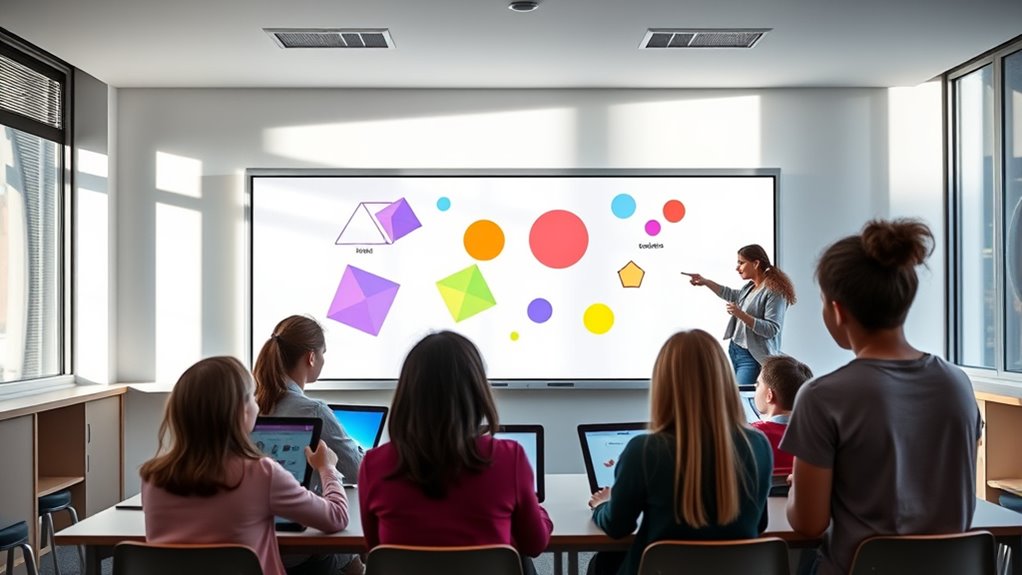

Recent updates in geometry education focus on moving beyond rote memorization. You now emphasize critical thinking, problem-solving, and understanding geometric proofs. Digital tools and interactive models help you visualize shapes and manipulate objects easily. Collaborative activities foster discussion and deeper insight. This modern approach makes geometry more engaging and accessible, preparing you for real-world applications. Keep exploring to discover how these innovative methods transform your learning experience even further.
Key Takeaways
- Emphasizing critical thinking and proof construction over rote memorization in geometry curricula.
- Integrating digital tools like dynamic geometry software to enhance visualization and exploration.
- Promoting spatial reasoning through interactive models, manipulatives, and 3D modeling.
- Incorporating collaborative, problem-based learning to develop reasoning and communication skills.
- Focusing on understanding geometric concepts deeply, including proofs and logical structures.
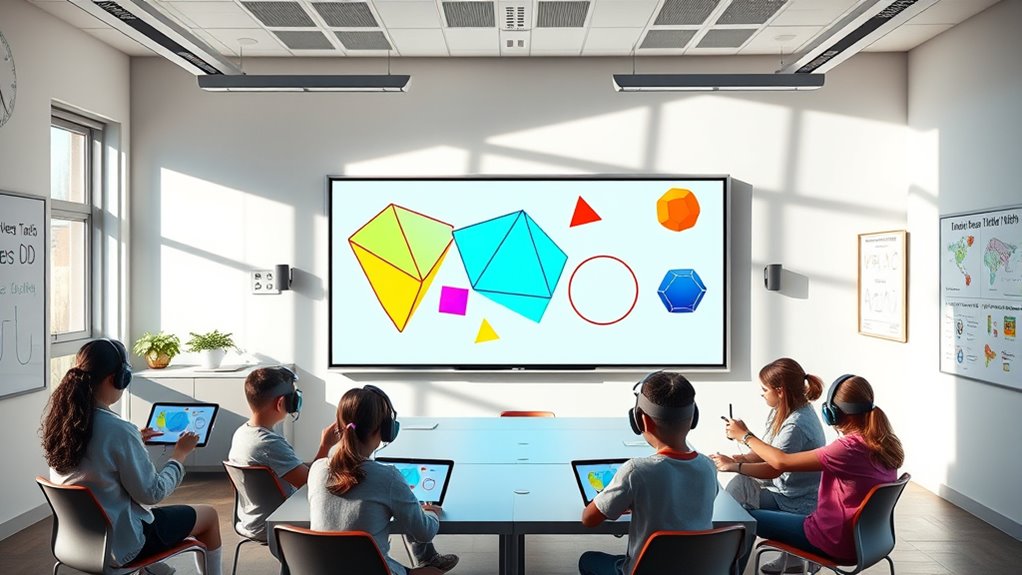
Have you ever wondered how geometry education is evolving to better prepare students for the future? Today’s curriculum updates are shifting away from rote memorization to focus on developing critical thinking skills through engaging methods. One key area gaining emphasis is the understanding of geometric proofs, which are fundamental in helping students grasp the logical structure behind geometric concepts. No longer are students just expected to memorize theorems; now, they’re encouraged to construct their own proofs, analyze different approaches, and understand the reasoning that underpins each step. This approach deepens their comprehension and fosters a more meaningful learning experience.
Alongside proofs, spatial reasoning is becoming a central component in modern geometry education. Spatial reasoning involves visualizing and manipulating shapes and objects in three dimensions, an essential skill for fields like engineering, architecture, and computer science. The new curriculum integrates hands-on activities, digital tools, and interactive models to sharpen these skills. For example, students might use 3D modeling software or manipulatives to explore how shapes fit together or transform. This not only enhances their spatial awareness but also makes abstract concepts more tangible, engaging, and accessible. Incorporating digital tools also aligns with trends in popular educational technology that support interactive learning environments.
Spatial reasoning enhances understanding through hands-on activities, digital tools, and interactive models, making abstract concepts engaging and accessible.
The shift toward incorporating technology plays a significant role in this evolution. Digital platforms allow students to experiment with geometric constructions and proofs dynamically, making the learning process more interactive. For instance, dynamic geometry software enables real-time adjustments to shapes and angles, helping students see how changes affect properties and relationships. This immediate feedback encourages exploration and experimentation, fostering a deeper understanding of geometric principles. It also prepares students for real-world problem-solving, where digital tools are integral.
Furthermore, the updated curriculum emphasizes collaborative learning and problem-based approaches. Instead of working in isolation, students are encouraged to discuss their reasoning, challenge assumptions, and learn from different perspectives. This collaborative environment promotes the development of logical reasoning and communication skills, essential for mastering geometric proofs and spatial reasoning. By engaging in group activities, students learn to articulate their thought processes clearly and listen critically to others’ ideas, enriching their understanding of complex concepts.
Frequently Asked Questions
How Will Teachers Be Trained to Implement the New Geometry Curriculum?
You’ll attend teacher workshops designed to familiarize you with the new curriculum and guarantee you understand its innovative approach. These workshops provide hands-on activities, collaborative planning, and practical strategies for implementation. Additionally, you’ll receive detailed curriculum manuals that serve as essential guides, helping you integrate modern concepts into your lessons seamlessly. This combination of workshops and manuals equips you with the confidence and resources needed to effectively teach the updated geometry curriculum.
Are There Any Assessments Aligned With the Updated Geometry Teaching Methods?
You’ll find assessments are now closely aligned with the updated curriculum, making it easier to measure student understanding effectively. Assessment strategies focus on real-world problem-solving and conceptual understanding, encouraging deeper learning. This alignment guarantees your evaluations reflect the new teaching methods, helping you identify areas where students excel or need extra support. The seamless integration of assessments with curriculum updates keeps your teaching relevant and ensures students are prepared for future challenges.
What Resources Are Available for Students Struggling With the New Content?
If you’re struggling with the new geometry content, you can access interactive tutorials that break down complex concepts into manageable steps. Additionally, peer support groups are available where you can ask questions and share insights. These resources help you grasp the material more effectively and build confidence. Don’t hesitate to use these tools—they’re designed to support you through the shift and improve your understanding of modern geometry lessons.
How Does the New Curriculum Cater to Diverse Learning Styles?
They say, “Different strokes for different folks.” Your new curriculum embraces this by catering to multiple intelligences through differentiated instruction, ensuring each student’s unique learning style is supported. Visual, kinesthetic, and logical learners all find tailored activities that resonate with them. This approach encourages active engagement and helps every student grasp geometric concepts more effectively, fostering confidence and success in a diverse classroom environment.
Will the Updated Curriculum Include Integration With Technology Tools?
Yes, the updated curriculum includes integration with digital tools and interactive platforms. You’ll find that these resources make learning geometry more engaging and accessible, allowing you to explore concepts visually and interactively. By using digital tools like virtual manipulatives and geometry software, you can deepen your understanding and solve problems more effectively. This modern approach helps you stay connected with current technology trends and enhances your overall learning experience.
Conclusion
Imagine stepping into a classroom where geometry isn’t just lines and angles, but a vibrant map of real-world connections. Just like a painter blending colors to create a masterpiece, these updates transform abstract concepts into engaging experiences. Studies show students’ understanding improves when lessons are relatable and interactive. With this modern twist, you’re not just teaching geometry—you’re sparking curiosity and shaping future problem-solvers. Embrace these changes, and watch your students thrive in a world of endless possibilities.