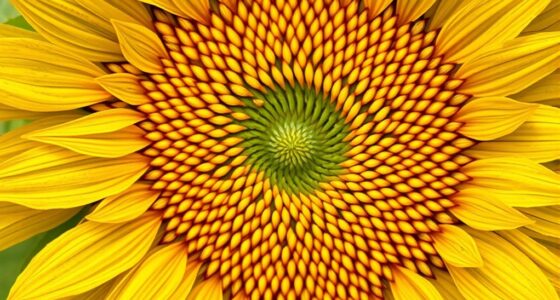

A constant feels natural in mathematics when you see its origins rooted in real-world phenomena or early geometric studies, creating a sense of timelessness. If it appears across different fields and fits seamlessly into formulas, it seems more fundamental. Its connection to natural processes or universal patterns enhances this feeling. These constants often have a rich history, reinforcing their intrinsic link to the universe. Keep exploring to uncover how these constants shape our understanding of the world around us.

Prime made for students and young adults
- Fast, free delivery for dorm and study essentials
- Prime Video and Amazon Music included
- Member-only deals
Key Takeaways
- Constants that seamlessly integrate into fundamental formulas and laws feel more intuitive and “right.”
- Widespread occurrence across multiple scientific disciplines reinforces their perception as universal.
- Their origins linked to real-world phenomena or natural processes enhance their relevance.
- Early and consistent appearance in mathematical history and various fields suggest intrinsic importance.
- Their connection to natural order and physical universe deepens the sense of their inherent “naturalness.”
Have you ever wondered why certain constants in mathematics feel more “natural” than others? It’s a question many thinkers have pondered over the years, and the answer often lies in their historical origins and intuitive significance. These constants aren’t just arbitrary numbers; they carry a deep sense of familiarity and importance because of their roots and the roles they play in understanding the universe. When a constant has a clear historical origin, it becomes more than just a symbol—it becomes a bridge linking mathematical discovery to real-world phenomena. For instance, constants like π have been known for thousands of years, originating from the ancient study of circles. Their historical journey from early geometry to modern mathematics gives them a sense of timelessness and universality. This longstanding presence in human history adds to their intuitive significance, making them feel embedded in our understanding of nature.
The intuitive significance of a constant is closely tied to how naturally it appears within mathematical formulas and physical laws. When a constant seamlessly integrates into equations that describe reality, it starts to feel more “right” or “familiar.” Take e, the base of the natural logarithm—its significance arises from its unique properties relating to growth and decay processes, which are common in nature. Its discovery through the study of compound interest and continuous growth links it directly to real-world phenomena, lending it an innate feel of relevance and importance. Similarly, the golden ratio, φ, appears in art, architecture, and biology, reinforcing its intuitive significance and natural appeal. Its occurrence across diverse contexts makes it feel less like a mere number and more like a fundamental aspect of the universe’s design. Additionally, the universality of these constants across multiple scientific disciplines reinforces their fundamental importance and contributes to their feeling of being “natural.” The recognition of these constants in various contexts also highlights their mathematical elegance, which further enhances their intuitive appeal. Moreover, the repeated appearance of these constants in different mathematical and scientific contexts helps solidify their perceived universality. This interconnectedness across disciplines fosters a sense that these constants are embedded in the very fabric of reality, solidifying their natural status.
The feeling of a constant being “natural” also depends on how early it was integrated into mathematical thought and how consistently it appears in various fields. When a constant arises independently in multiple scientific disciplines, it gains an air of universality, increasing its intuitive appeal. This widespread relevance fosters a sense that the constant is fundamental—an intrinsic part of the fabric of reality. Over time, as mathematicians and scientists uncover more connections involving these constants, their status as “natural” grows stronger. Their historical origins and intuitive significance aren’t just academic details; they shape our perception, making these constants feel like inherent components of the cosmos, rather than mere abstract symbols. The interdisciplinary relevance of these constants further deepens their perceived naturalness, as it shows how interconnected mathematical ideas are with the physical universe. That’s why some constants resonate more deeply—they tell a story, have a purpose, and appear in the natural order, making them feel undeniably “natural” in the grand tapestry of mathematics.
mathematics constants educational poster
As an affiliate, we earn on qualifying purchases.
As an affiliate, we earn on qualifying purchases.
Frequently Asked Questions
How Do Mathematicians Identify Which Constants Are “Natural”?
Mathematicians identify which constants are “natural” by examining their symbolic representations and historical origins. If a constant appears frequently across different areas of mathematics and has a simple, elegant notation, it’s likely considered natural. They also look at its historical discovery and how it connects various concepts. When a constant consistently arises in fundamental formulas, it signals that it holds a special, almost universal, place in mathematical understanding.
Are All Mathematical Constants Equally “Natural” Across Different Fields?
Not all mathematical constants feel equally “natural” across fields. You might see π celebrated for its historical significance in geometry, but e’s cultural interpretation links to exponential growth and calculus. These constants gain their “natural” status through their foundational roles, which vary depending on the context. Visualize this as different lenses: a constant’s importance shifts with the field’s focus, shaping its perceived “naturalness” based on historical and cultural perspectives.
Can a Constant Become “Natural” Over Time With More Research?
Yes, a constant can become “natural” over time as research deepens your understanding. Its historical significance and cultural perceptions influence this shift, often highlighting its importance in various fields. As more discoveries are made, the constant’s role becomes clearer, and it gains acceptance and intuitive appeal. Over time, this evolving perception helps the constant feel more integral and “natural” within mathematical frameworks.
How Do Constants Influence the Development of Mathematical Theories?
Constants influence the development of mathematical theories by guiding algebraic simplifications and enhancing computational efficiencies. When you recognize constants, you can simplify complex equations, making calculations faster and more intuitive. They act as fixed points, helping you identify patterns and relationships within theories. This clarity allows for more elegant proofs and deeper understanding, ultimately shaping how mathematical concepts evolve and how theories are constructed to be more streamlined and effective.
Are There Any Constants Considered “Unnatural” Despite Their Usefulness?
Some constants are seen as “unnatural,” despite their usefulness, because their symbolic representation lacks intuitive clarity or fundamental significance. For example, the imaginary unit ( i ) often feels abstract, like a shadow in the domain of real numbers. Yet, it’s essential for complex analysis. You might find that constants with clear symbolic representation and deep significance feel more “natural,” even if others seem detached or less intuitive.
physical constants reference book
As an affiliate, we earn on qualifying purchases.
As an affiliate, we earn on qualifying purchases.
Conclusion
Think of constants as the familiar landmarks in a vast mathematical landscape, guiding your intuition and understanding. Like a trusted compass, they help you navigate complex equations with ease. When a constant resonates with your experience or appears repeatedly in natural phenomena, it feels ‘natural’—like meeting an old friend in a new city. Embracing these constants reveal a deeper connection to math’s underlying beauty, turning abstract symbols into familiar, comforting signposts.
As an affiliate, we earn on qualifying purchases.
scientific calculator with constants
As an affiliate, we earn on qualifying purchases.
As an affiliate, we earn on qualifying purchases.
Fall Picks
fall essentials
As an affiliate, we earn on qualifying purchases.