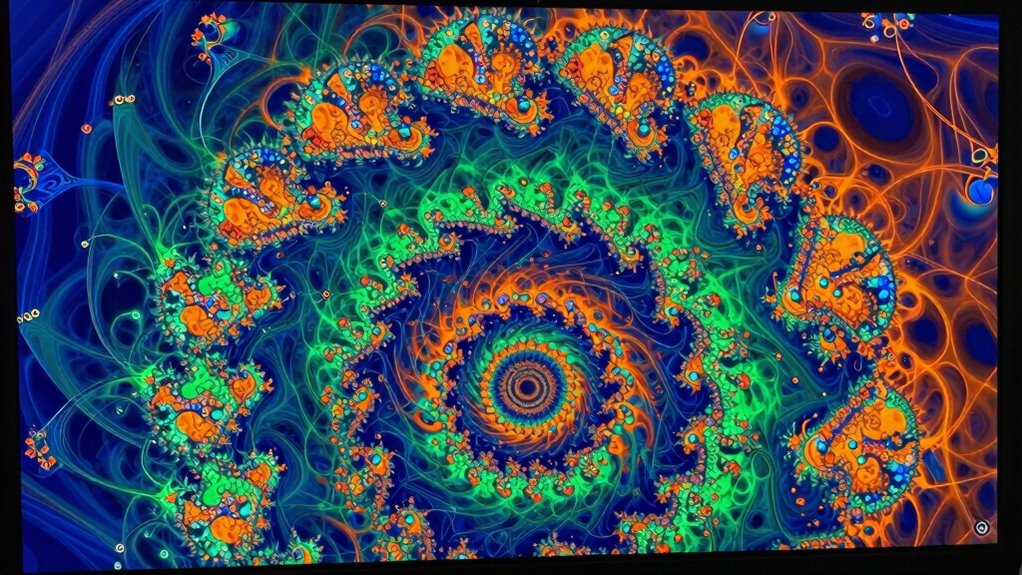

Feigenbaum’s constants appear as precise values that describe how bifurcations in chaotic systems shrink predictably as chaos unfolds. They demonstrate a universal pattern across different nonlinear systems, showing that the shift from order to chaos follows mathematical rules. When you observe these constants, you see that chaos isn’t random but structured. Keep exploring, and you’ll uncover how these elegant patterns reveal the deep interconnectedness of chaos and order.

Get school and study supplies delivered free — and shop member deals
- Fast, free delivery on millions of items
- Access to Prime Big Deal Days deals on October 6–7
- Prime Video, Amazon Music and more included
Key Takeaways
- Feigenbaum’s constants quantify the rate at which bifurcations occur as a system approaches chaos.
- They reveal a universal pattern in the spacing between bifurcations across different chaotic systems.
- The constants demonstrate that the transition to chaos follows predictable, self-similar fractal structures.
- They indicate that chaos development is governed by fundamental mathematical principles, not randomness.
- Feigenbaum’s constants link nonlinear dynamics to universal behaviors in complex systems.
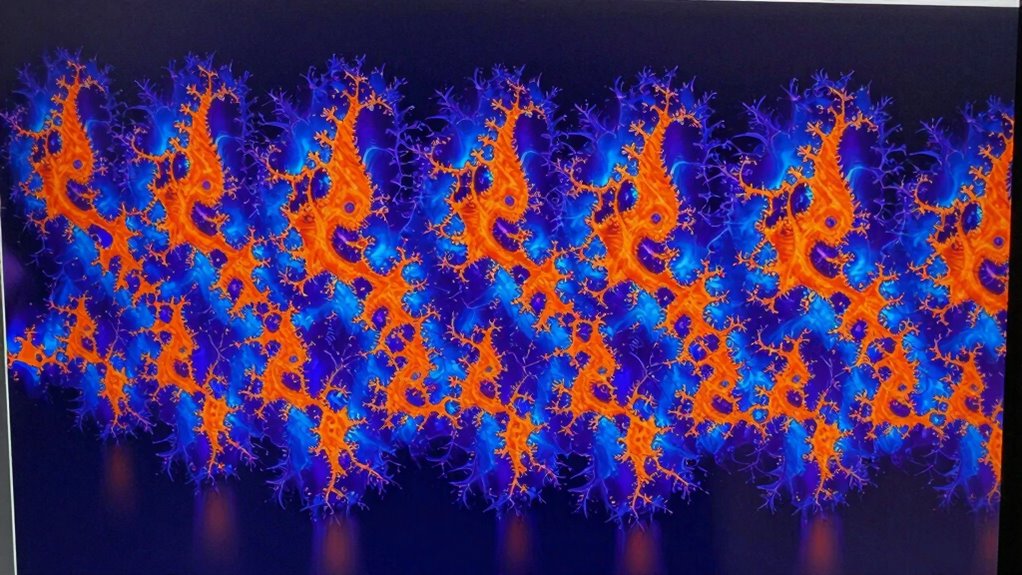
Have you ever wondered how chaos and order are connected in complex systems? It’s a fascinating question because, at first glance, chaos seems unpredictable and disordered, while order appears structured and predictable. But in the world of nonlinear dynamics, these two states are more intertwined than you might think. One of the key insights into this connection comes from the study of fractal bifurcations, which describe how systems transition from simple to complex behavior through a process called bifurcation. As you observe a system like a population model or a fluid flow, you’ll notice that small changes in parameters can lead to drastic shifts in behavior, creating a cascade of bifurcations that lead to chaos. These bifurcations form intricate, self-similar patterns known as fractals, which reveal the underlying order within chaos.
Chaos and order are connected through fractal bifurcations, revealing underlying patterns in complex systems.
Feigenbaum’s constants come into play precisely here. They are numbers that quantify the rate at which these fractal bifurcations occur as a system approaches chaos. When you analyze a nonlinear dynamic system, you’ll see that the bifurcation points don’t just happen randomly; they follow a precise mathematical pattern. As you tune the parameters, the intervals between bifurcations shrink by a consistent ratio, which is what Feigenbaum identified and measured. These constants, approximately 4.6692 for one and 2.5029 for another, show up repeatedly in different systems, hinting at an underlying universality. This universality suggests that the way systems become chaotic isn’t random but governed by fundamental principles.
Understanding how these constants manifest in nonlinear dynamics helps you grasp how complex, seemingly unpredictable systems operate. The concept of fractal bifurcations illustrates how order emerges from chaos—each bifurcation builds upon the previous one, creating a fractal structure that repeats at smaller scales. As you follow the progression, you see that the transition to chaos isn’t abrupt but follows a predictable pattern governed by Feigenbaum’s constants. This insight allows scientists to predict when a system will tip into chaos, even if the detailed behavior remains difficult to forecast. Additionally, recognizing these universal principles can help in developing models to better understand and control complex systems. Recognizing the universal behavior across different systems emphasizes how common underlying mechanisms shape diverse phenomena.
Furthermore, the discovery of these constants has led to a broader understanding of universality in critical phenomena across various scientific fields, emphasizing the interconnectedness of natural laws. In essence, Feigenbaum’s constants reveal that chaos isn’t just random noise but a structured process embedded within nonlinear dynamics. They show that within the seemingly disordered, there’s an underlying order waiting to be uncovered—a pattern woven into the fabric of complex systems. So, when you look at chaos through this lens, you realize that the boundary between order and disorder isn’t as distinct as it seems; it’s part of a continuum governed by universal principles like fractal bifurcations.
As an affiliate, we earn on qualifying purchases.
Frequently Asked Questions
How Are Feigenbaum’s Constants Calculated Mathematically?
You calculate Feigenbaum’s constants through a mathematical derivation involving the logistic map, which models population dynamics. By analyzing bifurcation points where the system shifts from stability to chaos, you measure the ratio of differences between these points. As you examine increasingly complex bifurcations, these ratios approach a universal constant—Feigenbaum’s delta. This process reveals the deep, underlying pattern of chaos in nonlinear systems.
Do Feigenbaum’s Constants Appear in Natural Phenomena?
Yes, Feigenbaum’s constants appear in natural phenomena, especially in fractal patterns and biological systems. You’ll notice these constants in how populations grow, how trees branch, and how coastlines form. They reveal a universal pattern underlying complex systems, showing that chaos isn’t random but follows predictable, mathematical laws. Recognizing these constants helps you understand the underlying order in nature’s seemingly chaotic beauty.
Can Feigenbaum’s Constants Predict Chaotic Behavior Accurately?
You can’t rely solely on Feigenbaum’s constants to predict chaotic behavior precisely. These constants emerge from fractal geometry and mathematical modeling of bifurcations, providing insight into how systems shift into chaos. While they help identify when chaos might occur, real-world systems are complex, and other factors influence their behavior. So, they’re useful tools but not foolproof predictors of chaos in every situation.
Are Feigenbaum’s Constants Universal Across All Chaotic Systems?
You’ll find that Feigenbaum’s constants follow the universality principle, showing up across many chaotic systems due to their elegant mathematical derivation. While not universally applicable to every chaos scenario, these constants reveal a common thread in bifurcation patterns, acting like a shared rhythm in the dance of chaos. Their presence hints at a deeper order amid apparent disorder, highlighting the beauty of interconnected mathematical structures.
How Do Feigenbaum’s Constants Relate to Bifurcation Theory?
You see that Feigenbaum’s constants relate to bifurcation theory through period doubling, a key process in chaos. As a system approaches chaos, the bifurcations double the period of oscillation, and these bifurcations follow a predictable pattern described by fractal geometry. Feigenbaum’s constants quantify the ratio between successive bifurcation intervals, revealing a universal scaling law that connects bifurcation theory to the intricate patterns found in chaotic systems.
fractal bifurcation visualization tools
As an affiliate, we earn on qualifying purchases.
As an affiliate, we earn on qualifying purchases.
Conclusion
So, now you see how Feigenbaum’s constants are like the secret sauce behind chaos theory. They reveal that even in chaos, there’s a pattern waiting to be uncovered, proving that sometimes, you’ve got to read between the lines to see the bigger picture. Keep digging, because in the world of chaos, there’s always more than meets the eye, and understanding these constants could be your way to opening the mysteries of complex systems.
nonlinear dynamics simulation software
As an affiliate, we earn on qualifying purchases.
As an affiliate, we earn on qualifying purchases.
As an affiliate, we earn on qualifying purchases.
Fall Picks
fall essentials
As an affiliate, we earn on qualifying purchases.