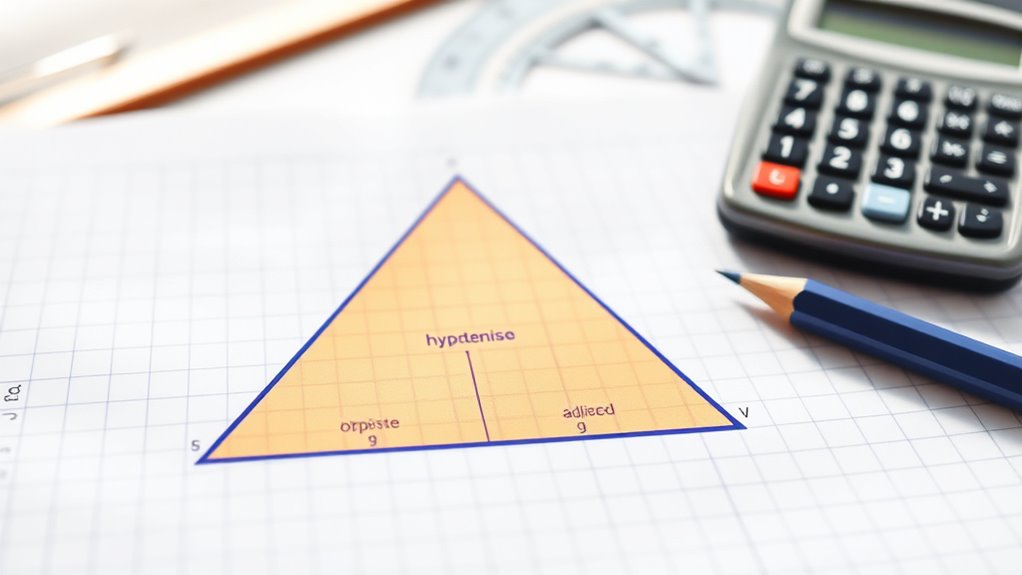

To solve a right triangle with missing sides and angles, start by identifying what you know—angles or sides. Use trigonometric ratios like sine, cosine, or tangent to find unknown sides if an angle and a side are given. To find missing angles when sides are known, apply inverse trigonometric functions. The Pythagorean theorem helps verify your answers or find a side when the other two are known. Keep your calculations organized, and you’ll discover how everything fits together.
Key Takeaways
- Identify known sides and angles, then choose appropriate trigonometric ratios or the Pythagorean theorem.
- Use sine, cosine, or tangent to find missing sides or angles from known data.
- Apply inverse trigonometric functions to determine unknown angles from side ratios.
- Calculate missing sides with the Pythagorean theorem when two sides are known.
- Verify your solutions by checking that all sides and angles satisfy triangle properties.
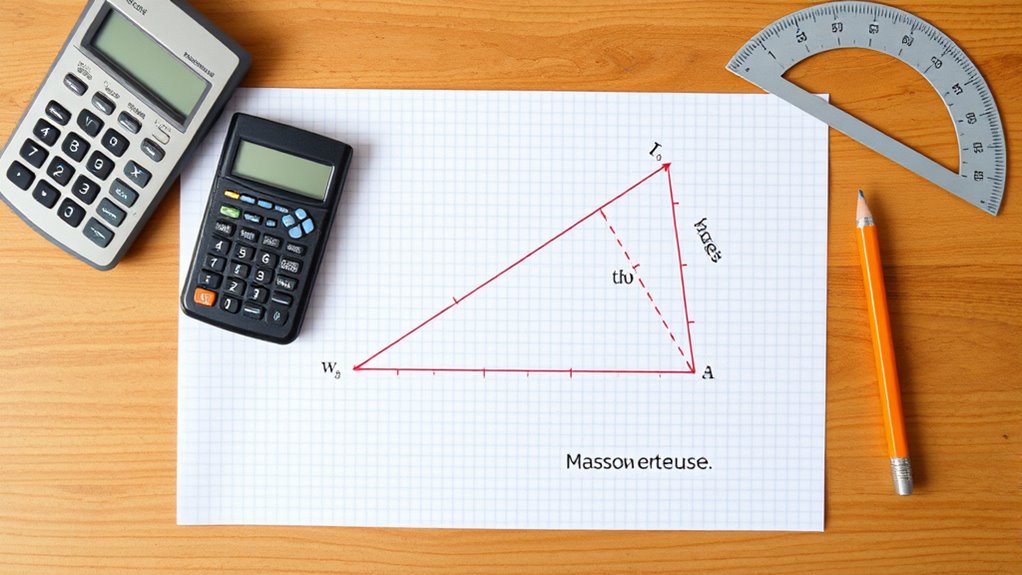
Solving right triangles involves finding the lengths of all sides and the measures of the non-right angles. To do this efficiently, you need to understand the relationship between the sides and angles, which can be established through trigonometric ratios and the Pythagorean theorem. First, identify the known parts of your triangle—whether it’s specific side lengths or angle measures. Once you have this information, you can use trigonometric ratios like sine, cosine, and tangent to find unknown angles or sides. These ratios relate the angles to the sides, making it easier to solve for missing parts.
For example, if you know one side and a non-right angle, you can use sine to find the opposite side, or cosine for the adjacent side. Tangent is especially helpful when you know the lengths of the opposite and adjacent sides. To illustrate, suppose you know an angle and an adjacent side; you can set up a tangent ratio: tangent of that angle equals the opposite side divided by the adjacent side. Rearranging this formula allows you to solve for the unknown side length. Once you have at least two sides or an angle and a side, you can verify your results by applying the Pythagorean theorem, which states that the square of the hypotenuse equals the sum of the squares of the other two sides. This theorem acts as a check to ensure your calculations are consistent and accurate.
Additionally, understanding how trigonometric functions relate angles and sides can improve your problem-solving efficiency and accuracy. After finding one side or angle, you can move on to determine the remaining parts of the triangle. Use inverse trigonometric functions if you need to find an angle from side ratios. For instance, if you know the lengths of the opposite and hypotenuse, applying the inverse sine yields the measure of the angle. Remember, all angles in a right triangle sum to 180 degrees, and since one angle is 90 degrees, the other two must add up to 90 degrees. This helps confirm your calculations and ensures your solutions make sense within the triangle’s context.
Throughout the process, it’s essential to keep your calculations organized. Use the known values to set up ratios and formulas, then solve step-by-step. The Pythagorean theorem is your go-to tool when you have two sides and need to find the third, especially when the given data doesn’t directly relate to the angles. Combining this with trigonometric ratios allows you to solve for all unknowns systematically. With practice, you’ll develop a clear method for solving any right triangle efficiently, confidently finding missing sides and angles with precision.

Texas Instruments TI-30Xa Scientific Calculator
- Display: 10-digit display for various math tasks
- Functions: Trigonometric, logarithmic, roots, powers, factorials
- Operations: Fraction calculations and basic arithmetic
As an affiliate, we earn on qualifying purchases.
Frequently Asked Questions
Can I Solve a Right Triangle With Only One Known Side?
Yes, you can’t fully solve a right triangle with only one known side because you lack enough information to determine the other sides and angles. To find missing parts, you rely on angle relationships and side length ratios, which require at least one side and one angle or two sides. Without that, the triangle’s dimensions remain indeterminate. You need additional data to apply trigonometry and solve the triangle completely.
Are There Special Cases for Solving Right Triangles?
Yes, there are special cases for solving a right triangle that can make your task easier or trickier. When two sides are known, or one side and an angle are given, you can use specific methods like the Pythagorean theorem or trigonometric ratios. These special cases act like shortcut keys, helping you solve the right triangle quickly and efficiently, especially when the triangle has some unique properties or constraints.
How Do I Verify My Solutions for Accuracy?
You verify your solutions by checking if your calculated angles and sides fit within the unit circle’s trigonometric values. Use trigonometric identities to confirm your results, guaranteeing sine, cosine, or tangent ratios match known identities. Also, verify that the sum of angles equals 90° and that your side lengths satisfy the Pythagorean theorem. This double-check helps ensure your solutions are accurate and consistent with right triangle properties.
What Tools or Software Can Assist in Solving Right Triangles?
You can use graphing calculators or triangle solver apps to easily solve right triangles. These tools allow you to input known sides or angles and quickly find missing measurements. Graphing calculators, like the TI-84, are versatile for complex calculations, while apps such as “Right Triangle Solver” provide quick, user-friendly interfaces. Both options help you verify your solutions and guarantee accuracy without manual guesswork.
How Does the Pythagorean Theorem Apply to Non-Right Triangles?
In non-right triangles, the Pythagorean theorem doesn’t directly apply, but you can use triangle similarity and trigonometric ratios instead. For example, if you have a triangle with two known angles and one side, you can find missing sides using sine, cosine, or tangent. These ratios relate angles to side lengths, helping you solve the triangle even when it isn’t a right triangle.

Texas Instruments TI-30XS MultiView Scientific Calculator
- MultiLine Display: View up to four calculations simultaneously
- Textbook Math Display: Displays math expressions as in textbooks
- Scientific Notation: Shows results in proper scientific notation
As an affiliate, we earn on qualifying purchases.
Conclusion
Now that you know how to solve right triangles, you can confidently find missing sides and angles using basic formulas. Don’t worry if it feels tricky at first—practice makes perfect. Even if you’re not a math whiz, these steps are simple once you get the hang of them. Keep practicing, and you’ll master solving right triangles in no time! Remember, every expert was once a beginner, so stay patient and keep trying.

Texas Instruments TI-36X Pro Engineering/Scientific Calculator | 9.7 Inch | Black.
- Suitable for non-graphing curricula: Ideal for exams without graphing allowed
- MultiView display: Displays multiple calculations simultaneously
- MathPrint technology: Shows math expressions and symbols clearly
As an affiliate, we earn on qualifying purchases.