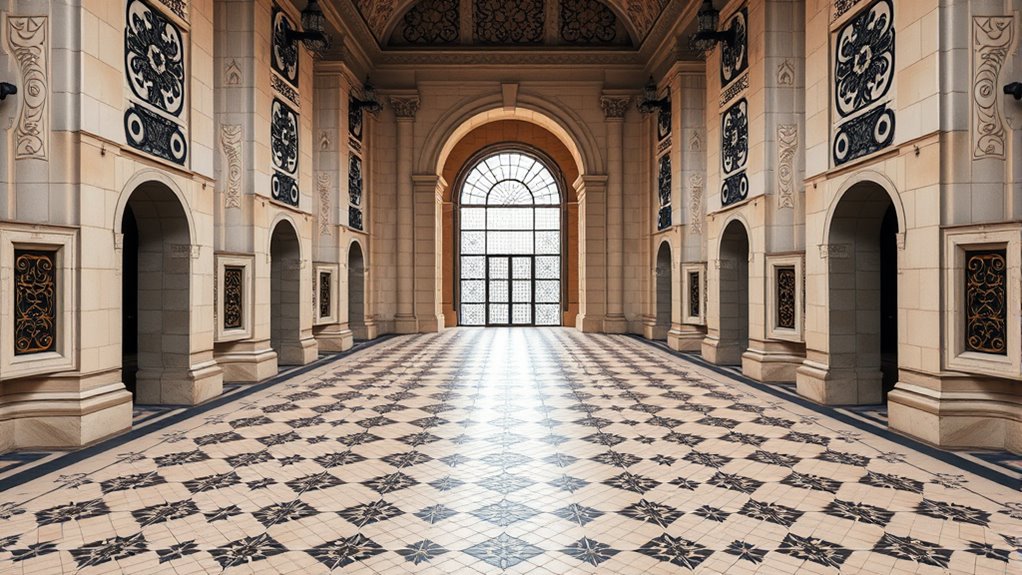

Symmetry involves creating balance in patterns and shapes through lines, points, and repetitions. You’ll find reflection symmetry when an object looks the same after flipping it over a line, like a butterfly’s wings. Rotational symmetry happens when a shape repeats after spinning around a point, like a star. Recognizing these types helps you see how natural and man-made designs achieve harmony. Keep exploring, and you’ll discover even more about how symmetry shapes the world around you.
Key Takeaways
- Symmetry involves balanced patterns created through reflections or rotations around lines or points.
- Reflection symmetry flips an object over a line, producing mirror images that remain unchanged.
- Rotational symmetry occurs when an object looks the same after rotating around a central point by specific angles.
- Both types of symmetry contribute to visual harmony, aesthetic appeal, and pattern recognition.
- Recognizing symmetry helps understand natural and man-made designs, enhancing perception of order and beauty.
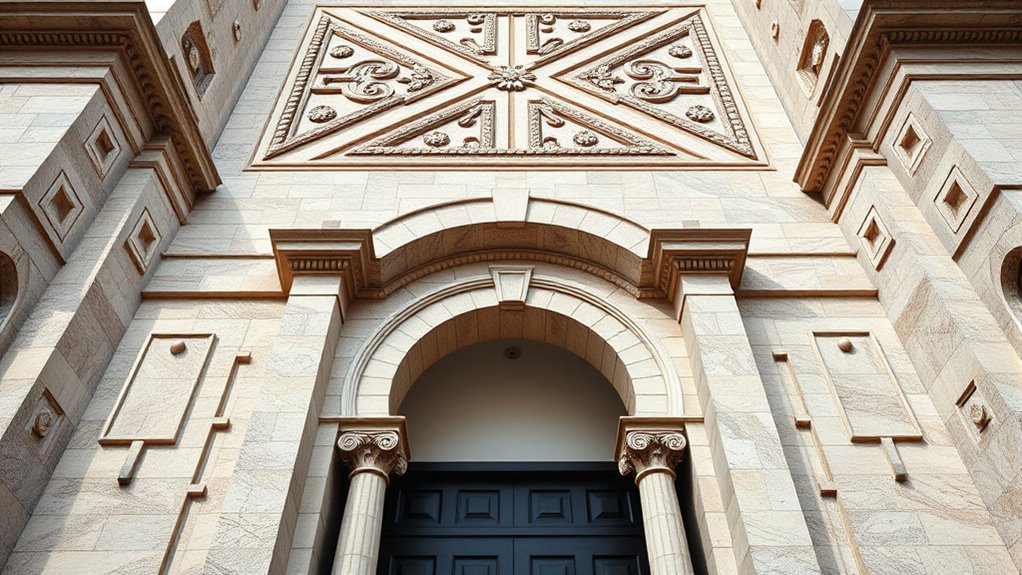
Have you ever wondered what makes objects and patterns look balanced and harmonious? It’s often because they exhibit symmetry, a fundamental concept that creates a sense of order and beauty. Symmetry isn’t just about mirror images; it encompasses various types that contribute to how we perceive patterns and shapes. One important aspect to understand is reflection types, which describe how an object can be flipped over a line—called the line of symmetry—and still look the same. These reflection types include vertical, horizontal, and sometimes diagonal symmetry, depending on the pattern. When you observe a butterfly or a human face, you’re seeing examples of reflection symmetry, where one side mirrors the other perfectly. Recognizing these reflection types helps you appreciate the balance in natural and man-made designs, from architecture to art. Additionally, the technology used in projectors, such as color accuracy, can influence how patterns and images are perceived, emphasizing the importance of precise visual presentation.
Beyond reflection, rotational symmetry plays a *vital* role in creating balanced patterns. Rotational symmetry occurs when you rotate an object around a central point, and it still looks exactly the same at certain angles. For example, a snowflake or a star often exhibits rotational symmetry, repeating their pattern after a specific turn, like 60°, 90°, or 120°. The degree of rotation needed for the pattern to look unchanged is called the *order* of rotational symmetry. If you spin a pattern and it matches its original form six times during a full turn, it has sixfold rotational symmetry. This type of symmetry is *powerful* because it allows for intricate, repeating designs that seem dynamic yet balanced, making them pleasing to the eye. Understanding rotational symmetry helps you see how complex patterns in tiles, jewelry, and textiles are constructed with a sense of harmony.
Both reflection types and rotational symmetry serve a purpose in design, art, and nature. They create patterns that are easy for the human eye to process and find appealing. When you notice symmetry in your surroundings, whether it’s in a building’s facade, a flower’s petals, or a symmetrical dance move, you’re experiencing how these symmetry types work together to form a feeling of completeness. By recognizing these concepts, you gain a deeper appreciation for the structure behind beautiful patterns and shapes. Symmetry isn’t just an aesthetic feature; it’s a *foundational* principle that influences how we interpret the world around us. So next time you see a repetitive pattern or a balanced object, consider the reflection types and rotational symmetry that make it so *engaging*.
Frequently Asked Questions
How Does Symmetry Appear in Nature Beyond Geometry?
You’ll notice symmetry in nature beyond geometry through natural camouflage, which helps animals blend into their surroundings. Symmetrical patterns offer evolutionary advantages by making prey less visible to predators or aiding in mate attraction. For example, butterfly wings display bilateral symmetry, enhancing survival. This natural symmetry not only creates beauty but also plays a crucial role in species’ adaptation and evolution, demonstrating nature’s inherent balance and harmony.
Can Symmetry Be Used to Improve Art and Design?
Yes, symmetry can notably improve your art and design by creating aesthetic enhancement and visual balance. When you incorporate symmetrical elements, your work feels harmonious and pleasing to the eye. Symmetry helps guide viewers’ attention and emphasizes important features. By using lines, points, and patterns consciously, you can craft compositions that are both engaging and well-structured, elevating your creative projects to a more polished and professional level.
What Are the Challenges in Identifying Complex Symmetry Patterns?
You might struggle with complex pattern recognition when identifying symmetry patterns, as they often involve intricate designs that aren’t immediately obvious. The challenge lies in accurately classifying symmetry types, especially when multiple symmetries overlap or are subtle. You need to carefully analyze the pattern’s features, such as lines, points, and motifs, to distinguish between different symmetry classifications and understand the underlying structure.
How Is Symmetry Related to Mathematical Concepts Like Group Theory?
Did you know that there are exactly 17 types of symmetry groups in two dimensions? Symmetry relates to group theory through concepts like group actions, which describe how symmetry operations—like reflections or rotations—act on objects. These symmetry groups help mathematicians classify patterns systematically, revealing the underlying structure of shapes and designs. By understanding the connection, you can better analyze complex patterns and appreciate their mathematical beauty.
Are There Cultural Differences in the Perception of Symmetry?
Yes, you’ll notice cultural differences in how symmetry is perceived. In some cultures, symmetry symbolizes balance and harmony, shaping aesthetic preferences and cultural symbolism. For example, in Asian art, symmetry often emphasizes spiritual balance, while Western designs might prioritize visual appeal. Your perception of symmetry is influenced by these cultural cues, affecting how you interpret patterns, architecture, and art across different societies.
Conclusion
Now that you understand the basics of symmetry, you’ll see it everywhere—from art to nature. Did you know that nearly 60% of plant leaves exhibit some form of symmetry? Recognizing these patterns helps you appreciate the beauty and order around you. Keep exploring different shapes and designs, and you’ll discover symmetry’s fascinating role in our world. So, next time you see a pattern, remember—you’re spotting the hidden harmony that makes everything look balanced and enthralling.