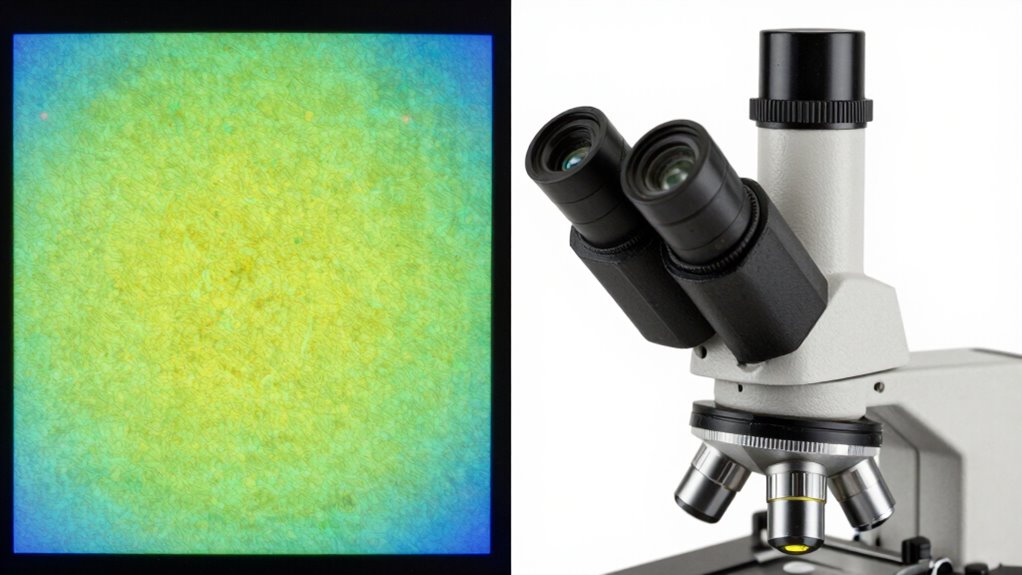

If you need true 3D depth perception, a stereo microscope is your best choice. It offers binocular optical paths that provide genuine depth cues, giving you a realistic three-dimensional view. Digital microscopes generally show flat, two-dimensional images, which limit depth perception, although some models incorporate 3D imaging. To understand how these differences impact your projects and which option suits your needs best, explore the details below.
Key Takeaways
- Stereo microscopes provide true depth perception through binocular optical paths, offering a genuine 3D view.
- Digital microscopes produce flat, 2D images but may include 3D imaging features that simulate depth.
- Depth perception in stereo microscopes relies on optical design, optical path separation, and high-quality lighting.
- Digital microscopes with stereoscopic imaging or 3D reconstruction enhance depth cues beyond simple 2D imaging.
- For accurate true depth, stereo microscopes generally outperform digital microscopes, which often rely on image processing for depth simulation.
Which Microscope Shows Better 3D Depth: Digital or Stereo?
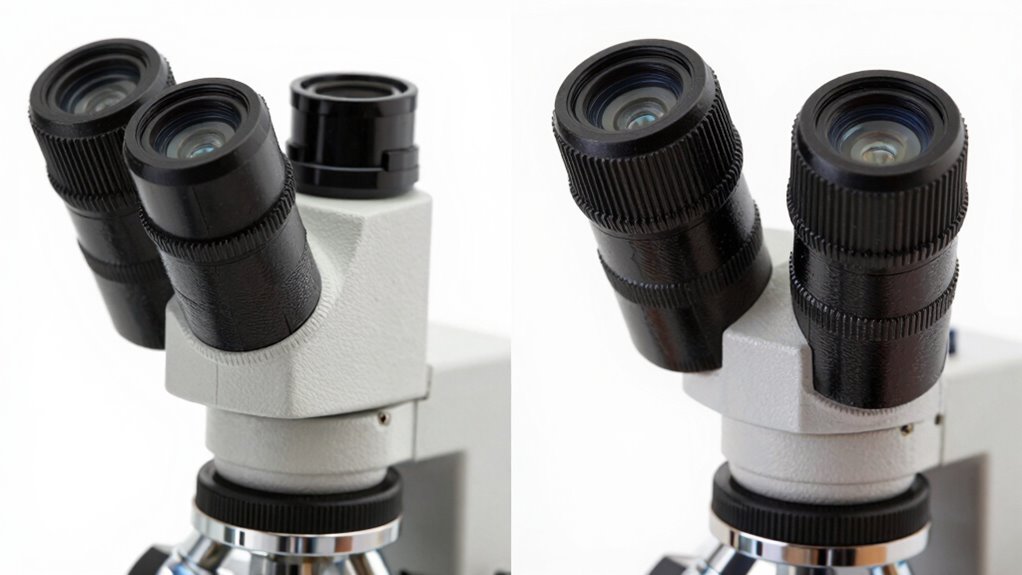
When it comes to seeing true 3D depth, stereo microscopes generally outperform digital microscopes. This is because they excel at providing better depth perception, which is essential for accurately judging the spatial relationships of your specimen. Stereo microscopes use dual optical paths, giving you a sense of three-dimensionality that digital microscopes often struggle to replicate. The imaging technology in stereo microscopes creates a natural, stereoscopic view, allowing you to perceive depth much more effectively. Digital microscopes tend to produce flat, two-dimensional images on a screen, limiting your ability to judge how objects relate in space. If depth perception is a priority, especially for tasks requiring precise manipulation, a stereo microscope is usually the better choice due to its superior imaging technology designed for 3D visualization. Additionally, the high resistance to wear and tear of stereo microscopes ensures consistent performance over time, making them a reliable tool for detailed observations. Their robust construction can also contribute to maintaining consistent optical clarity, which is vital for accurate depth judgment. Moreover, stereo microscopes often feature ergonomic designs that facilitate extended use without fatigue, enhancing observational accuracy. Furthermore, stereo microscopes incorporate advanced optical systems that improve image quality and depth cues, making them especially useful in complex inspection tasks. In addition, the ability of stereo microscopes to provide true depth perception makes them particularly valuable in fields like biological dissection, electronics repair, and quality control.
What Features Make a Microscope Good at Showing Depth?
Features that enhance a microscope’s ability to show depth mainly revolve around its optical design and imaging capabilities. Good depth cues come from how well the microscope maintains focus across different layers and how it manages light to create contrast and shadow. A microscope with high image resolution allows you to see fine surface details, which helps in perceiving depth more accurately. Sharp, clear images with minimal distortion provide better visual cues for depth perception. Additionally, optical systems that minimize aberrations and use appropriate lighting techniques improve the three-dimensional sense. Ultimately, a combination of strong depth cues and high image resolution makes a microscope more effective at conveying true depth, helping you analyze specimens with greater clarity and spatial understanding.
Do Stereo Microscopes Provide True 3D Visualization?
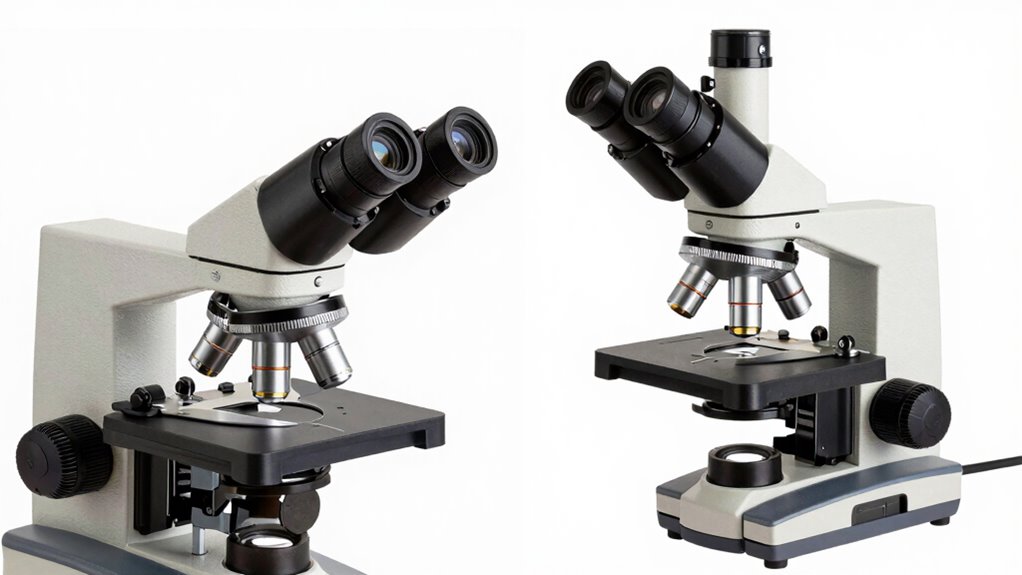
Stereo microscopes are designed to provide a three-dimensional view of specimens, but they do not produce true 3D images in the same way human eyes perceive depth. Instead, they create a stereoscopic effect through binocular vision, giving the illusion of depth. You might feel like you’re seeing a true 3D image, but it’s more about how your brain interprets slightly different angles from each eyepiece. The illusion of depth is influenced by the binocular disparity, which is the slight difference in images seen by each eye. This effect relies on the visual processing capabilities of the brain to interpret the images, rather than on the microscope creating an actual 3D image. Additionally, the quality of the stereoscopic effect can vary depending on the design and calibration of the microscope itself.
Can Digital Microscopes Accurately Show Depth? Pros and Cons
Digital microscopes have advanced substantially in recent years, offering high-resolution images and ease of use. However, when it comes to depth perception, they face limitations. While digital microscopes can provide detailed imaging accuracy, they often struggle to replicate true depth perception like stereo microscopes do. Some models incorporate 3D imaging or multiple lenses to improve depth cues, but these features may add complexity and cost. The lack of direct optical depth cues can make it harder to judge distances accurately, especially for intricate tasks. On the plus side, digital microscopes excel in capturing images for documentation and remote viewing. Additionally, depth perception capabilities vary widely among models, influencing their suitability for different applications. Overall, they can show depth to a degree, but for precise depth perception, they might not fully match the capabilities of traditional stereo microscopes.
When Do You Need Depth Perception Most in Your Projects?
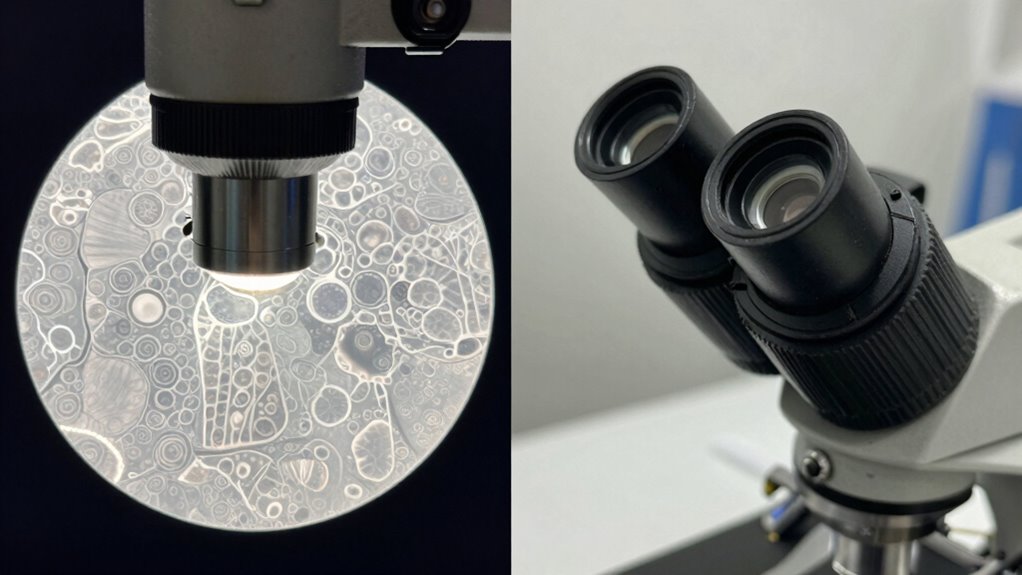
Depth perception becomes essential when your project requires precise manipulation or measurement of tiny objects, such as in microelectronics, biological research, or jewelry crafting. It helps you judge distances accurately and avoid mistakes. In astronomy, depth perception is crucial for understanding celestial distances, often enhanced by digital imaging techniques that combine multiple images for 3D effects. Imagine visualizing these scenarios:
| Task | Need for Depth Perception |
|---|---|
| Assembling microchips | Precise placement requires depth awareness |
| Examining biological tissues | Differentiating layers depends on depth |
| Crafting jewelry | Precise measurements demand depth insight |
| Analyzing planets in space | 3D understanding relies on depth cues |
| Using digital imaging tech | Combining images to create depth perception |
How to Choose the Right Microscope for Depth-Based Tasks
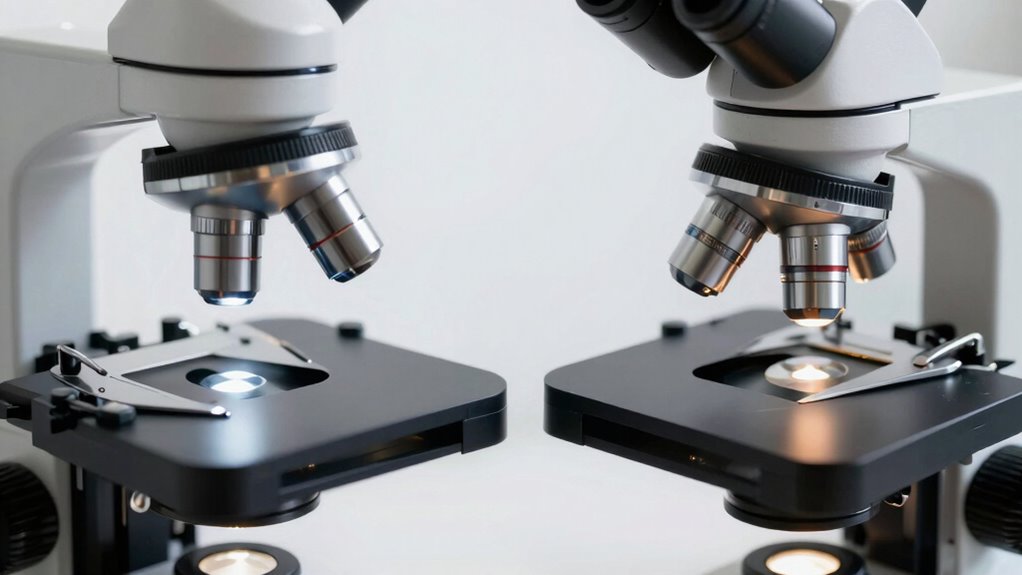
To select the appropriate microscope for depth-based tasks, you need to evaluate your specific depth perception requirements. Consider which features, like stereoscopic viewing or adjustable focus, will best support your projects. Matching these features to your needs guarantees you choose the most effective tool for your work. Additionally, understanding media literacy helps ensure you interpret online information about microscopes accurately and confidently.
Assessing Depth Perception Needs
Choosing the right microscope for depth-based tasks starts with understanding how much three-dimensional perception you need. Consider the importance of depth cues, such as shading, perspective, and parallax, which help your brain interpret spatial relationships. If these cues are essential for your work, a stereo microscope with true depth perception will serve you best. Be aware that some microscopes can produce visual illusions that affect depth perception, leading to misjudgments. Testing different models can help you identify which microscope offers the most accurate depth cues for your specific tasks. Ultimately, evaluating your needs involves understanding how critical accurate depth perception is to your work and choosing a microscope that minimizes visual illusions while maximizing realistic depth cues. Additionally, understanding the concept of Free Floating can be beneficial in assessing how different microscope designs influence depth perception and visual accuracy. Recognizing how visual illusions impact depth perception can help you select equipment that offers more reliable spatial cues. Moreover, considering the cost and quality of the microscope can influence the accuracy of depth perception and overall performance. Evaluating factors like ergonomic design can also improve your comfort and reduce fatigue, leading to better visual performance during extended use. To make an informed decision, it is also helpful to review user experiences and compare different models based on their ability to provide true three-dimensional viewing.
Matching Microscope Features
When selecting a microscope for tasks that rely on accurate depth perception, it is essential to compare features that influence three-dimensional viewing. Fiber optics can enhance illumination, providing even, shadow-free lighting that improves depth cues. Look for microscopes with adjustable fiber optic light sources to tailor lighting conditions for better spatial awareness. Additionally, consider the image resolution; higher resolution offers sharper, more detailed images, making it easier to distinguish subtle depth differences. Match these features to your specific needs—if you require precise depth judgment, prioritize models that combine fiber optic illumination with high-resolution imaging. By aligning these features with your tasks, you guarantee better depth perception and more accurate results during your microscopic work. Ensuring proper lighting quality is crucial, as it significantly impacts the accuracy of depth cues and overall viewing clarity.
Summary: Which Microscope Offers the Best True Depth?

Summary: Which Microscope Offers the Best True Depth?
When comparing microscopes, your focus should be on image depth perception, which affects how well you see three-dimensional details. Optical path differences influence clarity and the sense of depth, making some systems better at providing true depth. By examining focus and clarity, you can determine which microscope truly offers the most accurate three-dimensional view. Additionally, understanding the principles of Haute Couture, such as craftsmanship and detail, can help appreciate the precision required in high-quality optical instruments. Recognizing the importance of optical engineering can further enhance your understanding of how these instruments are designed for optimal depth perception. Furthermore, considering the scientific skepticism surrounding some claims about depth perception can help you evaluate the reliability of different microscopes. Exploring the cryptid mysteries and their elusive nature can serve as an analogy for understanding how visual perception can be deceived or enhanced through precise optical tools. Developing a solid foundation in optical principles can also assist in discerning the true capabilities of various microscopy systems.
Image Depth Perception
Digital microscopes generally provide a more accurate sense of depth compared to stereo microscopes, thanks to their advanced imaging technology. They utilize stereoscopic imaging, which combines two slightly different images to create a three-dimensional effect. This technique enhances your perception of depth, making it easier to judge distances and spatial relationships. Additionally, digital microscopes often incorporate sophisticated depth measurement techniques, such as focus stacking or 3D reconstruction, further improving true depth perception. While stereo microscopes also offer some three-dimensional view through optical design, digital systems tend to deliver more precise and consistent depth cues. As a result, digital microscopes are better suited when accurate depth perception is critical for detailed analysis or measurements, especially considering their depth measurement accuracy, which can be vital for scientific and industrial applications where precise spatial data is essential. Moreover, these systems often feature spatial understanding improvements that assist in complex examinations.
Optical Path Differences
Which microscope offers the best true depth? Optical path differences play a key role. In digital microscopes, light travels through a digital camera and display, which can introduce parallax effects, causing optical illusions that distort true depth perception. These effects make objects appear shifted or flattened, reducing the sense of three-dimensionality. Stereo microscopes, on the other hand, use separate optical paths for each eye, maintaining consistent optical pathways that preserve depth cues. This minimizes parallax effects, providing a more accurate sense of true depth. The clear separation of optical paths in stereo microscopes ensures your brain receives reliable spatial information, reducing optical illusions. As a result, stereo microscopes typically offer superior depth perception, especially when it comes to accurately judging the spatial relationships of objects.
Focus and Clarity
Achieving sharp focus and clear images is essential for accurately perceiving depth in microscopy. Your ability to see fine details depends heavily on lighting conditions, which can enhance or obscure clarity. Digital microscopes often offer adjustable lighting, helping you to optimize contrast and detail at various magnification levels. Stereo microscopes excel in providing a wide depth of field, maintaining clarity even as you change magnification. With proper focus, both microscopes can reveal true depth, but the stereo microscope’s design naturally supports better focus across different layers. In contrast, digital microscopes may require frequent refocusing at higher magnifications, which can impact clarity. Proper lighting and magnification levels are crucial for achieving crisp, three-dimensional images, and understanding plant properties can help in selecting the best equipment for specific observation needs. Additionally, depth perception is significantly enhanced by the microscope’s optical design, especially in stereo microscopes.
Frequently Asked Questions
Can Digital Microscopes Simulate True 3D Depth Effectively?
Digital microscopes can’t fully simulate true 3D depth because they rely on optical illusions created by digital rendering, which can sometimes distort depth perception. While they offer detailed images, they may give a false sense of depth, making it harder to interpret spatial relationships accurately. You might notice that the depth perception isn’t as precise as with stereo microscopes, which provide true three-dimensional views through optical means.
Are There Specific Applications Where Stereo Microscopes Outperform Digital Ones?
Yes, stereo microscopes outperform digital ones in application-specific situations that require stereo imaging and true depth perception. You’ll find them especially useful in tasks like dissecting biological specimens, precision assembly, or examining intricate circuit boards, where depth cues are essential. Their optical design offers better clarity and depth, making them ideal for detailed, three-dimensional views. Digital microscopes may struggle in these scenarios, lacking the natural depth perception stereo microscopes provide.
How Does User Experience Influence Depth Perception Accuracy?
Your user experience greatly impacts depth perception accuracy, as it’s often believed that better ergonomics and training enhance visual clarity. When you’re comfortable and well-trained, your eyes and hands coordinate smoothly, reducing fatigue and errors. Proper ergonomics minimize strain, allowing you to maintain focus longer. With targeted user training, you develop better depth cues recognition, making your observations more precise. So, investing in ergonomics and training directly improves your depth perception.
What Are the Limitations of Digital Microscopes in Depth Measurement?
Digital microscopes have limitations in depth measurement accuracy because their depth perception relies on digital imaging instead of true optical depth cues. You might notice issues like reduced 3D clarity, difficulty in capturing precise depth data, and potential distortions. These digital microscope limitations can make it harder to accurately measure and interpret three-dimensional features, especially compared to optical systems like stereo microscopes that provide more natural depth perception.
Is Additional Equipment Needed for Enhanced Depth Visualization?
You don’t need extra equipment for better depth visualization if your microscope has binocular vision, as it naturally enhances depth perception. However, adding advanced depth sensors can considerably improve your experience, especially with digital microscopes. These sensors provide more accurate 3D imaging, making it easier to judge distances and details. So, consider upgrading with depth sensors for an improved, more immersive viewing experience.
Conclusion
Think of choosing a microscope like picking a pair of glasses—you want clear, true depth to see your details sharply. If you’re working on intricate jewelry or biological samples, a stereo microscope can feel like having X-ray vision, revealing true 3D depth. Digital microscopes are great for sharing and recording, but may lack that genuine depth. Pick the right tool, and you’ll see your projects in perfect, lifelike clarity—making every detail pop like a well-placed spotlight.