Discover how sacred geometry connects you to the universe’s divine blueprint through timeless patterns like the Flower of Life and Vesica Piscis. These shapes symbolize interconnectedness, balance, and spiritual unity, helping you tap into higher consciousness and inner harmony. Incorporating sacred geometry into your practice or spaces can deepen your spiritual journey and foster a sense of universal order. Continue exploring, and you’ll uncover how these ancient symbols still hold powerful significance for modern spiritual growth.
Key Takeaways
- Sacred geometry reveals universal patterns that underpin spiritual concepts, fostering deeper connections in modern spiritual practices.
- Symbols like the Flower of Life and Vesica Piscis serve as gateways to higher consciousness and spiritual awakening.
- Incorporating sacred geometric shapes in meditation and sacred spaces enhances feelings of harmony and divine order.
- Contemporary spirituality embraces these patterns to promote stability, interconnectedness, and a sense of timeless wisdom.
- Sacred geometry acts as a universal language that links personal growth with the divine blueprint of the universe.
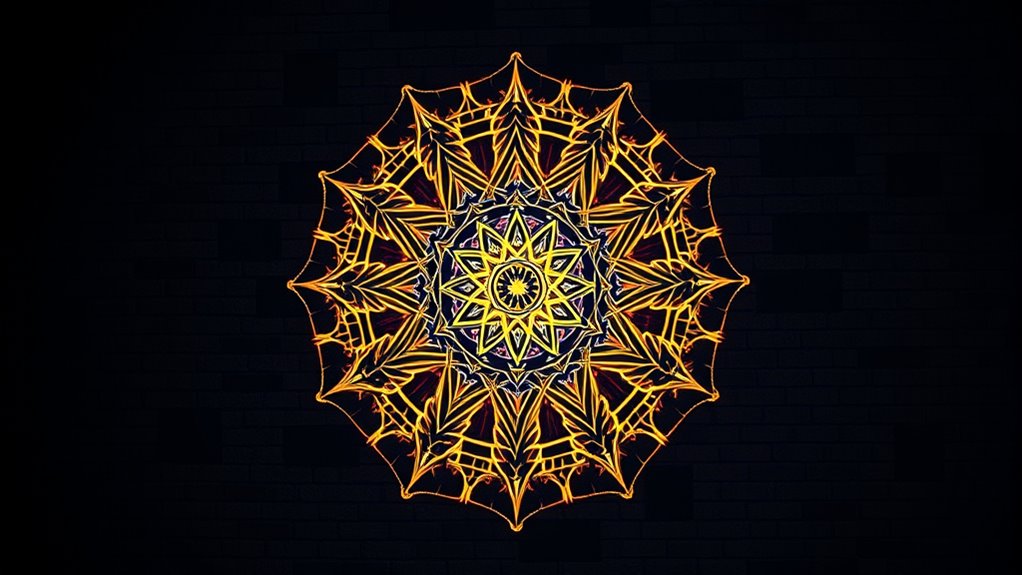
Have you ever wondered why certain shapes and patterns appear repeatedly in art, architecture, and nature? These recurring forms are no accident; they’re rooted in what’s called sacred geometry—a collection of mathematical patterns that have fascinated humans for centuries. When you look closely, you’ll notice that these geometric shapes aren’t just visually appealing; they carry deep spiritual symbolism, connecting us to the universe on a fundamental level. Sacred geometry reveals that the universe itself is built upon precise mathematical patterns, like the perfect proportions of the golden ratio or the intricate spirals of the nautilus shell. These patterns aren’t random; they’re embedded within the fabric of creation, echoing a divine order that many spiritual traditions seek to understand and emulate. Recognizing these geometric principles can deepen your appreciation of the interconnectedness inherent in all life.
As you explore this domain, you’ll see how these mathematical patterns serve as symbols of spiritual truth. For instance, the Flower of Life—a complex pattern of overlapping circles—appears in countless sacred sites and artworks. It’s believed to represent the interconnectedness of all life, embodying unity and harmony. Similarly, the Vesica Piscis, formed by two overlapping circles, symbolizes the union of dualities—such as spirit and matter or male and female—highlighting balance and divine harmony. These shapes are more than simple visuals; they’re visual expressions of spiritual concepts, acting as gateways to higher consciousness. When you incorporate these symbols into meditation or sacred spaces, they can help you connect more deeply with your spiritual self and the universe’s underlying order.
Modern spirituality often embraces these geometric patterns because they evoke a sense of timeless wisdom. Using sacred geometry in your practice might include creating mandalas, designing sacred spaces, or simply contemplating these shapes during meditation. The mathematical precision of these patterns can foster a feeling of stability and interconnectedness, reminding you that everything in existence is part of a greater, divine blueprint. In this way, sacred geometry becomes a tool for spiritual awakening, offering insights into the universe’s sacred design and your place within it. By recognizing these patterns, you tap into an ancient language that speaks to the core of your spiritual journey, helping you find harmony, purpose, and a sense of unity with all that surrounds you.
Frequently Asked Questions
How Can Sacred Geometry Influence Daily Spiritual Practices?
Sacred geometry influences your daily spiritual practices by enhancing your connection to the universe through numerology symbolism and meditation techniques. You can incorporate geometric patterns into your meditation to deepen focus and insight, while understanding numerology symbolism helps you interpret personal experiences. These practices foster mindfulness, promote spiritual growth, and create harmony in your routines, making sacred geometry a powerful tool for aligning your mind and spirit every day.
Are There Specific Tools Used to Study Sacred Geometry?
Think of sacred geometry as a hidden symphony, where geometric patterns reveal divine harmony. You use measurement tools like compasses, rulers, and protractors to explore these intricate designs. These tools act as your keys, revealing the secrets of perfect circles, spirals, and polygons. By studying these, you deepen your understanding of the universe’s sacred blueprint, making the complex beauty of geometric patterns your personal guide on the spiritual journey.
What Are Common Misconceptions About Sacred Geometry?
You might think sacred geometry is just mystical symbols, but it’s often misunderstood due to myth busting and cultural distortions. Many believe it’s solely spiritual or ancient, ignoring its presence in nature and architecture. It’s not about secret knowledge or exclusive practices. Instead, sacred geometry reveals universal patterns, bridging science and spirituality. Recognize these misconceptions and appreciate how cultural distortions have shaped false ideas, enriching your understanding of this fascinating subject.
Can Sacred Geometry Be Integrated Into Modern Architecture?
Yes, you can integrate sacred geometry into modern architecture by applying geometric design principles that emphasize harmony and proportion. You’ll find architectural symbolism in structures that incorporate these patterns, creating visually striking and spiritually meaningful spaces. Use sacred geometric shapes to guide layout, facades, and interior design, fostering a sense of balance and connection. This approach melds timeless principles with contemporary aesthetics, enhancing both function and spiritual resonance.
How Does Sacred Geometry Relate to Other Spiritual Traditions?
You see, sacred geometry relates to other spiritual traditions through its use of mathematical symbolism that underpins many belief systems. Different cultures interpret these geometric patterns uniquely, seeing them as divine symbols or spiritual maps. By recognizing these shared patterns, you can appreciate how sacred geometry acts as a universal language, connecting diverse traditions through its inherent harmony and spiritual significance, fostering a deeper understanding of the interconnectedness of all spiritual paths.
Conclusion
As you step back, you notice how the intricate patterns of sacred geometry align perfectly with your daily life—like the spiral of a sunflower or the honeycomb’s hexagon. It’s almost as if the universe itself is whispering its timeless design, inviting you to see the harmony woven into everything. Coincidentally, as you embrace these symbols, your connection to the sacred deepens, revealing that you’ve always been part of this divine blueprint.