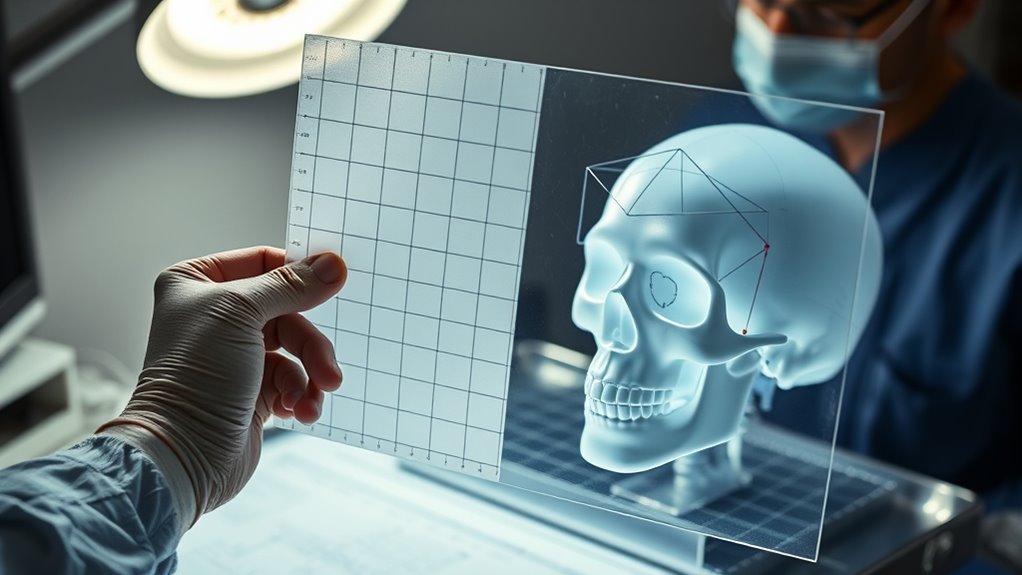

Applying geometry in surgery planning helps you visualize complex anatomy with precise, three-dimensional models derived from imaging scans. It allows you to map out ideal surgical routes, avoid critical structures, and personalize approaches for better outcomes. Using geometric principles enhances accuracy, safety, and efficiency during procedures. If you want to understand how these techniques transform complex surgeries and improve patient care, exploring further will provide valuable insights.
Key Takeaways
- Geometry enables detailed visualization of complex anatomical structures, improving surgical accuracy and planning.
- 3D models derived from imaging data guide precise surgical approaches and help avoid critical structures.
- Personalized geometric measurements tailor surgical interventions, reducing risks and enhancing patient outcomes.
- Real-time intraoperative navigation relies on geometric algorithms for accurate instrument tracking and guidance.
- Applying geometric principles elevates surgical safety, efficacy, and sets new standards in complex procedures.

Geometry plays a vital role in modern surgery planning by helping surgeons visualize and map complex anatomical structures with precision. When you approach a surgical case, understanding the precise layout of bones, blood vessels, and soft tissues is crucial. That’s where geometric principles come into play, allowing you to create accurate models and detailed maps that guide your every move. This process, known as anatomical mapping, transforms the way you plan procedures, ensuring each step is based on exact measurements and spatial relationships. It’s not just about seeing the anatomy; it’s about understanding it in three dimensions and translating that understanding into surgical accuracy.
Geometry enables precise 3D anatomical mapping, enhancing surgical planning and accuracy for better patient outcomes.
Using geometry, you can construct detailed 3D models from imaging data such as CT scans or MRIs. These models serve as a visual roadmap, helping you determine the best approach, avoid critical structures, and minimize invasiveness. Anatomical mapping through geometric calculations provides a level of surgical precision that was impossible before digital tools became commonplace. You can measure angles, distances, and volumes with high accuracy, allowing you to plan interventions that are safer and more effective. For example, in complex craniofacial surgeries, precise geometric modeling helps you contour bones and soft tissues, achieving optimal aesthetic and functional outcomes.
Moreover, geometric methods facilitate the customization of surgical plans tailored to individual patients. Instead of relying solely on generalized anatomical data, you can incorporate specific measurements into your planning, leading to personalized treatments. This approach reduces risks, shortens operative times, and enhances recovery. When you’re navigating delicate areas, such as the brain or inner ear, the ability to visualize the exact spatial relationships makes all the difference. It allows you to anticipate potential complications and adapt your strategy accordingly.
In addition, advances in climate control technology, such as precise temperature and humidity regulation, can improve the sterile environment and surgical conditions, further supporting successful outcomes.
Intraoperative navigation systems often rely on geometric algorithms to track your instruments in real-time relative to preoperative maps. This technological integration ensures you maintain surgical precision throughout the procedure, even in complex or minimally invasive surgeries. Essentially, geometry becomes your guiding framework, transforming abstract data into practical, actionable insights. As a surgeon, mastering geometric concepts enhances your ability to perform intricate procedures confidently, with accuracy rooted in mathematical principles. Whether planning a joint replacement or removing a tumor, applying geometry ensures your interventions are based on solid spatial understanding, ultimately improving patient outcomes and setting new standards in surgical excellence.
Frequently Asked Questions
How Does Geometry Improve Surgical Accuracy?
Geometry improves surgical accuracy by helping you interpret preoperative imaging precisely, allowing for detailed visualization of anatomy. You rely on this geometric data to plan your approach accurately. During surgery, surgical navigation systems use geometric principles to guide your instruments, ensuring you follow the planned path. This combination minimizes errors, enhances precision, and increases your confidence, resulting in better patient outcomes.
Are There Specific Geometric Tools Used in Surgery Planning?
Imagine holding a precise compass or a digital caliper, tools that bring clarity to complex shapes. In surgery planning, medical imaging creates detailed visuals, and geometric modeling transforms these into accurate 3D maps. These tools help you visualize and measure critical structures, ensuring precision. You use specialized software and digital templates that act like the compass and caliper, guiding your decisions and improving surgical outcomes with remarkable accuracy.
Can Geometry Reduce Operation Time and Complications?
Yes, geometry can reduce operation time and complications by optimizing patient positioning and enhancing surgical navigation. When you use geometric principles, you improve accuracy in aligning instruments and planning incisions, which minimizes errors. This precise approach helps you navigate complex anatomy more efficiently, shortening surgery duration and lowering the risk of complications. Ultimately, applying geometry in your surgical planning leads to better outcomes and smoother procedures.
How Do Surgeons Learn to Apply Geometric Principles?
You learn to apply geometric principles through hands-on experience and specialized training. Visualize medical imaging and surgical navigation as your guiding compass, helping you understand spatial relationships within the body. By practicing with simulations and real cases, you develop an intuitive sense of geometry’s role in surgery. Continuous education, mentorship, and technological tools sharpen your skills, enabling precise planning and execution for safer, more effective procedures.
Are There Limitations to Using Geometry in Complex Surgeries?
Yes, there are limitations to using geometry in complex surgeries. You might encounter challenges with surgical navigation, where geometric constraints make precise movements difficult. In highly intricate procedures, relying solely on geometric principles can oversimplify real tissue behavior. You need to adapt your approach, combining geometric insights with clinical judgment, to navigate these constraints effectively and ensure successful outcomes.
Conclusion
Just like a master navigator charts a course through uncharted waters, applying geometry in surgery planning guides you with precision and foresight. Every angle and curve becomes a compass, leading you toward successful outcomes. Embrace this mathematical map, and you’ll transform complex challenges into clear pathways. With geometry as your trusted ally, you’re not just planning a surgery—you’re sculpting hope and healing, turning intricate puzzles into works of art on the canvas of the human body.