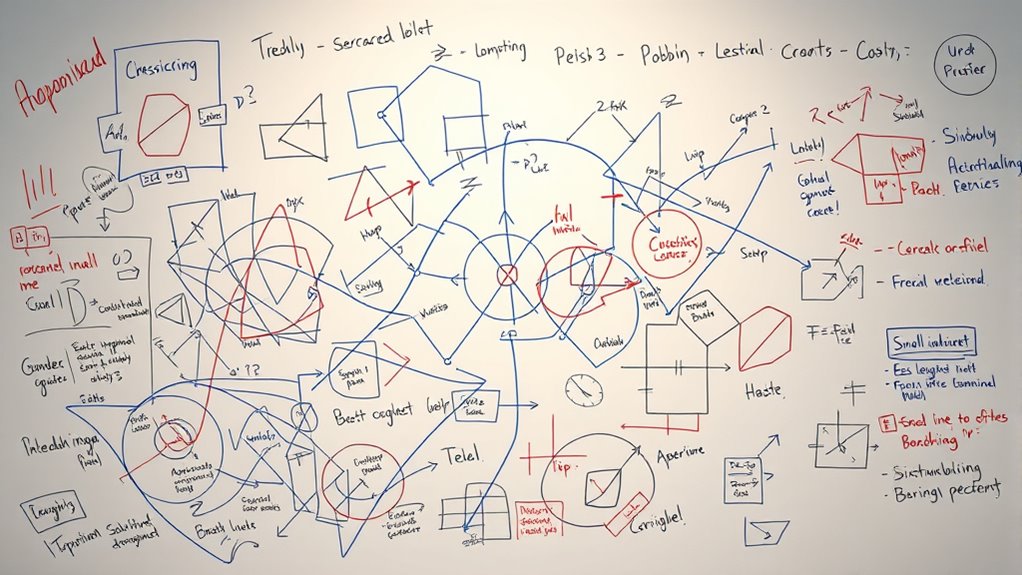

Adding lines to diagrams is a powerful visualization trick that helps clarify complex problems. By strategically inserting auxiliary lines, you can reveal hidden relationships, break down shapes into manageable parts, and turn abstract ideas into clear visual forms. This approach makes it easier to understand intersections, symmetries, and patterns. When you master this technique, solving tricky puzzles becomes more intuitive, and you’ll discover even more ways to simplify challenges as you explore further.
Key Takeaways
- Adding auxiliary lines, like diagonals or parallels, clarifies relationships within complex diagrams.
- Visualizing these lines helps break down intricate shapes into simpler, familiar components.
- Drawing boundary or dividing lines transforms abstract inequalities into clear, manageable regions.
- Mentally simulating added lines reveals intersections and symmetries, simplifying problem analysis.
- Using these visualization tricks enhances understanding and leads to more elegant, efficient solutions.

Visualization tricks can remarkably enhance your ability to understand and communicate complex ideas. When tackling challenging problems, especially in math or physics, adding lines to diagrams can clarify relationships and reveal solutions more straightforwardly. This approach leverages geometric interpretations, turning abstract concepts into visual representations that you can grasp intuitively. By incorporating mental imagery techniques, you can mentally manipulate these diagrams, making it easier to see patterns, intersections, or symmetries that might not be obvious at first glance.
Imagine you’re working on a geometry problem involving multiple polygons and angles. Instead of trying to juggle all the angles and side lengths mentally, you can draw auxiliary lines—like diagonals or perpendicular bisectors—to break down the figure into simpler parts. These lines act as visual aids, transforming a complex shape into a series of familiar, manageable components. This process taps into your mental imagery techniques, allowing you to simulate the effects of these added lines without constantly erasing or redrawing. Visualizing how these lines intersect or divide the figure helps you understand the problem’s core structure, often leading to more elegant solutions.
In problems involving algebraic expressions or inequalities, visualizing the solution space can be incredibly powerful. By adding lines that represent boundary conditions or constraints, you create a geometric interpretation of the problem. For instance, graphing lines to represent inequalities transforms a purely algebraic problem into a visual map, where feasible solutions are highlighted by the intersection of regions. When you see these regions, it becomes easier to analyze the problem holistically, rather than getting lost in algebraic manipulations alone. Using mental imagery techniques, you can picture shifting or scaling these lines to understand how solutions change, giving you a dynamic grasp of the problem.
The key to effective visualization tricks is recognizing that adding lines isn’t just about drawing more on your paper. It’s about mentally constructing a clearer picture. As you develop your skills in geometric interpretations, you learn to see how these lines reveal hidden relationships. With practice, you’ll be able to visualize the added lines mentally, reducing the need for constant sketching and making your problem-solving process more fluid. This mental agility allows you to approach complex problems with confidence, knowing that you can break them down into simpler, visual segments. Ultimately, mastering these visualization tricks transforms abstract challenges into concrete, solvable puzzles.
Additionally, understanding the residency requirements for divorce in different states can help you better prepare for legal proceedings if needed in the future.
Frequently Asked Questions
How Do I Choose the Best Line to Add for Clarity?
To choose the best line for clarity enhancement, focus on line selection that highlights key relationships or divides complex areas effectively. Look for lines that guide the viewer’s eye naturally, such as axes, diagonals, or symmetry lines. Consider lines that simplify the problem’s structure and reduce visual clutter. Test different options, and select the one that makes the problem easiest to understand at a glance, ensuring your visualization communicates your message clearly.
Can Visualization Tricks Help With Abstract or Non-Visual Problems?
Yes, visualization tricks can even help with abstract or non-visual problems. You can use mental models to create visual representations that clarify complex ideas, making them easier to understand and analyze. By translating abstract concepts into visual formats, you enhance your conceptual clarity and problem-solving skills. Visualization tricks turn intangible ideas into tangible images, allowing you to see relationships, patterns, and solutions more clearly and confidently.
What Tools or Software Are Recommended for Drawing Lines Easily?
For drawing lines easily, you should try digital drawing tools like Adobe Illustrator or CorelDRAW, which offer precise line creation and editing. Diagram software such as Microsoft Visio or Lucidchart also simplifies adding lines, making it easy to create clear, professional visuals. These tools let you quickly sketch, adjust, and organize lines to help you visualize complex problems more effectively.
How Can I Avoid Cluttering My Diagrams With Too Many Lines?
Imagine you’re a chef preparing a dish; too many ingredients can overwhelm the flavor. To avoid cluttering diagrams, use gesture simplification by limiting lines to essential connections, and apply color coding to differentiate elements clearly. This approach keeps your diagrams clean and easy to interpret, just like a well-balanced dish. Focus on clarity, not quantity, ensuring your visuals communicate effectively without unnecessary complexity.
Are There Common Mistakes to Watch Out for When Adding Lines?
When adding lines, watch out for common mistakes like creating misleading assumptions or overcomplication. You might accidentally imply connections that aren’t there or clutter your diagram, making it harder to understand. To avoid this, keep lines clear and purposeful, ensuring they genuinely clarify the problem. Always question if an extra line genuinely adds value or just makes the diagram more confusing, helping you stay focused and accurate.
Conclusion
By mastering these visualization tricks, you’ll turn complex problems into child’s play—so simple, they practically solve themselves! Adding lines will become your secret weapon, transforming chaos into clarity faster than you can say “problem solved.” With these tools, you’ll be unstoppable, conquering challenges with the precision of a laser beam. Get ready to wield your newfound skills and watch your problem-solving powers skyrocket—because once you see clearly, nothing can stand in your way!