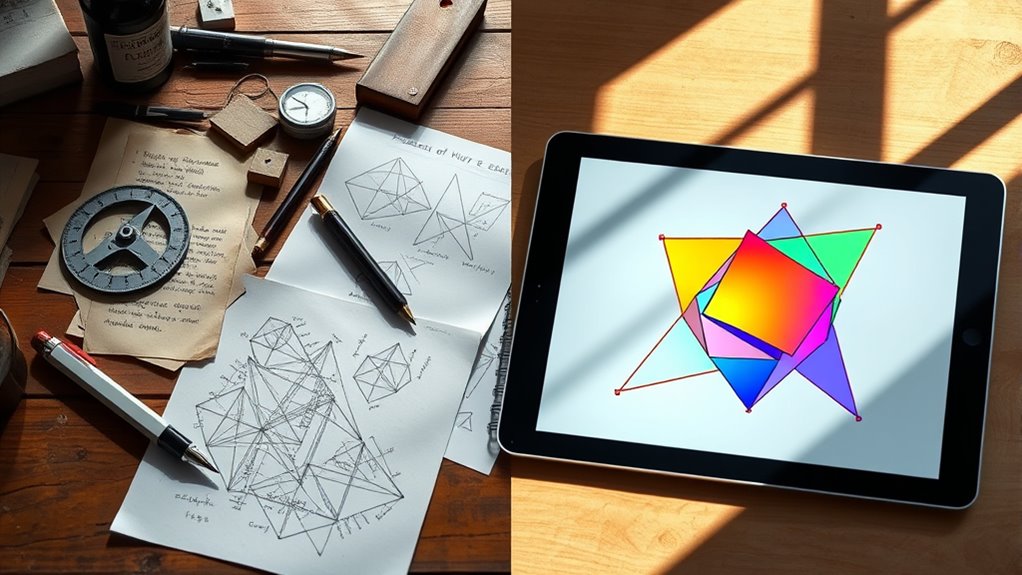

When comparing analytical and synthetic approaches to geometry problems, you’ll find that analytical methods rely on algebra, formulas, and coordinate systems to find solutions precisely, while synthetic methods use constructions and logical reasoning to understand properties visually. Analytical techniques handle complex calculations, whereas synthetic approaches build intuition through diagrams and properties. Combining both can make your problem-solving more effective. Keep exploring to discover how these methods complement each other and enhance your geometric skills.
Key Takeaways
- Analytical geometry uses algebraic equations and coordinate systems, while synthetic geometry relies on geometric constructions and reasoning.
- Analytical methods provide precise, algebraic solutions; synthetic approaches emphasize visual understanding and geometric properties.
- Combining both techniques enhances problem-solving by leveraging algebraic precision and geometric intuition.
- Use coordinate geometry for complex calculations involving curves, slopes, and distances; employ synthetic methods for proofs and diagram accuracy.
- Each approach has strengths: analytical offers systematic solutions; synthetic fosters conceptual insights and visual reasoning.

When comparing analytical and synthetic approaches, understanding their fundamental differences can help you make better decisions in problem-solving and reasoning. In geometry, these methods approach problems quite differently, and recognizing their distinctions is vital for choosing the right strategy. Analytical geometry, also known as coordinate geometry, uses algebra and coordinate systems to analyze geometric figures. It translates geometric problems into algebraic equations, allowing you to use formulas, graphing techniques, and algebraic manipulations to find solutions. For example, if you’re working with the intersection point of two lines, you might set up equations based on their slopes and intercepts, then solve algebraically. This approach often involves plotting points on a coordinate plane and applying formulas like the distance or midpoint formulas, which makes it highly precise and systematic.
On the other hand, the synthetic approach relies on geometric constructions and logical reasoning without the use of coordinates or algebra. It emphasizes visual intuition, properties, and relationships between figures. When you approach a problem synthetically, you might construct auxiliary lines, angles, or shapes to explore the problem visually and deduce relationships. This method is especially useful in classical geometry where proofs and constructions are performed with a compass and straightedge, relying on geometric axioms and theorems. For instance, establishing the congruence of triangles or proving that a point lies on a particular circle involves a series of logical steps based on known properties, rather than algebra.
The choice between these methods often depends on the problem at hand. Coordinate geometry can simplify complex calculations, especially when dealing with curves, slopes, or distances. It provides a clear, algebraic path to solutions, making it easier to handle problems that involve multiple variables or require precise measurements. Conversely, geometric constructions are invaluable when you need to understand the fundamental properties of figures or when visual intuition can guide you to a solution. They are also essential in creating accurate diagrams and proofs that rely on physical relationships rather than algebraic formulas.
In practice, you might find that combining these approaches yields the best results. For example, you can use synthetic methods to understand the geometric relationships and then switch to coordinate geometry to perform precise calculations. This hybrid approach leverages the strengths of both, giving you a versatile toolkit for tackling a wide range of geometry problems. Ultimately, mastering both methods enhances your reasoning skills and equips you to approach geometry with flexibility and confidence.
Geometric Constructions (Undergraduate Texts in Mathematics)
As an affiliate, we earn on qualifying purchases.
As an affiliate, we earn on qualifying purchases.
Frequently Asked Questions
Which Approach Is More Suitable for Beginners in Geometry?
As a beginner, you’ll find synthetic methods more suitable because they rely on visual reasoning and geometric intuition, making concepts easier to grasp. You won’t need advanced algebraic techniques initially, which can be intimidating. This approach helps you develop a solid understanding of basic shapes and relationships. Once comfortable, you can gradually explore analytical methods, but starting with synthetic approaches makes learning more intuitive and engaging.
How Do Real-World Applications Differ Between the Two Methods?
Think of it like exploring a city—analytical methods are like GPS, providing precise directions for practical applications, while synthetic methods are like exploring on foot, offering broader insights. In real-world examples, analytical approaches excel in engineering and computer graphics, ensuring accuracy. Synthetic methods shine in architectural design and art, emphasizing creativity and visual understanding. Your choice depends on whether you need exact solutions or a more holistic, visual perspective.
Can Both Approaches Be Combined Effectively in Problem-Solving?
Yes, you can effectively combine both approaches through hybrid strategies. You start by using synthetic methods to visualize and understand the problem’s structure, then switch to analytical techniques for precise calculations. This problem integration allows you to leverage the strengths of each approach, making your solutions more efficient and all-encompassing. By blending geometric intuition with algebraic precision, you improve your problem-solving skills and adapt to diverse challenges.
Are There Specific Types of Problems Better Suited for Each Approach?
Sometimes, you find certain problems more approachable with visualization techniques, like drawing or diagrams, making synthetic methods ideal. Other times, algebraic strategies simplify complex relationships, making analytical approaches better suited. You’ll notice that geometry puzzles involving figures and spatial reasoning benefit from visualization, while problems requiring formulas or equations lean on algebraic strategies. Recognizing these nuances helps you choose the best approach, enhancing your problem-solving efficiency.
How Has the Historical Development Influenced These Methods’ Usage?
You should recognize that historical context and method evolution have shaped how you use analytical and synthetic methods today. Over time, analytical techniques gained popularity with the development of algebra and coordinate geometry, making complex problems more manageable. Conversely, synthetic methods, rooted in classical geometry, emphasize visual and logical reasoning. This evolution influences your choice, allowing you to select the most effective approach based on the problem’s nature and your familiarity with each method.

Scientific Calculator, 2 Line Cute Scientific Math Calculator Function Calculator for Students Algebra Geometry Basic Caculator for Middle and High School Students College School Supplies (Pink)
【240 Functions Scientific Calculator】Pungltd scientific calculator has 240 functions and covers the most scientific functions what students need…
As an affiliate, we earn on qualifying purchases.
As an affiliate, we earn on qualifying purchases.
Conclusion
In choosing between analytical and synthetic approaches, you determine your method based on your desire for detail or discovery. Both paths provide powerful perspectives, pushing you to problem-solve and progress. Whether you prefer precision or perception, mastering these methods makes you more meticulous and motivated. So, embrace the balance, boost your understanding, and boldly bridge the gap between complexity and clarity in geometry. Your journey from question to conclusion depends on your choice—so choose confidently and conquer creatively!

Mr. Pen Geometry Set with 6 Inch Swing Arm Protractor, Divider, Set Squares, Ruler, Compasses and Protractor, 15 Piece Set
Geometry Set For All Levels Designed in USA
As an affiliate, we earn on qualifying purchases.
As an affiliate, we earn on qualifying purchases.

Developing Geometry Proofs with Geometry Expressions
As an affiliate, we earn on qualifying purchases.
As an affiliate, we earn on qualifying purchases.