In Geometry, understanding “if-then” statements helps you analyze logical relationships, like “if lines are parallel, then angles are equal.” Using truth tables guarantees these statements are valid always, while recognizing fallacies prevents you from accepting invalid reasoning. Developing strong reasoning skills allows you to evaluate arguments carefully and avoid mistakes. Keep exploring these concepts to build a solid foundation in logical thinking and improve your problem-solving abilities further.

Prime made for students and young adults
- Fast, free delivery for dorm and study essentials
- Prime Video and Amazon Music included
- Member-only deals
Key Takeaways
- Understand that “if-then” statements form the basis of logical reasoning in geometry, establishing conditional relationships.
- Use truth tables to systematically verify whether geometric conclusions follow from given premises.
- Recognize common logical fallacies to avoid invalid reasoning in geometric proofs and arguments.
- Apply “if-then” reasoning to deduce properties such as parallel lines implying equal angles, ensuring logical validity.
- Develop critical thinking skills by evaluating statements carefully, combining truth tables with fallacy awareness for reliable problem-solving.
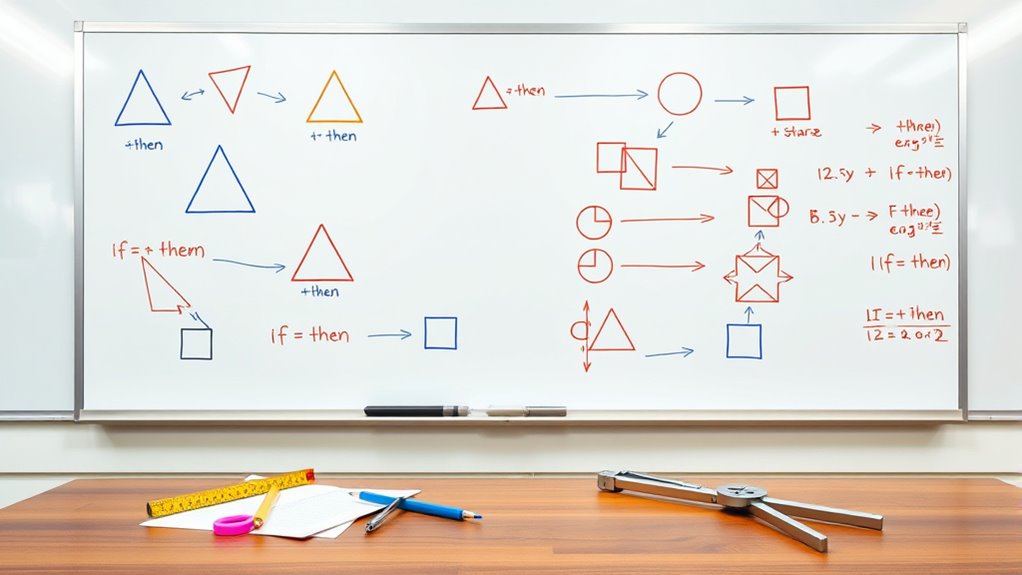
Have you ever wondered how we distinguish good reasoning from bad? It’s a question that gets to the heart of logic itself. When you’re analyzing an argument or trying to solve a geometric problem, understanding how to evaluate reasoning is essential. One of the foundational tools you can use is truth tables. These tables help you systematically examine all possible truth values of statements to see if a conclusion logically follows from premises. For example, if you’re working with a conditional statement like “If a figure is a square, then it has four right angles,” a truth table can confirm whether this statement is valid or if there are scenarios where it fails. By carefully constructing these tables, you eliminate guesswork and guarantee your reasoning is sound.
However, it’s equally important to recognize logical fallacies—errors in reasoning that seem convincing but are actually flawed. Many fallacies stem from misusing logic or making false assumptions. For instance, assuming that just because two conditions often occur together, one causes the other, is a common mistake. When you’re analyzing geometric arguments, spotting these fallacies prevents you from accepting invalid conclusions. An example might be assuming that because two angles are supplementary, they must be on the same line, which isn’t necessarily true without additional information. Recognizing such errors keeps your reasoning clear and accurate. Additionally, understanding the scientific basis of sound reasoning helps reinforce critical thinking skills in geometry.
In geometric reasoning, if-then statements are especially prevalent. They set up conditions that lead to certain conclusions, such as “If two lines are parallel, then corresponding angles are equal.” To verify these, you can test their validity through truth tables or logical analysis. If a statement’s truth table reveals it’s false under certain circumstances, you know it’s not universally true. This process helps you refine your understanding of geometric properties and guarantees your deductions are valid. By mastering these tools, you avoid common pitfalls and strengthen your logical skills.
Ultimately, good reasoning hinges on careful evaluation of statements and their logical connections. Using truth tables allows you to methodically check the validity of if-then statements, while being aware of logical fallacies helps you avoid flawed arguments. When you combine these approaches, you develop a sharper, more precise way of thinking about geometry and logic. Whether you’re proving a theorem or analyzing an argument, understanding how to distinguish good reasoning from bad empowers you to think critically and confidently. It’s these skills that form the foundation of all logical and mathematical reasoning, making your problem-solving clearer, more reliable, and ultimately more effective.
truth table calculator for logic
As an affiliate, we earn on qualifying purchases.
As an affiliate, we earn on qualifying purchases.
Frequently Asked Questions
How Do I Identify Valid Logical Statements in Geometry?
You can identify valid logical statements in geometry by using truth tables and understanding logical connectives. First, break down the statement into simpler parts and analyze their truth values with a truth table. Check how the connectives like “and,” “or,” and “if-then” affect the overall truth. If the statement holds true in all cases, it’s valid. Practice with different examples to strengthen your reasoning skills.
What Are Common Mistakes in Applying If-Then Logic?
You often make mistakes by confusing common fallacies like affirming the consequent or denying the antecedent, which lead to faulty assumptions. It’s easy to assume that if the conclusion is true, the premise must be true too, but that’s a fallacy. Always double-check your logic, verify your premises are accurate, and don’t jump to conclusions based on incomplete or incorrect assumptions. This careful approach helps avoid common errors.
How Does Contrapositive Differ From Inverse in Reasoning?
You’ll find that the contrapositive differs from the inverse because it uses negation techniques to flip both the hypothesis and conclusion, maintaining logical equivalence. The contrapositive states that if the conclusion isn’t true, then the hypothesis isn’t true either, which is logically equivalent to the original statement. In contrast, the inverse simply negates both parts without ensuring equivalence, often leading to incorrect conclusions if not carefully analyzed.
Can Logic Be Used to Prove Non-Constructive Geometry Theorems?
Yes, logic can be used to prove non-constructive geometry theorems. Imagine uncovering truths without constructing explicit examples—you rely on non-constructive proofs within logical frameworks. These proofs often show that something exists without showing how to find it. By applying formal logical reasoning, you can establish the validity of such theorems, challenging your intuition and expanding your understanding of what geometry can reveal through pure reasoning rather than direct construction.
How Do I Visualize Logical Relationships in Geometric Diagrams?
To visualize logical relationships in geometric diagrams, use visualization techniques like highlighting related points, lines, or angles to show connections clearly. Interpret diagrams by identifying key elements that represent logical conditions, such as marked equalities or congruencies. Practice breaking down complex relationships into simpler parts, and use different colors or labels to clarify the logical flow. This approach helps you see how geometric properties support logical reasoning effectively.
As an affiliate, we earn on qualifying purchases.
Conclusion
Just like a map guides you through uncharted territory, understanding if-then statements helps you navigate complex geometry. When you master this logical tool, you can confidently solve proofs and reason effectively. Remember, thinking logically is like building a house brick by brick — each statement supporting the next. Keep practicing, and you’ll find that reasoning becomes clearer and more powerful, opening doors to new mathematical adventures. So, stay curious and keep exploring!
logical fallacy identification book
As an affiliate, we earn on qualifying purchases.
As an affiliate, we earn on qualifying purchases.
geometry proof practice workbook
As an affiliate, we earn on qualifying purchases.
As an affiliate, we earn on qualifying purchases.
Fall Picks
fall essentials
As an affiliate, we earn on qualifying purchases.