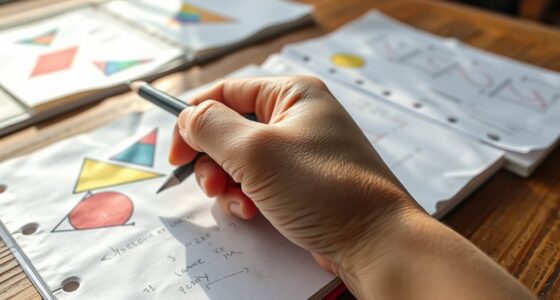
Your input is essential in shaping the next geometry lessons. By voting on topics like the coordinate plane and angle bisectors, you help focus the curriculum on areas that interest you most. This active participation ensures lessons are engaging and relevant to your learning goals. When you share your preferences, you’re guiding your educational experience. Keep exploring to discover how your choices can make a real difference in your geometry journey.
Key Takeaways
- Student voting influences curriculum focus, ensuring lessons cover topics of greatest interest and relevance.
- Participating in votes helps tailor geometry lessons to deepen understanding of key concepts like the coordinate plane and angle bisectors.
- Voting encourages active engagement, making learning more meaningful and motivating students to explore geometry topics further.
- Student input aids teachers in prioritizing concepts such as distance, slopes, and symmetry, enhancing overall comprehension.
- Your voice empowers you to shape your learning experience and ensures curriculum remains engaging and aligned with student needs.
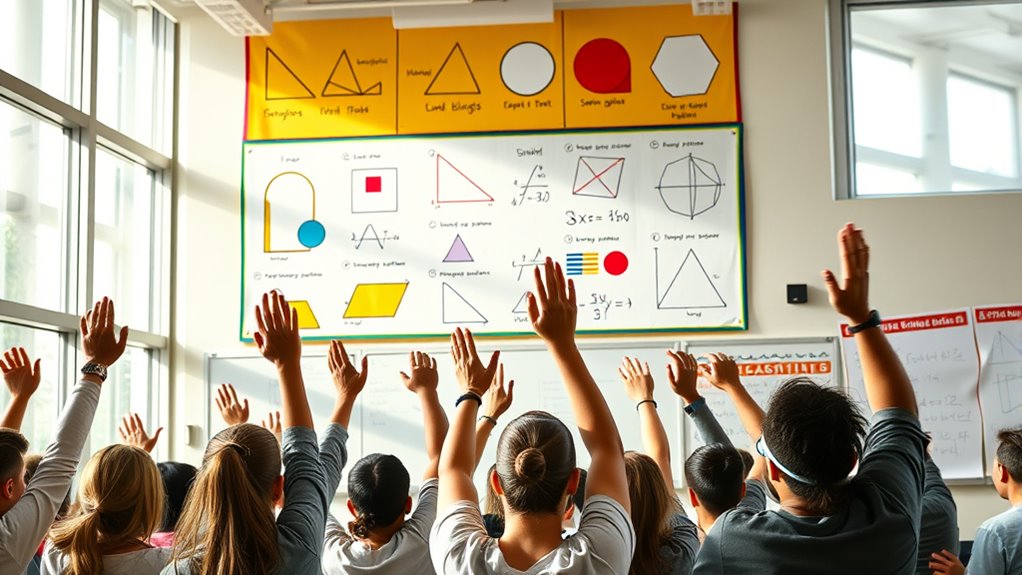
Have you ever wondered which geometry topics you should learn next? You’re not alone. Many students want to deepen their understanding of the subject, but with so many concepts to choose from, it’s hard to decide where to focus. That’s why we’re asking for your input. Your voice matters in shaping the curriculum, and by voting, you help prioritize the topics that interest you most. One area many find fascinating is the coordinate plane, along with the special lines called angle bisectors. These topics are fundamental in understanding how shapes and points relate in space, and mastering them opens the door to more advanced geometry concepts.
When you learn about coordinate planes, you gain a powerful tool for visualizing and analyzing geometric figures. The coordinate plane is a grid made up of horizontal and vertical lines intersecting at the origin. It allows you to locate points precisely using ordered pairs, such as (x, y). This framework makes it easier to understand the positions of shapes, find distances between points, and analyze how different figures relate to each other. Geometry on the coordinate plane also introduces you to concepts like slopes and equations of lines, which are essential in solving real-world problems. If this sounds interesting, voting to prioritize coordinate plane topics can help you get more practice working with these concepts.
Another key topic you might want to explore is angle bisectors. These are lines that divide an angle into two equal parts. They’re vital because they help you understand symmetry and how angles work together within polygons and other figures. Learning about angle bisectors can improve your ability to solve problems involving angles, such as finding unknown angles or proving geometric properties. Plus, they play a role in constructing perpendicular bisectors and in understanding the incenter of triangles, which is the point where all angle bisectors intersect. Additionally, understanding how the contrast ratio affects the perception of images can enhance your comprehension of visual clarity in various applications. If you’re curious about how angles can be split evenly and want to see their applications in various geometric proofs, voting for this topic could make it a focus of upcoming lessons.
Ultimately, the choice is yours. Whether you’re drawn to the coordinate plane’s practical applications or the elegance of angle bisectors, your input shapes your learning experience. By voting, you help your teachers understand what excites you most and what skills you want to develop further. So, take a moment to cast your vote and tell us which topics you’d like to see covered next. Your involvement guarantees that your geometry lessons stay engaging and relevant, helping you build a stronger understanding of the subject. Remember, your preferences guide the curriculum, so don’t miss out on shaping your learning journey.

Heltec Handheld GPS Land Meter, High Accuracy GNSS Surveying Equipment for Land Measurement & Hiking 6 Satellite System Positioning IP65 Waterproof 18H Battery Slope/Mountain Mode Real-Time Graphics
High-Accuracy GNSS Land Measurement: This handheld GPS for surveying delivers professional-grade precision with ±1% error for large areas...
As an affiliate, we earn on qualifying purchases.
Frequently Asked Questions
How Can I Submit My Own Topic Suggestions?
To submit your own topic suggestions, simply visit the platform’s suggestion page. You can propose ideas like interactive polygons or symmetry puzzles by filling out the provided form. Make sure to clearly describe your idea and how it relates to geometry. Your input helps shape future content, so don’t hesitate to share your creative ideas. This way, you directly contribute to expanding topics that interest you and others.
When Will the Final Topic Choices Be Announced?
Did you know that 78% of students find geometry topics like angle bisectors and congruence criteria more engaging when they’re relevant? The final topic choices will be announced soon, giving you a clear idea of what’s next. Keep an eye out for updates, as your input shaped the options. You’ll soon know if your suggestions or interests in angle bisectors or congruence criteria made it into the final selection!
Are There Any Rewards for Participating in the Voting?
You might wonder if there are reward incentives for voting. While specific details vary, participating in the voting process offers notable benefits, like influencing the future of geometry topics and gaining a sense of contribution. Some platforms may include additional voting benefits or reward incentives to encourage engagement. So, by casting your vote, you not only help shape content but also potentially unseal rewards or recognition, making your involvement even more worthwhile.
Can I Vote More Than Once for the Same Topic?
You might wonder if you can vote more than once for the same topic. Typically, voting limits prevent topic repetition, meaning you can only vote once per topic to keep the process fair. This ensures everyone has an equal chance to influence the selection. So, if you really want to support a specific topic, make sure to cast your vote carefully because multiple votes for the same topic aren’t usually permitted.
Will the Selected Topics Be Covered in Detail?
Like a finely tuned instrument, the selected topics will be explored in detail. You can expect thorough coverage of angle bisectors and congruence criteria, ensuring you grasp each concept thoroughly. Rest assured, the lessons will dive deep into each subject, providing clarity and insight. Your vote helps shape this focused journey, and you’ll find the material both engaging and enriching, turning complex ideas into understandable melodies of geometry.

ZL180 Handheld GPS for Surveying, High Precision Rugged Land Surveying Equipment for Ranches, Garden, Farmland and Parking Area Distance Measuring
HIGH PRECISION ACCURACY: 2 high sensitivity satellites global GPS + GLONASS coverage for reliable surveying around the world,...
As an affiliate, we earn on qualifying purchases.
Conclusion
Your voice is the key to shaping the future of geometry lessons, just like a compass guides a traveler through uncharted territory. By voting, you’re helping create lessons that truly interest and inspire you. Don’t let this opportunity slip away—your input is the spark that ignites excitement in learning. So, take a moment, cast your vote, and be the reason why geometry becomes more engaging and fun for everyone.
Amazon Product B0F6KMH7V8
As an affiliate, we earn on qualifying purchases.

NiesahYan ZL190 Handheld GPS for Surveying, High Precision GPS Surveying Equipment for Mountainous Land Slope and Flat Field Outdoor Use
ACCURATE: Great support 4 high precision satellite system,GPS+BEIDOU+GLONASS+QZSS ,strong satellite signal, small measurement errors, area measurement error in...
As an affiliate, we earn on qualifying purchases.