

Boolean algebra is the foundation for understanding digital logic, allowing you to simplify complex expressions and visualize logic geometrically. By using truth tables, gates, and algebraic laws like De Morgan’s, you can see how different combinations work together. This helps you design efficient circuits and troubleshoot issues. If you keep exploring, you’ll discover powerful ways to analyze and optimize digital systems through both algebraic and geometric perspectives.

Prime made for students and young adults
- Fast, free delivery for dorm and study essentials
- Prime Video and Amazon Music included
- Member-only deals
Key Takeaways
- Boolean algebra represents logical expressions geometrically, often using Venn diagrams to visualize set operations and logic relationships.
- Logical gates correspond to geometric regions in diagrams, illustrating how input combinations produce specific outputs.
- Simplifying Boolean expressions can be visualized as minimizing overlapping regions or areas in geometric models.
- Truth tables translate logical functions into geometric regions, aiding in understanding circuit behavior visually.
- Geometric interpretations help optimize digital circuits by visualizing logic relationships and reducing complexity.
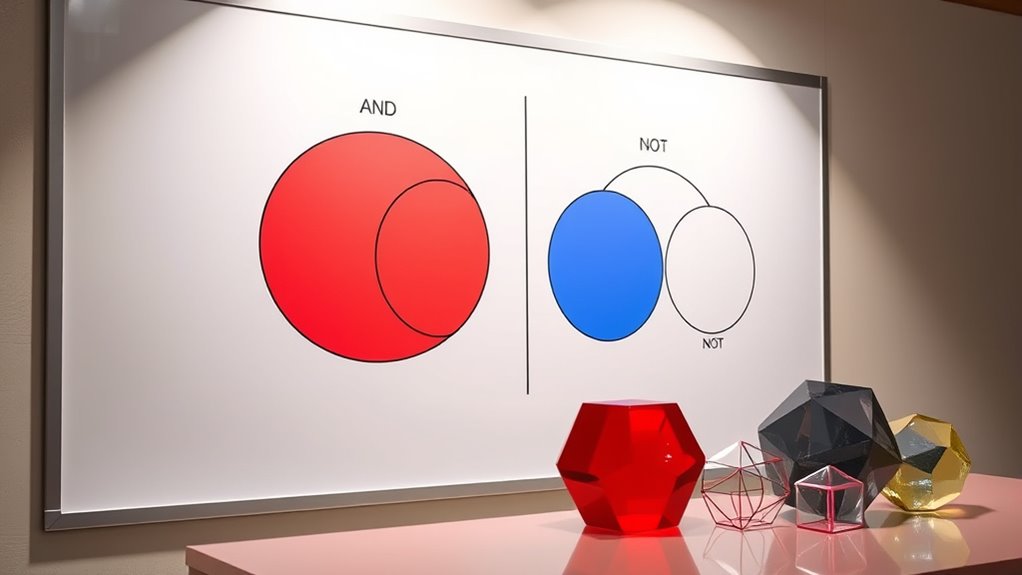
Boolean algebra forms the foundation of digital logic and computer design, allowing you to simplify complex logical expressions. At its core, it helps you understand how digital circuits behave by translating logical operations into algebraic formulas. When you look at a circuit, you’ll see different components called logical gates—AND, OR, NOT, NAND, NOR, XOR, and XNOR—that perform basic logical functions. These gates are the building blocks of digital systems, and understanding how they work is essential for designing or troubleshooting circuits. To grasp how these gates operate, you need to explore their corresponding truth tables, which serve as a visual map of all possible input combinations and their resulting outputs.
Truth tables are your go-to tool for decoding the behavior of logical gates. They list every possible combination of inputs—say, 0s and 1s—and show what the output will be for each case. For example, an AND gate only outputs a 1 when both inputs are 1; otherwise, it outputs 0. Its truth table clearly lays out this rule, ensuring you know exactly how the gate responds to any input scenario. Similarly, an OR gate outputs a 1 if at least one input is 1, and a NOT gate inverts its input. These truth tables make it easy for you to visualize and verify how different gates work in operation. Once you understand these basic truth tables, you can combine gates to form more complex expressions, which can be simplified using Boolean algebra rules.
Boolean algebra allows you to manipulate these expressions to reduce the number of gates needed in a circuit, saving space and power. For example, you might start with a complicated expression and use Boolean laws—like the distributive, associative, or De Morgan’s laws—to simplify it. This process makes your circuit more efficient without changing its behavior, as verified by the truth tables. Recognizing that these simplifications are grounded in logical equivalence helps you confidently optimize your designs. In summary, the truth tables act as a reference point, confirming that your simplified expression still produces the same outputs for all input combinations. When you master this interplay between Boolean algebra, logical gates, and truth tables, you gain a powerful toolkit for designing streamlined digital circuits. It’s like learning the geometry of logic—visualizing how different components fit together to produce the desired outcomes efficiently and accurately.
As an affiliate, we earn on qualifying purchases.
Frequently Asked Questions
How Does Boolean Algebra Differ From Standard Algebra?
Boolean algebra differs from standard algebra because it focuses on binary operations like AND, OR, and NOT, rather than addition and multiplication. You work with binary values, typically 0 and 1, to form logical expressions. Unlike standard algebra, Boolean algebra simplifies logical statements and circuits, making it essential for digital logic design. You use its rules to analyze and optimize logical expressions efficiently, enabling precise control of digital systems.
Can Boolean Algebra Be Applied to Quantum Computing?
Absolutely, you can apply Boolean algebra to quantum computing. You’ll find it useful for understanding quantum gates, which manipulate qubits in superpositions. While traditional Boolean logic deals with definite values, quantum superposition introduces multiple possibilities simultaneously. By blending Boolean principles with quantum concepts, you can deepen your understanding of quantum algorithms and enhance your ability to analyze quantum systems, making the complex concepts more comprehensible and controllable.
What Are Common Real-World Applications of Boolean Logic?
You use Boolean logic daily in real-world applications like data encryption and search algorithms. It helps in creating efficient, reliable systems by enabling you to set conditions and make decisions based on true or false values. When encrypting data, Boolean functions secure information, while search algorithms filter results quickly. This logic underpins much of modern technology, making digital processes smarter, faster, and more secure.
How Does Boolean Algebra Relate to Digital Circuit Design?
You use Boolean algebra to design digital circuits by applying logic gates, which perform basic operations like AND, OR, and NOT. It helps you simplify complex circuits through circuit simplification, reducing the number of logic gates needed. This process improves efficiency, saves space, and lowers power consumption. Basically, Boolean algebra provides the mathematical foundation that makes creating reliable, optimized digital circuits more manageable and precise.
Are There Limitations to Boolean Algebra’s Application?
Boolean algebra has limitations, especially in complex logic simplification and real-world scenarios. It can become cumbersome with large circuits, making it hard to optimize designs. Additionally, Boolean algebra doesn’t account for timing issues, noise, or physical constraints in circuits. These limitations mean you sometimes need other tools or methods, like Karnaugh maps or software, to streamline logic effectively and ensure reliable digital circuit performance.
Boolean algebra circuit simulator
As an affiliate, we earn on qualifying purchases.
As an affiliate, we earn on qualifying purchases.
Conclusion
Now that you’ve glimpsed the geometry of logic, you see how Boolean algebra shapes your understanding of digital worlds. It’s not just lines and symbols, but the very foundation of how computers think. Like a silent architect, it constructs the unseen structures beneath every binary decision. Embrace this knowledge, for in mastering these basics, you reveal the power to navigate and create within the digital universe—where logic dances like an invisible force guiding every step.
As an affiliate, we earn on qualifying purchases.
As an affiliate, we earn on qualifying purchases.
Fall Picks
fall essentials
As an affiliate, we earn on qualifying purchases.