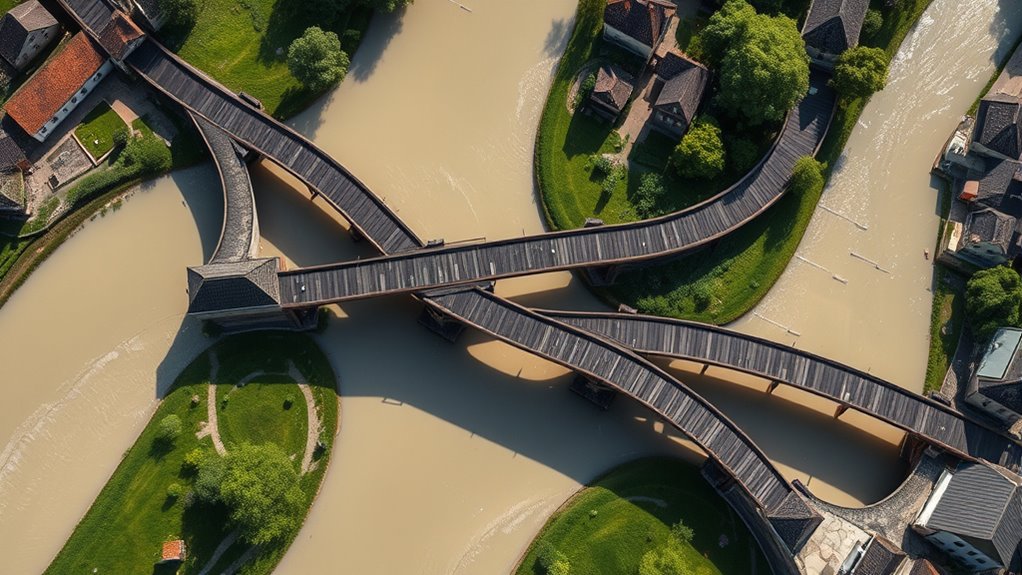

Euler’s solution to the Königsberg Bridges problem marks the birth of graph theory, transforming a physical puzzle into a mathematical framework. You learn that he modeled land masses as nodes and bridges as edges, analyzing their connections. By focusing on node degrees and connectivity, Euler identified conditions needed for a route crossing each bridge exactly once. If you want to discover how this breakthrough laid the groundwork for network analysis, keep exploring further.
Open a free Amazon Business account
Business pricing, bulk buying and tax-exempt orders.
As an affiliate, we earn on qualifying purchases.
Key Takeaways
- Euler modeled the Königsberg bridges as a graph of nodes (land masses) and edges (bridges), transforming a physical puzzle into a structural problem.
- He established that for a complete crossing, each node must have an even degree, laying the foundation for what became Eulerian paths.
- Euler’s analysis identified that disconnected or odd-degree nodes prevent a full traversal, linking graph structure to route feasibility.
- His work marked the first systematic application of graph theory, shifting focus from physical routes to network properties.
- The problem’s solution and insights led to the development of modern graph theory and its applications in network analysis.
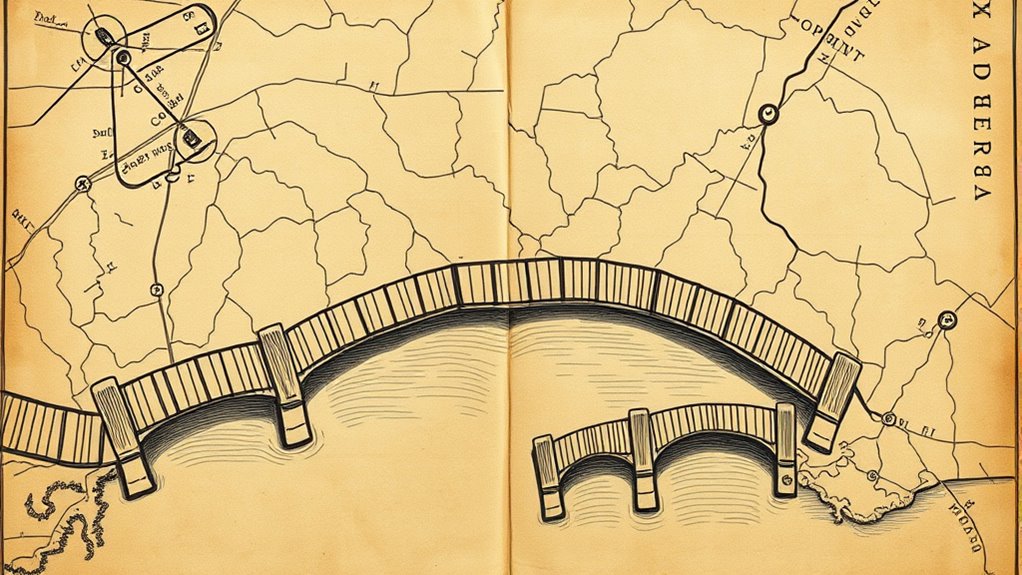
Have you ever wondered if it’s possible to cross all seven bridges in Königsberg exactly once? This question may seem simple, but it actually led to a groundbreaking development in mathematics. When you look at the problem closely, you’re fundamentally examining a type of graph traversal—analyzing how to move through a network without retracing your steps. In this case, the network is the land masses connected by bridges, and understanding its network connectivity is key to solving the puzzle. You can think of each land mass as a node, and each bridge as an edge connecting these nodes. By translating the physical layout into a graph, you start to see the problem in a new way, one that allows you to analyze the underlying structure systematically.
Euler’s approach was revolutionary because he didn’t just try different routes blindly; he examined the properties of the graph itself. He looked at the degree of each node—how many bridges connected to each land mass—and realized that for a route to exist crossing every bridge exactly once, certain conditions had to be met. In particular, he found that the network’s connectivity mattered a lot. If the graph was disconnected, or if some nodes had an odd number of connections, crossing all bridges exactly once wouldn’t be possible. This insight shifted the focus from trial and error to a more analytical method rooted in graph theory.
Euler’s insight: node degrees and connectivity determine if a complete graph traversal is possible.
Furthermore, Euler’s analysis demonstrated that the problem could be generalized to other networks, laying the foundation for graph traversal algorithms and the study of network structures in various fields.
You might notice that this perspective is the foundation of modern network analysis. When you analyze network connectivity, you’re examining how different parts of a system relate and how movement or information can flow through it. Euler’s work showed that the ability to traverse a network without retracing steps depends on the degrees of its nodes and how they connect. In the Königsberg problem, since four land masses had an odd number of bridges, Euler proved that such a route couldn’t exist. His findings essentially set the rules for what is now called an Eulerian path—an essential concept in graph traversal and network connectivity.
What makes this even more fascinating is that Euler’s solution didn’t require you to physically walk the bridges again. Instead, by studying the graph’s structure, he uncovered fundamental principles that apply to countless real-world networks—like traffic routing, circuit design, and communication systems. His insights laid the groundwork for graph theory, showing that understanding network connectivity and node degrees can reveal whether a certain path exists. So, when you think about crossing all seven bridges in Königsberg, you’re really contemplating the properties of a network and whether it supports a complete traversal—a question that has shaped the way we analyze complex systems today.
As an affiliate, we earn on qualifying purchases.
Frequently Asked Questions
How Did Euler’s Work Influence Modern Network Analysis?
Your work on Euler’s work revolutionized modern network analysis by laying the foundation for graph algorithms and network modeling. You now analyze complex systems like social networks, transportation, and communication networks, applying principles derived from Euler’s insights. His ideas enable you to optimize routes, identify critical connections, and better understand interconnected systems, making your work more efficient and impactful. Euler’s pioneering approach continues to shape how you study and improve networks today.
Are There Real-World Applications of Euler’s Graph Theory Today?
Imagine a web of city streets and transportation routes woven seamlessly together—your daily life relies on these connections. Today, Euler’s graph theory subtly guides urban planning and transportation networks, helping you navigate efficiently. Its principles optimize routes, reduce congestion, and improve infrastructure, making your journeys smoother. You benefit from this mathematical foundation every time you travel, ensuring cities stay connected and accessible in ways you might never directly see but always feel.
What Challenges Did Euler Face in Developing His Theory?
You face challenges in developing Euler’s theory due to mathematical complexities and data collection difficulties. You need to simplify complex problems into manageable parts, which requires deep understanding and innovative thinking. Gathering accurate data about the bridges and their connections was tough, making it hard to analyze and draw conclusions. Overcoming these obstacles, you realize the importance of logical reasoning and systematic methods in building a new mathematical framework.
Did Euler’s Discovery Impact Other Mathematical Fields?
Your discovery greatly impacted other mathematical fields by highlighting the power of mathematical abstraction. It opened pathways for interdisciplinary influence, allowing concepts from graph theory to be applied in computer science, logistics, and network analysis. Euler’s work demonstrated how abstract structures could solve real-world problems, inspiring mathematicians and scientists across disciplines. This broad influence underscores the significance of his discovery beyond pure mathematics, shaping modern approaches in various scientific and technological areas.
How Is Euler’s Königsberg Problem Connected to Computer Science?
You see, Euler’s Königsberg problem connects to computer science through graph algorithms and network optimization. It teaches you how to model complex systems like transportation networks, social interactions, or data structures efficiently. By understanding how to analyze and traverse these graphs, you can develop algorithms that optimize routes, improve connectivity, and solve real-world problems faster. This foundational concept underpins many modern computing techniques and network designs.
As an affiliate, we earn on qualifying purchases.
Conclusion
You stand at the edge of Königsberg, imagining the intricate web of bridges crisscrossing the river. Euler’s insight transforms this scene into a blueprint of connection and logic, laying the groundwork for graph theory. As you envision the silent, unyielding structure of networks, you realize how this moment shaped mathematics forever. The bridges, once simple crossings, now whisper the story of how abstract ideas can liberate the universe’s hidden patterns.
As an affiliate, we earn on qualifying purchases.
As an affiliate, we earn on qualifying purchases.
Fall yard work Picks
leaf blowers
As an affiliate, we earn on qualifying purchases.