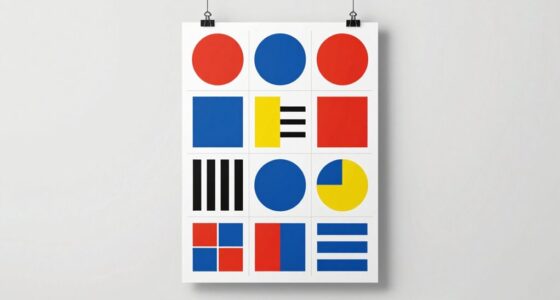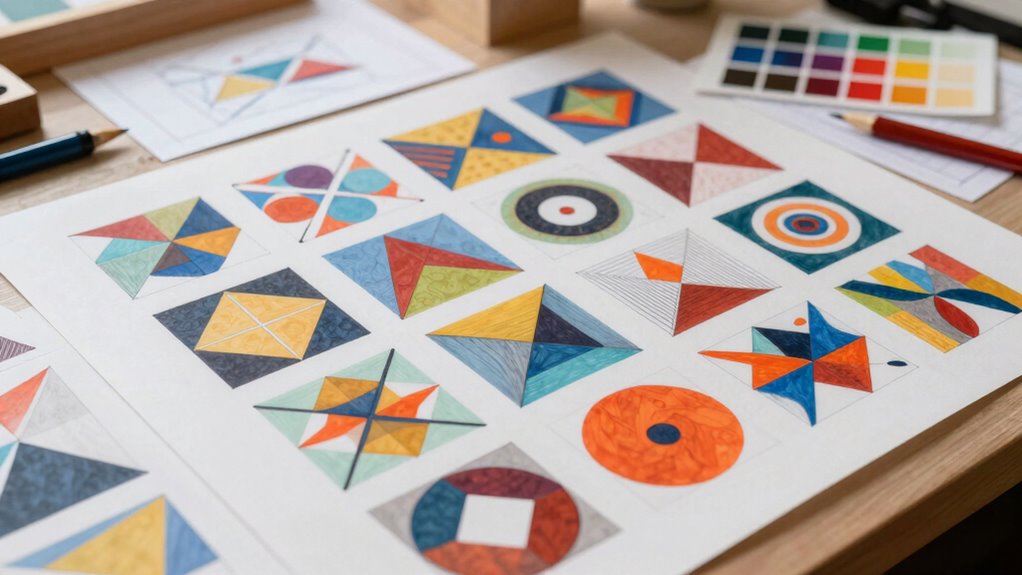

To build repeatable geometric motifs, you start by choosing basic shapes like circles, squares, and triangles, ensuring they fit within a grid system for consistency. You carefully measure and arrange these shapes to achieve seamless patterns that align perfectly when tiled. Using harmonious color schemes enhances the design’s mood, while studying historical influences adds depth. If you keep exploring, you’ll find even more ways to create mesmerizing, perfectly repeated patterns.

Prime made for students and young adults
- Fast, free delivery for dorm and study essentials
- Prime Video and Amazon Music included
- Member-only deals
Key Takeaways
- Use precise measurements and a grid system to ensure shape alignment and seamless repetition.
- Develop motifs with symmetry and consistent spacing for effortless tiling.
- Test pattern flow digitally to identify and correct mismatched edges or awkward breaks.
- Incorporate geometric relationships and variations to maintain visual harmony across repeats.
- Refine motifs for seamless tiling, adjusting scale, spacing, and alignment for continuous flow.
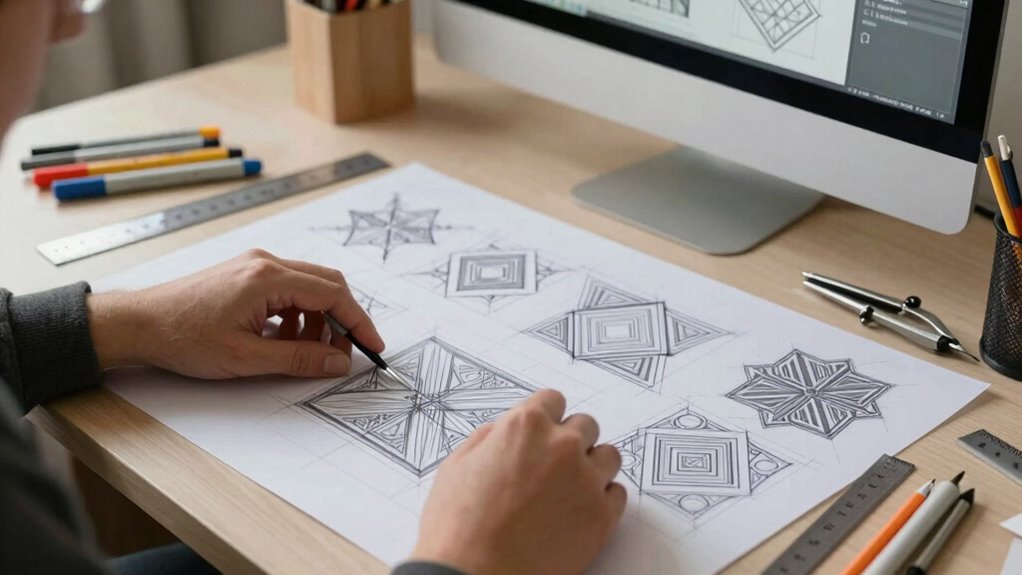
Pattern designers craft intricate geometric motifs that seamlessly repeat, transforming simple shapes into mesmerizing visual tapestries. When you’re creating these patterns, understanding how color theory influences your choices can make a huge difference. Color theory helps you select harmonious palettes that evoke specific moods or cultural associations, ensuring your designs resonate with viewers. For instance, warm colors like reds and oranges can create energy, while cool blues and greens evoke calmness. By applying color principles deliberately, you can craft patterns that are not only visually appealing but also emotionally impactful. Additionally, historical influences play a crucial role in shaping your approach. Many traditional patterns draw inspiration from cultural symbols, art movements, or ancient crafts. Recognizing these influences allows you to infuse your work with deeper meaning, connecting modern designs with time-honored aesthetics. For example, Islamic geometric patterns emphasize symmetry and mathematical precision, while Art Deco motifs highlight bold lines and luxurious color schemes. By studying how these historical styles were constructed, you gain insight into the underlying principles that make a pattern both functional and beautiful.
When you start building a repeatable motif, you focus on the fundamental shapes—circles, squares, triangles—and how they interact within a grid. You sketch your ideas, paying close attention to the relationships between shapes, ensuring they align perfectly when repeated. This process involves precise measurements and grid systems that serve as the backbone for your pattern. As you refine your design, you consider how the motifs will flow when tiled, avoiding awkward breaks or mismatched edges. Digital tools like vector graphic software help you test and tweak these repetitions, making sure each element aligns flawlessly. You also experiment with scale and spacing, understanding that these factors influence the pattern’s rhythm and visual impact.
Ultimately, building a repeatable geometric pattern is about balance—between symmetry and variation, tradition and innovation. You draw from color theory to evoke emotions and from historical influences to embed your work with cultural resonance. With patience and precision, you craft motifs that, when repeated, create mesmerizing illusions and captivating textures. Whether inspired by ancient mosaics or contemporary digital art, your goal is to produce seamless designs that enthrall the eye and stand the test of time.
As an affiliate, we earn on qualifying purchases.
Frequently Asked Questions
What Tools Do Pattern Designers Use for Creating Geometric Motifs?
You typically use digital sketching tools like tablets and apps to brainstorm ideas quickly. Then, you move on to vector illustration software like Adobe Illustrator or Affinity Designer to create precise, scalable geometric motifs. These tools allow you to easily manipulate shapes, symmetry, and patterns, ensuring your motifs are repeatable and seamless. Combining digital sketching with vector illustration helps you refine your designs efficiently and achieve professional, intricate geometric patterns.
How Do They Choose Color Palettes for Repetitive Patterns?
You choose color palettes for repetitive patterns by focusing on color harmony, ensuring the hues complement each other. You consider the mood or message you want to convey and select a palette that enhances that feeling. Palette selection involves experimenting with contrasting and analogous colors, balancing vibrant and neutral tones. Ultimately, you select colors that create visual harmony and consistency across the pattern, making it appealing and cohesive.
What Are Common Challenges Faced When Designing Geometric Repeats?
You might think designing geometric repeats is straightforward, but scaling complexities and symmetry constraints make it quite the challenge. Ironically, achieving perfect alignment across large repeats often requires meticulous precision, yet small miscalculations can cause noticeable flaws. Balancing these constraints demands patience and attention to detail. You constantly wrestle with maintaining symmetry while adapting to size changes, making the process both frustrating and rewarding, especially when everything finally lines up perfectly.
How Do Pattern Designers Ensure Seamless Tiling?
To guarantee seamless tiling, you focus on symmetry exploration, carefully aligning motifs so they connect perfectly at edges. You test patterns by repeating them digitally, checking for gaps or overlaps. Texture integration helps create visual cohesion, disguising minor misalignments. By iterating and adjusting symmetry and textures, you make certain your pattern tiles smoothly without visible seams, resulting in a professional, continuous design that flows effortlessly across surfaces.
What Historical Influences Inspire Geometric Motif Designs?
You draw inspiration from cultural symbolism and artistic movements that have shaped geometric motifs throughout history. For example, you might explore Islamic art’s intricate tessellations or Art Deco’s bold, symmetrical patterns. These influences help you create designs that resonate with cultural significance and reflect artistic innovation. By studying historical contexts, you guarantee your motifs honor tradition while adding a contemporary touch, making your patterns meaningful and visually compelling.
As an affiliate, we earn on qualifying purchases.
Conclusion
You now see how pattern designers carefully craft repeatable geometric motifs, turning simple shapes into mesmerizing designs. With patience and precision, you can build motifs that seamlessly connect, creating endless visual interest. Remember, Rome wasn’t built in a day, so don’t rush the process. Embrace the journey of experimentation and refinement, and soon you’ll have patterns that not only look great but also stand the test of time. Keep designing—your masterpiece is within reach.
As an affiliate, we earn on qualifying purchases.
As an affiliate, we earn on qualifying purchases.
Fall Picks
fall essentials
As an affiliate, we earn on qualifying purchases.