
When working with transversals crossing parallel lines, you can identify key angle pairs like alternate interior angles, which are equal, and corresponding angles, which are also equal. These relationships help you determine if lines are parallel or solve for missing angles. Understanding these patterns makes geometric problems easier to solve. If you pay attention to these angle pairs and their properties, you’ll build a stronger grasp of how transversals and parallel lines interact. Continuing will reveal more about these important relationships.

Prime made for students and young adults
- Fast, free delivery for dorm and study essentials
- Prime Video and Amazon Music included
- Member-only deals
Key Takeaways
- Transversals intersect parallel lines, creating specific angle pairs such as alternate interior, corresponding, and same-side interior angles.
- Alternate interior angles are equal when lines are parallel, aiding in identifying parallel lines.
- Corresponding angles are equal and help verify parallelism in a figure.
- Same-side interior angles are supplementary (add up to 180°), indicating lines may not be parallel if they aren’t.
- Recognizing these angle relationships simplifies solving for unknown angles and proves line parallelism.
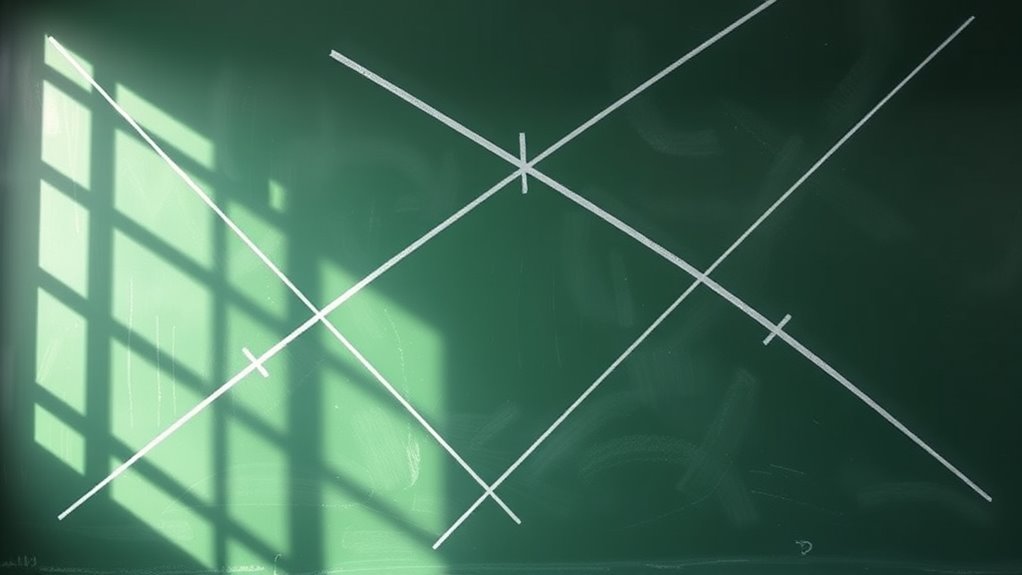
Understanding geometric relationships is essential for grasping how shapes, angles, and distances interact within space. When working with lines and angles, you’ll quickly notice certain patterns and properties that help you solve problems and understand the structure of different figures. One of the most fundamental concepts involves parallel lines and the angles formed when a transversal crosses them. When you draw a transversal across two parallel lines, you create a series of angles that have predictable relationships. These include alternate interior angles, corresponding angles, and same-side interior angles, each following specific rules that make geometry easier to understand.
Focusing on interior angles, these are the angles found between the two parallel lines, on the inside of the shape created by the crossing of the transversal. When a transversal intersects two parallel lines, the interior angles have special relationships. For example, alternate interior angles are equal, meaning that if you find one angle, you automatically know the measure of its alternate on the opposite side of the transversal. Similarly, corresponding angles—those that are in the same relative position at each intersection—are equal as well. This means that once you identify one interior angle, you can determine others without measuring each one individually. Recognizing these relationships saves you time and effort, especially when solving complex problems or proofs.
Interior angles between parallel lines and a transversal are equal in specific patterns like alternate and corresponding angles.
Knowing that interior angles formed by a transversal intersecting parallel lines are related by these rules gives you a powerful tool. For instance, if you’re given one interior angle measure, you can find others by applying these properties directly. This understanding also helps in identifying whether lines are parallel or not; if certain angle pairs are equal as expected, then the lines are parallel. Conversely, if the angles don’t match the relationships, the lines might not be parallel, guiding your deduction process. This concept is fundamental in many geometric proofs and constructions, allowing you to justify steps based on established angle relationships. Additionally, understanding the properties of transversals can be useful in real-world applications such as architecture and engineering, where precise angles are crucial.
In practice, understanding how interior angles behave when lines are parallel and crossed by a transversal enhances your ability to analyze geometric figures efficiently. It helps you see the bigger picture and make logical connections between angles and lines. Whether you’re working on a problem set, designing a structure, or just exploring geometric principles, knowing these properties allows you to approach each situation with confidence. By mastering the relationships between parallel lines and their interior angles, you develop a deeper comprehension of how space is organized and how different elements relate within it.
Popular right now

Dyson V8 Cordless Vacuum

Vitamix 5200 Professional-Grade Blender, 64 oz. Container, Black

Ninja Foodi 10-Qt DualZone Smart XL Air Fryer, 6-in-1, DZ550
As an affiliate, we earn on qualifying purchases.
Frequently Asked Questions
How Do Transversals Relate to Parallel Lines?
When you have parallel lines, a transversal creates specific transversal properties. These properties guarantee certain angle pair types, like corresponding angles, alternate interior angles, and consecutive interior angles, are congruent or supplementary. Recognizing these angle pairs helps you understand the relationships between the lines and the transversal. This understanding makes it easier to solve geometric problems involving parallel lines and angles, improving your grasp of geometric relationships.
What Is the Significance of Alternate Interior Angles?
Alternate interior angles are like secret handshake partners because they’re equal when lines are parallel. Their angle pairings show that if you know one, you automatically know the other, thanks to their angle congruence. This property helps you prove lines are parallel or find missing angles in geometric figures. Recognizing these angles makes solving problems easier, acting like a key that unfastens the relationships between lines and angles.
Can Angle Pairs Be Congruent Without Parallel Lines?
Yes, angle pairs can be congruent without parallel lines. For example, when lines are non-parallel, certain angle pairs like vertical angles or some alternate interior angles may still be congruent due to their geometric properties. You’ll see that angle pair congruence isn’t exclusive to parallel lines; it can also occur in non-parallel configurations, especially when specific angles are formed by intersecting lines or transversals.
How Do Exterior Angles Interact With Transversals?
Exterior angles extend outside the lines, engaging with transversals in intriguing interactions. When a transversal crosses parallel lines, exterior angles often form pairs that are equal or supplementary. You’ll notice that exterior angles are supplementary to their adjacent interior angles, meaning they add up to 180 degrees. This relationship helps you understand angle measures and proves that exterior angles interact dynamically with transversals, emphasizing equality, equality, and essential supplementary sums.
Are There Real-World Applications of These Geometric Concepts?
Yes, you can see real-world applications of these geometric concepts in architectural designs and optical illusions. Architects use transversals and angle relationships to create visually appealing structures and ensure stability. In optical illusions, these concepts help craft images that challenge perception and appear distorted. Understanding how exterior angles interact with transversals enables you to design innovative buildings and create mesmerizing visual effects that intrigue the eye.
Conclusion
As you explore the world of transversals and angle pairs, picture the rays stretching across the sky like beams of sunlight, creating intricate patterns of angles that fit together perfectly. You see how these relationships form a beautiful geometric tapestry, guiding your understanding like a compass. Keep observing these connections around you—each angle tells a story, and with your newfound knowledge, you can decipher the secrets woven into every line and intersection.