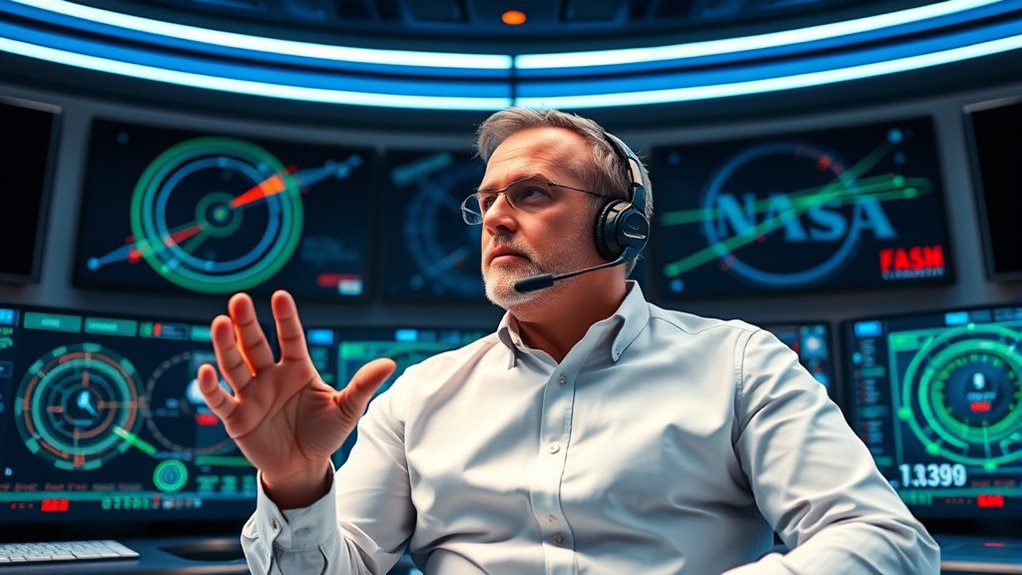

As a NASA mission planner, you understand that orbital geometry is key to designing successful space missions. You focus on optimizing trajectories to conserve fuel, guarantee safety, and meet scientific goals. You use celestial mechanics to calculate precise maneuvers and leverage gravitational assists when possible. Continuous monitoring allows you to adjust orbits in real time, keeping the mission on track. If you’re curious about the detailed strategies involved, you’ll find more insights by exploring further.
Key Takeaways
- NASA mission planners utilize orbital geometry to design efficient trajectories that conserve fuel and optimize mission timelines.
- They analyze celestial mechanics to leverage gravitational assists, reducing propulsion requirements.
- Continuous monitoring and adaptive planning ensure spacecraft stay on planned orbits amid gravitational perturbations.
- Precise calculations of orbital elements enable successful mission maneuvers like orbit corrections and planetary insertions.
- Strategic orbit optimization enhances safety, scientific return, and mission success through detailed trajectory modeling.

Understanding orbital geometry is essential for planning successful space missions, and NASA mission planners rely on precise calculations to navigate the complexities of space. When you’re involved in spacecraft navigation, every detail counts. The way a spacecraft moves through space depends on its orbit, and optimizing that orbit is vital for mission success. Orbit optimization isn’t just about getting from point A to point B; it’s about finding the most efficient path that minimizes fuel consumption, maximizes scientific return, and guarantees safety. This involves analyzing celestial mechanics, gravitational influences, and the spacecraft’s specific mission parameters. As a mission planner, you need to understand how to adjust orbital elements to achieve mission objectives while conserving resources.
Effective orbit optimization ensures safe, efficient space missions by analyzing celestial mechanics and adjusting orbital elements strategically.
In practice, this means you use sophisticated models and simulations to predict how the spacecraft will behave once in orbit. Small adjustments—such as firing thrusters at precise moments—can notably alter the trajectory. These maneuvers, known as orbit corrections or plane changes, are carefully calculated to maintain or change the spacecraft’s path with minimal fuel use. Your goal is to fine-tune the orbit so it aligns perfectly with mission needs, whether that’s rendezvousing with another spacecraft, reaching a planetary orbit, or maintaining a stable orbit around a celestial body. This process requires a deep understanding of orbital dynamics and the ability to interpret data from tracking stations.
Spacecraft navigation also involves continuous monitoring and real-time adjustments. As the spacecraft progresses along its path, you analyze tracking data to verify its position and velocity. If deviations occur—due to gravitational perturbations or other factors—you plan corrective maneuvers to bring the craft back on course. This cycle of assessment and adjustment exemplifies the importance of precise orbital calculations and the need for flexible, adaptive planning. Orbit optimization isn’t static; it evolves throughout the mission as conditions change and new scientific opportunities arise. Additionally, understanding orbital geometry helps in designing trajectories that take advantage of natural gravitational assists, conserving fuel and time.
Ultimately, your role as a mission planner hinges on your ability to leverage orbital geometry for the best possible outcomes. Successful navigation depends on detailed knowledge of celestial mechanics, careful planning of maneuvers, and ongoing adjustments. By mastering these principles, you help guarantee that spacecraft reach their destinations efficiently and safely, pushing the boundaries of exploration while conserving valuable resources. The intricacies of orbital geometry may seem complex, but with precise calculations and strategic planning, you turn theoretical models into real-world success stories in space exploration.

Weems & Plath Marine Navigation Tool Set (Basic)
Includes Weems Protractor (#255)
As an affiliate, we earn on qualifying purchases.
As an affiliate, we earn on qualifying purchases.
Frequently Asked Questions
How Do Orbital Plans Change With Unexpected Space Weather?
When space weather impacts occur, you need to quickly adjust your orbital plans to guarantee safety and mission success. Solar storms and geomagnetic disturbances can alter satellite trajectories and increase atmospheric drag, prompting you to modify orbital inclinations or timing. You continuously monitor space weather data, making real-time orbital plan adjustments to mitigate risks, protect equipment, and maintain mission objectives despite the unpredictable effects of space weather impacts.
What Tools Are Used to Simulate Orbital Trajectories in Real-Time?
You use advanced simulation tools like GMAT and STK to model orbital trajectories in real-time, considering spacecraft instrumentation and mission timeline constraints. These software programs process real-time data, enabling you to adjust plans quickly when space weather impacts your mission. They help predict potential deviations, ensuring your spacecraft stays on course and mission objectives are met efficiently, even amid unexpected space weather events.
How Do Mission Goals Influence Orbital Design Choices?
You decide on orbital design based on your mission goals, balancing mission trade-offs and orbital flexibility. For example, if you need quick access to multiple targets, you might choose a more adaptable orbit, even if it requires more fuel. Conversely, for long-term stability, you might prioritize orbits that minimize fuel use. Your choices directly reflect the mission’s priorities, ensuring ideal performance while managing trade-offs effectively.
What Are Common Challenges in Coordinating Multiple Spacecraft Orbits?
Dealing with multiple spacecraft orbits feels like juggling flaming torches in a hurricane. You’ll face challenges like avoiding space debris, which can be as unpredictable as a storm, and managing communication delays that stretch time like taffy. Coordinating precise orbital paths requires meticulous planning, constant updates, and quick adjustments. Without this, mission success can quickly spiral into chaos, making it essential to anticipate and mitigate these common hurdles.
How Does NASA Ensure Safety During Orbital Adjustments?
NASA guarantees safety during orbital adjustments by carefully planning maneuvers, considering spacecraft thermal limits and communication relays. You’ll find that mission teams monitor thermal conditions closely to prevent overheating or freezing, while adjusting orbits. They also coordinate with communication relays to maintain constant contact. This proactive approach helps avoid collisions, ensures data integrity, and keeps spacecraft operating safely as they perform necessary orbital changes.

Computer Simulations in Molecular Biology: From Quantum Mechanics to Molecular Dynamics (Scientific Computation)
As an affiliate, we earn on qualifying purchases.
As an affiliate, we earn on qualifying purchases.
Conclusion
Understanding orbital geometry isn’t just complex science; it’s the key to successful space missions. Did you know that precise calculations can reduce fuel costs by up to 20%? This shows how mastery of orbital mechanics directly impacts mission efficiency and safety. As you now see, every degree and orbit matter, making space exploration both a science and an art. Embrace these insights, and you’ll appreciate the incredible precision behind every launch.

Spacecraft Mission Design, 2nd Edition (AIAA Education Series)
As an affiliate, we earn on qualifying purchases.
As an affiliate, we earn on qualifying purchases.

Spot Trace Satellite Tracking Device | Handheld Tracker for Hiking, Camping, Cars, Kids, Outdoor Activities, and Assets with Globalstar Network Coverage | Subscription Applicable
SATELLITE TRACKING DEVICE: Using satellite technology, Spot Trace can track anything, use it to track moving truck, boat…
As an affiliate, we earn on qualifying purchases.
As an affiliate, we earn on qualifying purchases.