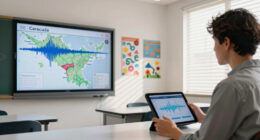
To make geometry accessible, you should focus on actively engaging your students through hands-on activities, visual aids, and real-world examples that relate to their interests. Incorporate models, digital simulations, and group work to build confidence and foster curiosity. Connecting abstract concepts to practical applications helps students see the relevance and stay motivated. By using varied teaching methods and making learning interactive, you’ll create a supportive environment where every student can understand and enjoy geometry. Keep exploring to find more effective strategies.
Key Takeaways
- Use hands-on activities and visual aids to make geometric concepts tangible and engaging for all learners.
- Incorporate real-world examples and applications to connect geometry to students’ everyday experiences.
- Employ interactive technology and simulations for instant feedback and dynamic exploration of shapes and angles.
- Promote collaborative learning through group tasks and peer teaching to deepen understanding and confidence.
- Design lessons that start with basic shapes and progressively build toward complex concepts, ensuring accessibility and clarity.

Making geometry accessible can be a challenge, but dedicated teachers are finding innovative ways to break down complex concepts for students. As a math teacher, you understand that geometry often intimidates students, making it essential to craft lessons that foster both understanding and interest. One of the most effective strategies involves focusing on student engagement. When students are actively involved in their learning, they’re more likely to grasp abstract ideas like angles, shapes, and proofs. Incorporating hands-on activities, visual aids, and real-world applications keeps students curious and motivated. For example, using physical models or digital simulations allows students to manipulate geometric figures, making the concepts tangible and easier to understand. This active participation transforms passive memorization into meaningful exploration, encouraging deeper comprehension.
Curriculum design plays a vital role in making geometry accessible. You need to structure your lessons thoughtfully, ensuring that each concept builds on the previous one. Starting with foundational ideas—such as basic shapes and their properties—sets the stage for more complex topics like congruence, similarity, and trigonometry. When designing your curriculum, consider integrating various teaching methods to cater to different learning styles. Visual learners benefit from diagrams and videos, while kinesthetic learners thrive with manipulatives and physical activities. Incorporating technology, such as interactive geometry software, can further enhance student engagement by providing instant feedback and allowing students to experiment with geometric principles in a dynamic environment. Additionally, understanding the benefits of airless paint sprayers can inspire creative teaching projects that relate to real-world applications of geometry, making lessons more engaging.
You also recognize the importance of contextualizing geometry within real-life scenarios. Showing students how geometry appears in architecture, art, or nature makes abstract concepts relevant and exciting. This approach not only boosts engagement but also helps students see the practical value of what they’re learning. Throughout your teaching, you emphasize clear explanations and opportunities for students to ask questions and collaborate. Group activities, peer teaching, and problem-solving challenges foster a community of learners where everyone feels empowered to participate.
Ultimately, making geometry accessible isn’t about simplifying the subject but about designing a curriculum and learning environment that meet students where they are. By prioritizing student engagement and thoughtfully structuring your lessons, you help students develop confidence and a genuine appreciation for geometry. Your commitment to innovative teaching methods can turn what once seemed intimidating into an accessible, enjoyable subject that students want to explore.

The Interactive Geometry Software Cinderella (Interactive Geometry on Computers)
Used Book in Good Condition
As an affiliate, we earn on qualifying purchases.
As an affiliate, we earn on qualifying purchases.
Frequently Asked Questions
How Do You Tailor Lessons for Diverse Learning Styles?
You tailor lessons for diverse learning styles by incorporating visual aids and hands-on activities that engage all students. You use diagrams, models, and colorful charts to help visual learners grasp concepts, while hands-on activities like building geometric shapes cater to kinesthetic learners. By mixing these approaches, you guarantee each student can connect with the material in a way that suits their learning style, making geometry accessible and enjoyable for everyone.
What Technology Tools Enhance Geometry Understanding?
Think of technology tools as your gateway to a vivid, interactive universe. You can enhance geometry understanding by using dynamic visualizations that bring shapes and angles to life. Interactive software like GeoGebra or Desmos let you manipulate figures in real-time, helping students see concepts unfold. These tools make learning engaging, allowing learners to explore and discover geometry’s beauty firsthand, transforming abstract ideas into tangible experiences.
How Do You Assess Student Progress in Geometry?
You assess your students’ progress in geometry through visual assessments like sketches and diagrams, which reveal their understanding of concepts. You also provide formative feedback during activities and discussions, helping students identify areas for improvement. By observing their problem-solving approaches and offering timely guidance, you guarantee they stay on track and deepen their comprehension, making learning engaging and effective.
What Common Misconceptions Do Students Have About Geometry?
Like a foggy window, misconceptions obscure understanding, making it hard to see geometry clearly. You might think angles always add up to 180 degrees or that all triangles are the same shape. To clear this, you use visualization techniques to help students see the true relationships. Correcting misconceptions involves active discussion and hands-on activities, guiding students from confusion to clarity, much like polishing a foggy mirror until everything shines through.
How Can Parents Support Geometry Learning at Home?
You can support geometry learning at home by using visual aids like diagrams, models, and drawings to help your child understand concepts better. Encourage them to explore real-world applications, such as measuring objects or analyzing shapes in their environment. Ask questions that promote critical thinking and problem-solving. Your active involvement, combined with practical examples and visual tools, makes geometry more engaging and accessible, boosting your child’s confidence and understanding.
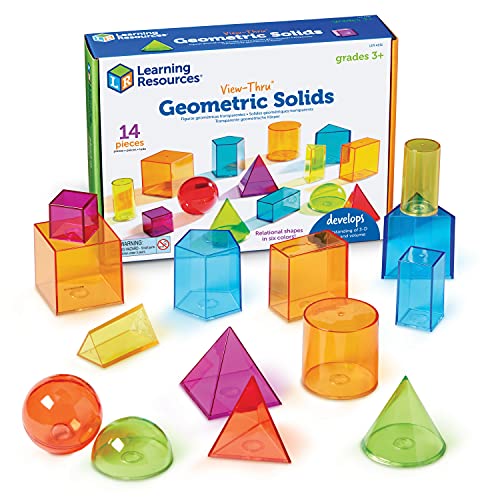
Learning Resources View-Thru Geometric Solids – Classroom Must Haves, Teacher Supplies, Geometry Set, Pattern Blocks, Homeschool, 3d School Shapes For Teaching, Math Manipulatives Essentials
VISUALIZE GEOMETRIC CONCEPTS – Transparent, colorful 3D shapes allow students to see inside geometric solids, making abstract math…
As an affiliate, we earn on qualifying purchases.
As an affiliate, we earn on qualifying purchases.
Conclusion
Ultimately, embracing innovative teaching methods gently guides students toward a deeper appreciation of geometry. By fostering curiosity and confidence, you help them navigate complex concepts with grace. Your dedication subtly shapes a more inclusive learning environment, where every learner feels valued and empowered. In this quiet pursuit, you’re not just teaching geometry—you’re inspiring a lifelong love of discovery. Keep nurturing that spark, knowing your effort quietly transforms minds and opens new horizons.

Pull String 3D Geometry Learning Book for Volume & Surface Area | Interactive Math Manipulatives & Teaching Aid | Classroom & Homeschool Supplies | Gift for Kids, Teens, Students Ages 10-15 (Blue)
✨ WITNESS THE MAGIC OF 3D TRANSFORMATION! Tired of flat, confusing geometry diagrams? Our revolutionary pull-string 3D geometry…
As an affiliate, we earn on qualifying purchases.
As an affiliate, we earn on qualifying purchases.

STAEDTLER Metal Drawing Compass, Geometry Tool, 4-7/8in with Safety Point & Universal Adapter, Includes Protective Storage Case with Measurement Guide
STUDENT COMPASS – This geometry compass draws accurate circles every time. STAEDTLER craftsmanship shows in smooth rotation and…
As an affiliate, we earn on qualifying purchases.
As an affiliate, we earn on qualifying purchases.