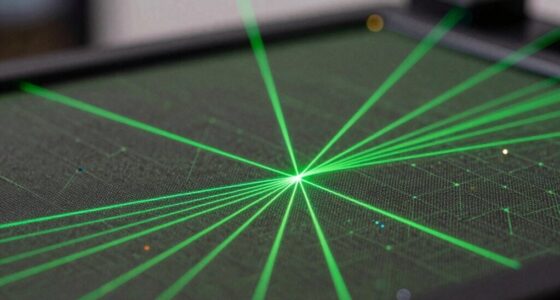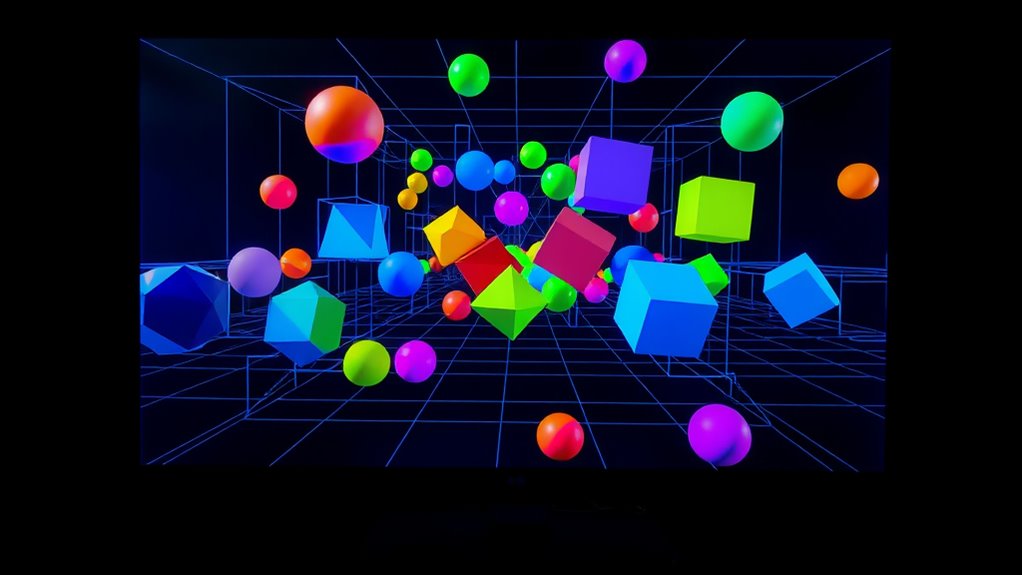
Collision detection algorithms are essential for creating realistic and smooth interactions in games. They use geometric shapes like bounding boxes, spheres, and more detailed meshes to identify when objects touch or intersect. To optimize performance, techniques such as spatial partitioning and broad-phase/narrow-phase checks are employed. These methods help games run efficiently while providing believable physics. Continuing explore these concepts reveals how geometry plays a crucial role in game development.

Prime made for students and young adults
- Fast, free delivery for dorm and study essentials
- Prime Video and Amazon Music included
- Member-only deals
Key Takeaways
- Collision detection in games relies on geometric models like bounding volumes and meshes for accurate interaction modeling.
- Broad-phase algorithms quickly identify potential collisions using simplified shapes, reducing unnecessary detailed checks.
- Narrow-phase algorithms perform precise collision tests on candidate object pairs, ensuring realistic physics responses.
- Spatial partitioning methods such as quad-trees and oct-trees optimize collision checks by organizing game space efficiently.
- Selecting appropriate algorithms balances performance and realism, crucial for maintaining seamless gameplay.

Collision detection is a fundamental component of game development that guarantees objects interact realistically within a virtual environment. When you’re designing a game, you want characters, projectiles, and environment elements to respond naturally to each other’s presence and movement. This is where physics simulation comes into play, creating the illusion of real-world behavior through mathematical models. To make these interactions seamless, you rely on collision detection algorithms that determine when objects intersect or come into contact. But as your game’s complexity grows, so does the computational load. To maintain smooth gameplay, you implement optimization techniques that streamline these calculations, making collision detection both accurate and efficient.
Imagine you’re working with a vast environment filled with numerous objects. Checking every object against every other object for collisions would be computationally prohibitive. Instead, you utilize spatial partitioning methods, such as quad-trees or oct-trees, which subdivide the game world into manageable sections. This way, collision checks are limited to objects within the same or neighboring partitions, drastically reducing the number of calculations needed. Bounding volume hierarchies also help; by enclosing complex objects within simple geometric shapes like spheres or boxes, you can quickly eliminate non-colliding pairs before performing more detailed checks. These optimization techniques are vital for maintaining real-time performance, especially in fast-paced games where milliseconds matter.
On the technical side, you often choose between different collision detection approaches based on your game’s needs. Broad-phase algorithms swiftly identify potential collisions using simplified models, filtering out unlikely pairs. Narrow-phase algorithms then perform precise checks on these candidates, using more detailed geometry. This layered approach balances speed and accuracy, ensuring that your game responds correctly without bogging down the system. For example, if you’re developing a racing game, you might use bounding boxes in the broad phase to rule out distant cars, then switch to detailed mesh collision detection for vehicles that are close together. This combination ensures a realistic physics simulation while optimizing resource use. Additionally, selecting the appropriate collision detection algorithm significantly impacts the performance and realism of your game.
collision detection game development kit
As an affiliate, we earn on qualifying purchases.
As an affiliate, we earn on qualifying purchases.
Frequently Asked Questions
How Do Collision Detection Algorithms Impact Game Performance?
Collision detection algorithms markedly impact your game’s performance by influencing how efficiently physics simulations run. When you optimize these algorithms, you reduce the computational geometry workload, which speeds up processing. This means fewer frame drops and smoother gameplay. If you choose or design algorithms wisely, you can balance accuracy with speed, ensuring your game remains responsive while accurately detecting collisions, providing a better experience for players.
What Are the Latest Advancements in Collision Detection Technology?
Modern methods meld machine learning with real-time computation, making collision detection smarter and swifter. You’ll find algorithms that adapt dynamically, minimizing lag and maximizing accuracy, thanks to breakthroughs in artificial intelligence. These advancements enable games to handle complex environments seamlessly, providing smoother gameplay and more realistic interactions. As technology evolves, you’ll experience more immersive worlds, where collision detection is precise, responsive, and powered by cutting-edge AI-driven techniques.
How Do Developers Choose the Right Collision Detection Method?
You choose the right collision detection method by considering your game’s physics simulation needs and complexity. If you need fast, efficient checks, you’ll likely use spatial partitioning techniques like quad-trees or oct-trees to narrow down potential collisions. For more precise interactions, you may opt for bounding volumes or mesh-based collision detection. Balancing performance with accuracy helps you select the best approach for your game’s specific requirements.
Can Collision Detection Algorithms Be Optimized for Virtual Reality?
Yes, collision detection algorithms can be optimized for VR to enhance immersive accuracy. You should focus on VR optimization techniques like spatial partitioning and simplified geometry to reduce latency, ensuring smooth interactions. Prioritize real-time responsiveness and minimize false positives, so your VR experience remains seamless. By tailoring algorithms specifically for VR environments, you create more realistic interactions, making users feel truly immersed in the virtual world.
How Does Collision Detection Handle Complex, Deformable Objects?
You handle complex, deformable objects by using collision detection techniques that account for mesh deformation and soft body dynamics. These methods update the collision meshes in real-time as the object deforms, ensuring accurate detection. Soft body simulations allow the objects to bend and stretch naturally, while algorithms adapt dynamically to changes in shape. This approach maintains realistic interactions, even with highly complex, deformable objects in your game environment.
As an affiliate, we earn on qualifying purchases.
Conclusion
Understanding collision detection algorithms is essential for creating seamless gaming experiences. Did you know that efficient algorithms can reduce processing time by up to 50%, allowing games to run smoother and more realistically? By mastering geometry’s role in these algorithms, you’ll enhance your game development skills, ensuring players stay immersed without lag or glitches. So, keep exploring these techniques—because in gaming, precise collision detection makes all the difference between a good game and a great one.
spatial partitioning software for games
As an affiliate, we earn on qualifying purchases.
As an affiliate, we earn on qualifying purchases.
bounding box collision detection tools
As an affiliate, we earn on qualifying purchases.
As an affiliate, we earn on qualifying purchases.
Fall Picks
fall essentials
As an affiliate, we earn on qualifying purchases.