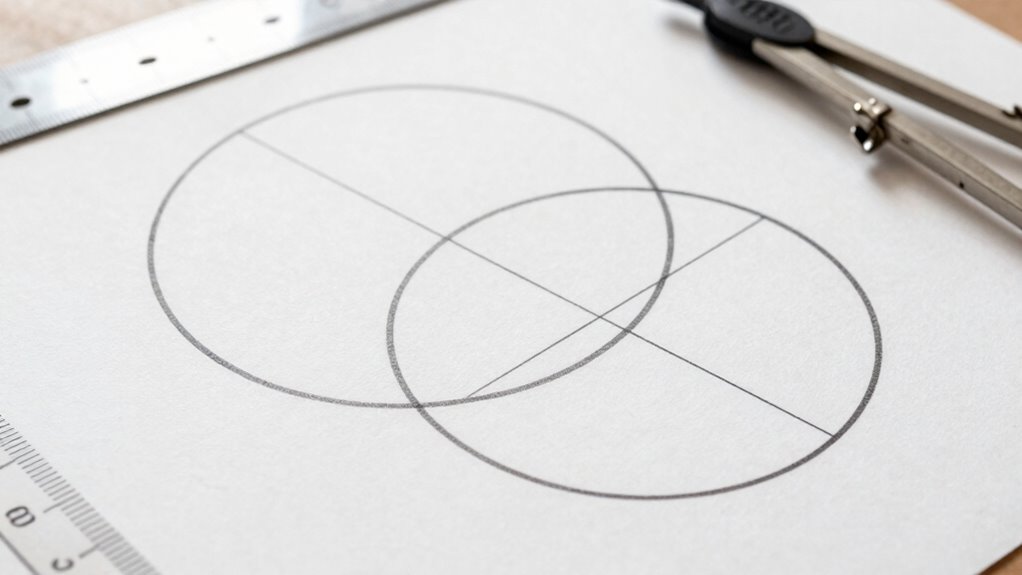

Ratios are the secret language of geometric comparison because they reveal proportional relationships that show how shapes relate beyond just measurements. They help you see patterns, determine similarity, and understand scale invariance in figures of all types. By focusing on ratios, you can compare shapes regardless of their size, making complex problems simpler. Keep exploring, and you’ll discover how ratios uncover the deeper connections within geometry’s hidden language.
Key Takeaways
- Ratios reveal proportional relationships, allowing meaningful comparisons regardless of size differences.
- They maintain consistency in scale-invariant properties, essential for identifying similar figures.
- Ratios enable analysis based on relative measurements, simplifying complex geometric assessments.
- As dimensionless values, ratios unify diverse shapes and figures for universal comparison.
- They serve as a foundational language that uncovers hidden relationships and patterns in geometry.
When comparing geometric figures, ratios serve as a powerful tool to understand their relative sizes and proportions. They allow you to see beyond the raw measurements and grasp the fundamental relationships between shapes. This is especially true when dealing with similar figures, where the concept of scale invariance comes into play. Scale invariance means that the proportions between corresponding parts remain consistent, regardless of the actual size of the figures. Recognizing this invariance helps you understand that two figures are similar because their ratios of corresponding sides are equal. It’s a key idea that simplifies complex comparisons, letting you focus on proportional reasoning rather than getting lost in absolute measurements.
Proportional reasoning is at the core of why ratios are so effective in geometric comparisons. When you approach a problem involving shapes, you don’t have to measure every side or angle precisely. Instead, you compare ratios of corresponding parts. For example, if you’re looking at two triangles and find that the ratio of their corresponding sides is consistent, you can conclude they’re similar. This reasoning allows you to make predictions, solve problems, and understand relationships without extensive calculations. It’s a way of thinking that emphasizes the relative rather than the absolute, which is crucial in geometry. Additionally, understanding the concept of similarity enhances your ability to recognize patterns and make connections across different geometric figures. Recognizing these patterns helps in developing a deeper understanding of geometric principles****, making your reasoning more intuitive.
Ratios also serve as a universal language that bridges different types of geometric figures. Whether you’re working with polygons, circles, or three-dimensional objects, ratios help you identify patterns and similarities. They allow you to compare properties like angles, side lengths, and areas in a meaningful way. Because ratios are dimensionless, they let you compare figures of different sizes directly, reinforcing the idea of scale invariance. This universality makes ratios invaluable in fields ranging from architecture to engineering, where understanding how components relate to each other is essential. Moreover, these ratios often reveal hidden relationships within complex figures, simplifying analysis and interpretation.
Moreover, ratios enable you to simplify complex problems by reducing them to manageable parts. When you analyze a figure through ratios, you’re isolating the key relationships that define its shape. This focus helps you develop a deeper understanding of geometric principles and enhances your ability to reason proportionally. It’s a skill that translates across math and real-world applications, allowing you to scale designs, interpret maps, or analyze biological structures with confidence. Recognizing the importance of scale invariance in geometry can further deepen your understanding of how different shapes relate and compare. Ultimately, ratios unlock the secret language of geometric comparison, making it easier to see the connections, similarities, and invariances that define the world of shapes.

Scientific Calculator, 2 Line Cute Scientific Math Calculator Function Calculator for Students Algebra Geometry Basic Caculator for Middle and High School Students College School Supplies (Pink)
【240 Functions Scientific Calculator】Pungltd scientific calculator has 240 functions and covers the most scientific functions what students need…
As an affiliate, we earn on qualifying purchases.
As an affiliate, we earn on qualifying purchases.
Frequently Asked Questions
How Do Ratios Differ From Fractions in Geometry?
Ratios differ from fractions in geometry because ratios compare two quantities directly, often representing scale factors or relationships between figures. Fractions are specific ratios expressed as parts of a whole. You use ratios in proportional reasoning to determine if figures are similar or scaled correctly. Unlike fractions, ratios aren’t limited to parts of a whole; they help you understand how shapes relate and compare in size, shape, or proportion.
Can Ratios Be Negative or Only Positive?
Ratios can be negative or positive, depending on the values involved. Negative values in ratios indicate that one quantity is opposite in direction or sign compared to the other, affecting ratio interpretation. You should interpret negative ratios carefully, as they often reflect directional differences or contrasting relationships. In geometry, positive ratios typically show proportionality, while negative ones reveal inverse or opposing relationships, helping you understand the underlying geometric comparison better.
Are Ratios Applicable in Three-Dimensional Geometric Comparisons?
Yes, ratios are applicable in three-dimensional geometric comparisons. You can use them for dimensional scaling and analyzing spatial proportions in 3D objects. Ratios help you compare lengths, widths, and heights across different shapes, maintaining proportionality. This allows you to understand and visualize how three-dimensional figures relate to each other, ensuring accurate comparisons and consistent scaling in complex designs or models.
How Do Ratios Relate to Similarity in Geometric Figures?
You realize that ratios hold the key to understanding similarity in geometric figures. Through proportional reasoning, you compare corresponding sides, revealing scale factors that connect shapes. When these ratios are equal, the figures are similar, just scaled versions of each other. This subtle relationship allows you to discover the secrets of geometric comparison, transforming complex shapes into understandable, comparable forms—making ratios the silent language that guides your exploration of geometry’s true harmony.
What Role Do Ratios Play in Non-Euclidean Geometry?
Ratios in non-Euclidean geometry help you understand scale invariance when shapes distort under curved space. You use ratio transformations to compare lengths and angles, even as traditional Euclidean rules don’t apply. These ratios reveal consistent relationships despite the geometry’s non-flat nature. By focusing on ratios, you grasp how distances and angles relate, enabling you to analyze and compare complex curved figures effectively.

STAEDTLER 10-Piece Math Set with Metal Compass, 6" Ruler & Triangle Squares, 45° & 30/60° Set Squares, Alphabet Stencil – Measuring Tools
COMPLETE DRAWING SET – This geometry set includes a metal compass, ruler, alphabet stencil, and two set squares…
As an affiliate, we earn on qualifying purchases.
As an affiliate, we earn on qualifying purchases.
Conclusion
Understanding ratios unravels the secret language of geometry, helping you compare shapes and sizes effortlessly. Did you know that the concept of the golden ratio, approximately 1.618, appears in everything from ancient architecture to nature’s design? By mastering ratios, you gain a powerful tool to see the world more clearly and appreciate its underlying harmony. Next time you observe a building or a flower, remember: ratios are the key to understanding their perfect proportions.

Zakrafo 4 Pcs Multifunctional Geometric Ruler,Math Measuring Rulers for Drawing and Art,Metric Ruler Drawing Tool for School Office Supplies and Build
PACKAGE INCLUDES: You'll get 4 multifunctional drawing ruler: 3 semi-oval long rulers with rotatable protractors and 1 square…
As an affiliate, we earn on qualifying purchases.
As an affiliate, we earn on qualifying purchases.

UCEC Calibration Weights for Digital Scale, 10mg – 100g Gram Weights Kit, Precision Stainless Steel Balance Scale Calibration Weight Set with Tweezers for Lab Educational Science
17 PCS PRECISION WEIGHTS: This calibration weight set contains 17 pieces of different weights (includes 1x10mg, 2x20mg, 1x50mg,…
As an affiliate, we earn on qualifying purchases.
As an affiliate, we earn on qualifying purchases.