

The geometry of force involves understanding how vectors represent both magnitude and direction. When forces act on an object, you can analyze their effects by breaking them into components along axes, using trigonometry. If the forces balance perfectly, the vectors form a closed polygon, indicating equilibrium. Recognizing how forces add and cancel helps explain whether an object remains at rest or moves. Continuing will reveal how this geometric approach unlocks deeper insights into force interactions.
Key Takeaways
- Force vectors represent magnitude and direction, essential for analyzing equilibrium and motion in physical systems.
- Resolving forces into perpendicular components simplifies complex interactions using trigonometry.
- Equilibrium occurs when the vector sum of all forces equals zero, forming a closed force polygon.
- Vector addition visually and mathematically determines net forces, clarifying conditions for balance or movement.
- Understanding the geometry of force vectors aids in solving real-world problems involving forces and structural stability.

Have you ever wondered how forces interact in space? When multiple forces act on an object, understanding their combined effect is essential. This is where vector addition comes into play. Unlike scalar quantities, which only have magnitude, vectors have both magnitude and direction. To analyze how these forces influence an object, you need to add the vectors together, considering their directions. This process, called force resolution, involves breaking down complex forces into simpler components—usually along perpendicular axes—and then summing these components to find the resultant force. By visualizing forces as arrows, with length representing magnitude and direction indicating their orientation, you can better grasp how they combine.
Understanding how vectors combine helps explain forces acting in any direction.
Force resolution simplifies the problem by decomposing a single force into components along axes that are easier to work with. For example, if a force acts at an angle, you can resolve it into horizontal and vertical components using basic trigonometry. These components are vectors themselves, and by adding all horizontal components together and all vertical components together, you find the total forces acting in each direction. Once you’ve summed these components, you can recombine them to find the resultant vector, which represents the net force acting on the object. This approach makes it straightforward to analyze complex force systems, especially in equilibrium situations where forces balance out.
In equilibrium, the net force on an object is zero, meaning all individual forces cancel each other out through vector addition. You can visualize this as forces forming a closed polygon of vectors, where the tip of one arrow connects to the tail of the next, ultimately returning to the starting point. When forces are balanced this way, the object remains at rest or moves with constant velocity. Understanding force resolution helps you see how different forces contribute to this balance, whether they are tension, gravity, friction, or applied pushes. By resolving each force into components and summing them via vector addition, you verify whether the forces are in equilibrium or if there’s a net force causing acceleration.
Mastering the concepts of vector addition and force resolution also enhances your understanding of multi-dimensional force systems and their applications in real-world scenarios. Whether you’re dealing with a hanging weight, a ship sailing against the wind, or a structure under load, these principles help you break down complex interactions into manageable parts. Recognizing how vectors add and resolve clarifies the true nature of forces and how they work together to produce equilibrium or motion. This geometric perspective not only enhances your understanding of physics but also improves your ability to solve practical problems involving forces in space.
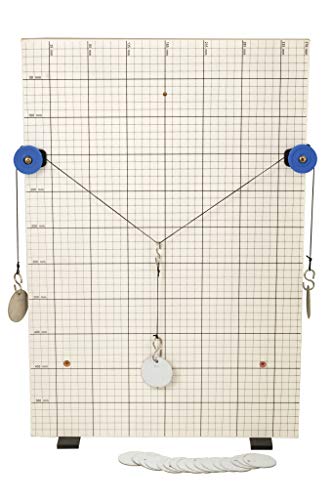
Eisco – Vector and Force Board Study Apparatus, Includes Pulleys, S Hooks, String, 10g Masses & 55cm x 37.5cm Backboard, Free-Standing Grid for Physics Force & Vector Experiments
- Complete Vector Study Kit: Includes pulleys, hooks, string, masses, backboard
- High-Contrast Force Grid: 5cm and 1cm resolution for precise measurements
- Low-Friction Pulleys: Clamp-on ABS pulleys with ball bearings for smooth operation
As an affiliate, we earn on qualifying purchases.
As an affiliate, we earn on qualifying purchases.
Frequently Asked Questions
How Do Vector Principles Apply in Real-World Engineering Structures?
In real-world engineering structures, you apply vector principles through vector addition to analyze forces acting on components. Structural analysis involves breaking down complex forces into simpler vectors, then combining them to find resultant forces and moments. This helps you guarantee stability and safety. By understanding how vectors work, you can design structures that resist loads efficiently, preventing failures and optimizing material use in bridges, buildings, and other critical constructions.
What Are Common Mistakes When Calculating Force Equilibria?
Did you know that over 30% of engineering errors in force calculations stem from misinterpretation errors? When calculating force equilibria, common mistakes include approximation mistakes that skew results and misreading vector directions. Always double-check your vector components and confirm you’re correctly summing forces. Small misinterpretations can lead to significant structural issues, so take your time to verify each step and avoid these frequent pitfalls.
Can Vectors Be Used to Analyze Dynamic Forces?
Yes, you can use vectors to analyze dynamic forces. By applying vector addition, you combine forces acting at different angles, and force decomposition helps you break complex forces into simpler components. This allows you to understand how forces change over time and influence motion. Using vectors provides a clear and precise way to visualize and calculate the effects of dynamic forces, ensuring accurate analysis of real-world situations.
How Does Friction Affect Force and Equilibrium Calculations?
Frictional forces play a vital role in equilibrium analysis because they oppose motion and can either prevent slipping or help maintain balance. When you account for friction, you add an additional force vector to your calculations, affecting the overall force balance. This means you need to carefully include frictional forces in your vector analysis to accurately determine whether an object is in equilibrium or if movement will occur.
Are There Software Tools for Visualizing Force Vectors?
Yes, many software tools specialize in vector visualization, making force diagrams clearer and easier to interpret. These tools often allow you to manipulate vectors interactively, providing real-time feedback on force direction and magnitude. Programs like GeoGebra, PhET simulations, and specialized engineering software help you better understand how forces interact, making complex equilibrium calculations more intuitive. Such visualization tools are invaluable for students and professionals tackling force analysis tasks.
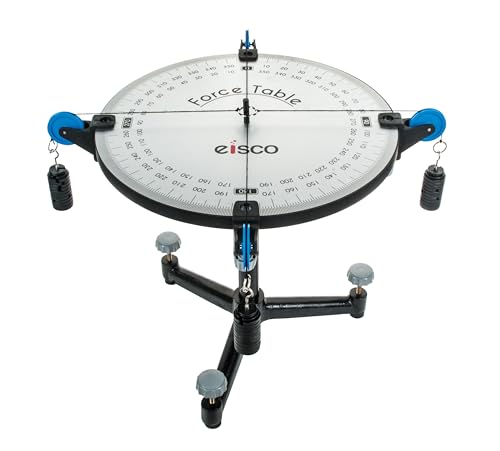
Eisco – Standard Physics Force Table, 40cm Polymer Top, Dual-Angle Measurement Scales, Heavy Cast Base, Leveling Screws, Pulleys and 250g Mass Sets for Vector and Equilibrium Experiments
- Complete Vector Experiment Kit: Includes tabletop, pulleys, masses, and accessories
- Dual-Angle Measurement Scales: Marked every 10° with 0.5° increments
- Stable Cast Base with Leveling: Heavy-duty base with leveling screws for stability
As an affiliate, we earn on qualifying purchases.
As an affiliate, we earn on qualifying purchases.
Conclusion
Remember, understanding the geometry of force helps you see how vectors balance each other out in equilibrium. Some might think it’s too complex or abstract, but once you grasp the visual relationships, it becomes clear and intuitive. Don’t shy away from practicing these concepts; with a little effort, you’ll find that analyzing forces becomes straightforward. Embracing this geometric perspective empowers you to solve real-world problems confidently, turning complex forces into simple, manageable diagrams.
Eisco – Standard Physics Force Table, 40cm Polymer Top, Dual-Angle Measurement Scales, Heavy Cast Base, Leveling Screws, Pulleys and 250g Mass Sets for Vector and Equilibrium Experiments
- Complete Vector Experiment Kit: Includes tabletop, pulleys, masses, and accessories
- Dual-Angle Measurement Scales: Marked every 10° with 0.5° increments
- Stable Cast Base with Leveling: Heavy-duty base with leveling screws for stability
As an affiliate, we earn on qualifying purchases.
As an affiliate, we earn on qualifying purchases.

Carson Dellosa The 100 Series Geometry Workbook, Math Book for Grades 8 and Up Covering Trigonometry, Geometric Equations, and More, Classroom or Homeschool Curriculum (Volume 7)
As an affiliate, we earn on qualifying purchases.
As an affiliate, we earn on qualifying purchases.