You’ll find that simple, symmetrical shapes like squares, rectangles, and circles are easier to measure because their properties are clear and consistent. You can use straightforward methods, like measuring one side or radius, with basic tools. Symmetry reduces complexity and errors, making measurements more reliable. In contrast, irregular or complex shapes are harder because they need more advanced techniques and careful reference points. Stay with us to discover more about measuring different shapes accurately.

Get school and study supplies delivered free — and shop member deals
- Fast, free delivery on millions of items
- Access to Prime Big Deal Days deals on October 6–7
- Prime Video, Amazon Music and more included
Key Takeaways
- Simple geometric shapes like squares and circles have consistent properties, making measurement straightforward.
- Symmetrical shapes require less complex measurement techniques, reducing potential errors.
- Irregular or complex shapes often need breaking into smaller sections or advanced methods for accurate measurement.
- Using coordinate systems and reference points improves precision in measuring complex or irregular shapes.
- Basic tools are sufficient for simple shapes, while digital aids are necessary for intricate or irregular forms.
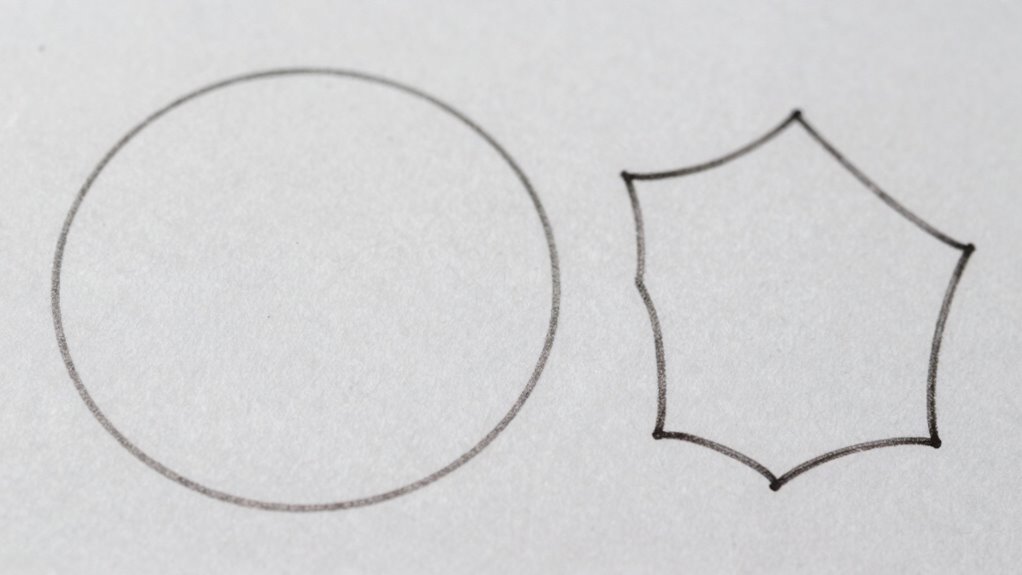
Measuring 2D shapes can be straightforward or tricky, depending on their geometry. When you work with simple shapes like squares, rectangles, or circles, the process tends to be more direct. These shapes have clear, consistent properties that make measurement easier. For example, with a square, you only need to measure one side and then use that to find the area or perimeter. Circles, on the other hand, involve the radius or diameter, which are usually easy to find with a good ruler or measuring tape. The key to accurate measurement lies in understanding the shape’s inherent properties and using the right tools. Additionally, having a basic understanding of geometric properties can help you choose the most effective measurement method. This knowledge can also assist in identifying the most suitable tools for different shapes. However, some shapes are more complex, especially those with irregular edges or curves. These shapes require a more careful approach, and your measurement accuracy can be affected by factors like tool precision or the shape’s complexity. For irregular shapes, you might need to break them down into smaller, simpler sections or use more advanced techniques like grid overlay or coordinate systems. When you use coordinate systems, you can establish a precise reference point for each measurement. This system helps reduce errors since you’re working from fixed points rather than guessing or approximating. By plotting key points on a coordinate grid, you can measure distances more precisely, which is especially useful for irregular or intricate shapes. Using coordinate systems improves measurement accuracy because it provides consistency. Instead of relying solely on physical tools that might slip or stretch, you’re referencing fixed coordinates, making your measurements more reliable. This is particularly helpful if you need to replicate the shape or compare measurements across different sessions. In addition, coordinate systems can make complex calculations easier, such as finding the area of irregular polygons, because you can apply mathematical formulas directly to the coordinates of vertices. To further enhance measurement precision, digital tools and software can also be employed for more detailed analysis, especially with complex shapes. Furthermore, understanding the properties of different shapes allows for better planning of measurement strategies, saving time and reducing errors. Knowing the geometric principles involved can also guide you in choosing the right measurement technique for each shape. In contrast, measuring simple, symmetrical shapes often doesn’t require such detailed methods. You can rely on straightforward tools and techniques with less concern for errors. But for more complex or irregular 2D shapes, adopting a systematic approach—like establishing a coordinate system—ensures you maintain accuracy throughout your measurement process. Overall, understanding the shape’s geometry and choosing the right measurement approach helps you get precise results, no matter how complex the shape might be.
digital measuring tape for shapes
As an affiliate, we earn on qualifying purchases.
As an affiliate, we earn on qualifying purchases.
Frequently Asked Questions
How Does the Material of a Shape Affect Measurement Accuracy?
The material of a shape impacts measurement accuracy because material properties and surface texture influence how precisely you can measure. Smooth, stable materials like metal or plastic give clearer, more consistent readings, while rough or flexible materials can introduce errors. Surface texture affects how well measurement tools make contact; rough or uneven surfaces can cause inaccuracies, making precise measurement more challenging. Choosing the right material helps guarantee more reliable results.
Are There Specific Tools Best Suited for Measuring Complex Shapes?
Yes, specific tools like calipers, coordinate measuring machines (CMMs), and flexible rulers are best suited for measuring complex shapes. You should guarantee these tools are properly calibrated using calibration techniques aligned with measurement standards. This guarantees accuracy, especially for intricate designs. Regular calibration and adhering to measurement standards help you obtain precise measurements, making complex shapes easier to measure reliably and efficiently.
How Does the Size of a Shape Influence Measurement Difficulty?
The size of a shape substantially influences measurement difficulty because larger shapes can be harder to handle and require more precise tools. Shapes with clear edges and high symmetry are easier to measure, regardless of size, because their edge clarity makes it simple to identify boundaries. Smaller or irregular shapes demand more careful attention, while symmetrical shapes with distinct edges simplify the process, making measurement more straightforward and accurate.
Can Digital Tools Improve Measurement Precision for Irregular Shapes?
Yes, digital tools can improve measurement precision for irregular shapes. By using digital calibration, you guarantee your measurements are accurate and consistent. Measurement algorithms analyze the shape’s contours and dimensions, reducing human error. These tools can automatically detect edges and calculate areas or perimeters more precisely than manual methods. As a result, you get reliable, repeatable measurements, making complex or irregular shapes easier to analyze accurately and efficiently.
What Are Common Mistakes Made When Measuring 2D Shapes?
Nearly 60% of measurement errors come from common mistakes, like misreading rulers or poor calibration techniques. When measuring 2D shapes, you might forget to double-check your tools or ignore scale accuracy, leading to inaccuracies. You should always guarantee your measuring instruments are properly calibrated and use consistent techniques. Avoid rushing and double-check your work to minimize errors and improve measurement precision.
As an affiliate, we earn on qualifying purchases.
Conclusion
So, next time you find yourself measuring a shape, remember how some are easier than others. It’s no coincidence that simple shapes like squares and circles lend themselves to quick, straightforward measurements, while complex polygons challenge you more. In the end, understanding why certain shapes are easier to measure helps you work smarter, not harder. It’s almost like the shapes themselves want to remind you that sometimes, simplicity really is the key to clarity.
coordinate grid for drawing and measuring
As an affiliate, we earn on qualifying purchases.
As an affiliate, we earn on qualifying purchases.
As an affiliate, we earn on qualifying purchases.
Halloween Picks
halloween
As an affiliate, we earn on qualifying purchases.