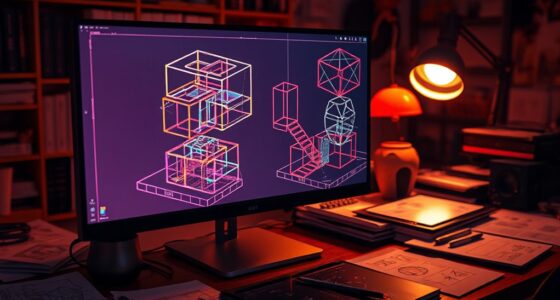

As a game designer explains, geometry plays a crucial role in building immersive worlds and seamless gameplay. It shapes environments, supports realistic objects, and enables dynamic interactions. Procedural generation uses algorithms to create unique landscapes on the fly, adapting to your perspective for consistency and realism. Techniques like level of detail optimize performance without sacrificing immersion. Keep exploring how geometry influences game design, and you’ll discover even more behind-the-scenes magic shaping your gaming experience.
Key Takeaways
- Game designers use geometry to craft immersive worlds and realistic objects that enhance gameplay experiences.
- Procedural generation employs algorithms to create unique, dynamic environments tailored to player actions.
- Perspective-dependent rendering ensures environments look coherent and believable from both first-person and third-person views.
- Optimization techniques like level of detail (LOD) maintain visual fidelity while ensuring smooth performance.
- Geometry fundamentally shapes how game worlds respond, creating engaging, responsive, and believable virtual environments.
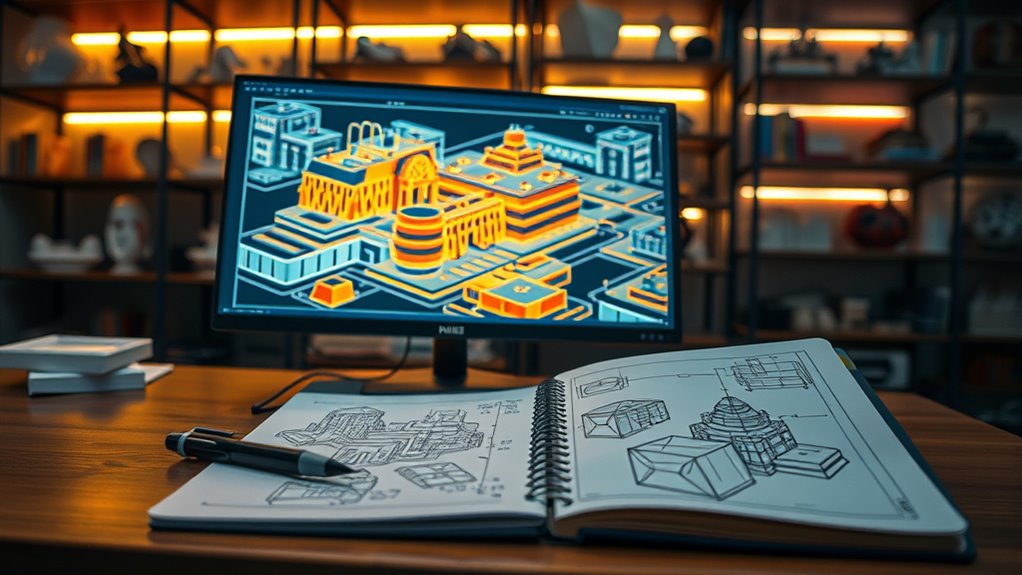
Many players may not realize that behind the immersive worlds and seamless gameplay, geometry plays a crucial role in shaping the experience. It’s the backbone that allows developers to craft expansive environments, realistic objects, and dynamic interactions. One of the most fascinating aspects of this is procedural generation, a technique that uses algorithms to create vast, varied landscapes and structures on the fly. This method enables you to explore unique worlds every time you play, without the need for pre-designed assets. As you move through a game, your perspective — whether it’s a first-person view or a third-person vantage point — influences how these geometries are rendered and experienced. Developers optimize the underlying geometry to match your perspective, ensuring that the environment feels consistent and believable from your chosen angle.
Geometry shapes immersive worlds, adapting dynamically to your perspective for seamless, believable gameplay experiences.
Procedural generation relies heavily on algorithms that generate geometry dynamically, saving developers countless hours of manual design and allowing for endless variability. When you’re traversing through a procedurally generated dungeon or an open-world landscape, the geometry isn’t static; it adapts to your position, movement, and even your actions. This creates a sense of discovery and immersion because the environment responds to your presence in real-time. For example, in a first-person shooter, the geometry of complex corridors and rooms is algorithmically constructed to fit your viewpoint, making each encounter feel fresh and unpredictable. In third-person games, the geometry adjusts seamlessly to your camera angle, ensuring that objects, landscapes, and structures align correctly with your perspective, maintaining spatial coherence. Additionally, advancements in geometry optimization techniques help improve performance without compromising visual fidelity or immersion.
Your perspective also affects how geometry is optimized for performance. Games often use techniques like level of detail (LOD) adjustments, where distant objects are simplified to reduce processing load, but still appear convincing from your view. Whether you’re peering around a corner or gazing over a vast valley, the geometry adapts to give you the best possible experience without sacrificing realism or smooth gameplay. This careful balancing act is what makes modern game worlds feel alive and responsive. Developers think about how you’ll perceive the environment from your chosen vantage point and tailor the geometry accordingly, ensuring that every scene, every object, and every terrain piece contributes to the overall immersion.
In essence, understanding the role of geometry in games reveals a lot about how worlds are built and experienced. From procedural generation creating endless landscapes to the way geometry adapts to your perspective, it’s a complex, behind-the-scenes art that profoundly shapes your gaming journey.
Frequently Asked Questions
How Does Geometry Influence Game Level Difficulty?
Geometry plays a essential role in shaping level difficulty by affecting your spatial awareness and visual perception. When level design uses complex shapes or narrow pathways, it challenges your ability to navigate and judge distances. Simpler geometric structures make it easier to understand the environment, while intricate designs increase difficulty. By manipulating geometry, developers can guide, surprise, or disorient you, creating a more engaging and challenging experience.
What Tools Do Designers Use to Analyze Game Geometry?
You use tools like procedural generation software to analyze and create complex game geometry efficiently. Collision detection algorithms help you identify interactions between objects and navigate environments smoothly. These tools enable you to optimize level design, ensuring the geometry supports gameplay mechanics while maintaining performance. By leveraging procedural generation and collision detection, you gain better insights into how your game’s geometry influences player experience and level difficulty.
Can Players Identify Geometric Patterns During Gameplay?
Imagine you’re tuning into the subtle language of the game. With sharp visual pattern recognition and strong spatial awareness skills, you can often pick up on clever geometric cues woven into the environment. These patterns guide your actions and enhance immersion, even if you don’t consciously notice them. As you play, you naturally become more attuned to these hidden design elements, enriching your overall gaming experience.
How Does Geometry Impact Game Performance Optimization?
Geometry substantially impacts game performance optimization by enhancing collision detection and rendering efficiency. When you understand how geometric structures are used, you can reduce unnecessary calculations, leading to smoother gameplay. Optimizing collision detection involves simplifying complex shapes into basic geometric forms. Similarly, efficient rendering relies on managing geometric data to decrease processing load. By leveraging geometry effectively, you improve your game’s speed, responsiveness, and overall player experience.
Are There Cultural Differences in Geometric Design Choices?
You’ll find that cultural differences greatly influence geometric design choices. Different cultures embed their symbolism and artistic styles into game geometry, shaping visual storytelling and player experience. For example, Eastern designs might emphasize harmony and flowing shapes, while Western styles favor sharp angles and realism. These variations reflect unique cultural symbolism, enriching game worlds and making them more authentic and engaging for diverse audiences.
Conclusion
As you step back, you see the intricate web of polygons and curves shaping worlds beneath your fingertips. Every pixel and vertex dances silently, guiding your journey through immersive landscapes. The geometry isn’t just code; it’s the silent architect crafting your experience, turning abstract lines into vibrant realities. With each glance, you realize how these hidden structures breathe life into your adventures, inviting you to explore deeper, revealing the unseen artistry behind every seamless scene.